


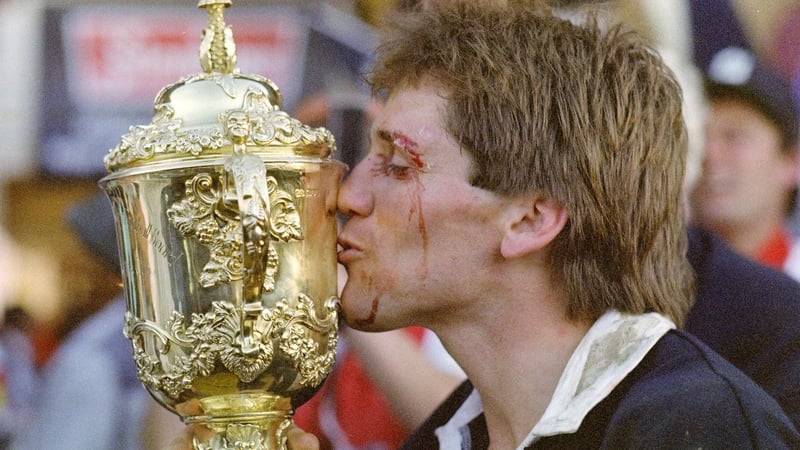

With just under nine weeks to go until the 2023 Rugby World Cup kicks off in Paris, we're looking back at the history of the tournament, from its origins in New Zealand and Australia 36 years ago, to its 10th instalment in France this September.
Every weekend between now and then, we’ll count down to the Rugby World Cup by looking back on each edition of the tournament, starting with the first ever global tournament in 1987.
Played across New Zealand and Australia in May and June of 1987, the All Blacks became the first team to win the Webb Ellis Cup when they defeated France 29-9 in the final in Auckland.
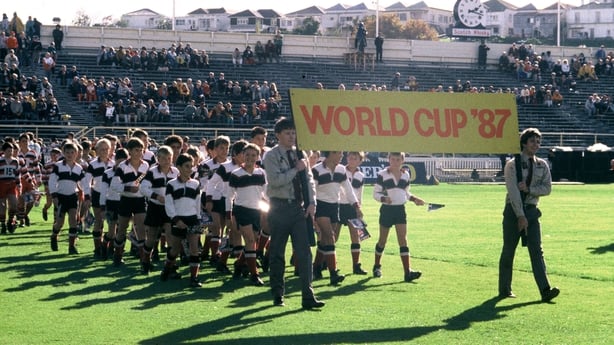
The Hosts
Having driven the concept of a Rugby World Cup for some time, it was only appropriate that New Zealand and Australia would have the honour of hosting the inaugural tournament in 1987.
Despite the tournament having just 16 teams, 11 different venues were used across the two countries. Just two of the 11 venues were in Australia; the Concord Oval in Sydney and Ballymore Stadium in Brisbane, both of which hosted semi-finals.
The final was played at Eden Park in Auckland in front of 48,000 people, with overall attendances surpassing 600,000, a number which was viewed as successful at the time.
Christchurch’s Lancaster Park was the only other ground used for a knockout game with Wellington, Hamilton, Dunedin, Invercargill, Rotorua and Palmerston North and Napier also hosting pool games.
The Pools
Pool 1: Australia, England, Japan, USA
Pool 2: Canada, Ireland, Tonga, Wales
Pool 3: Argentina, Fiji, Italy, New Zealand
Pool 4: France, Romania, Scotland, Zimbabwe
Ireland
Coached by Mick Doyle and Syd Millar, the Ireland squad for the World Cup in 1987 was heavily populated with players who won a Triple Crown just two years previous, and was captained by Donal Lenihan.
Nigel Carr had been included in the squad but withdrew due to the injuries he suffered in an IRA bombing, which claimed the lives of two people.
Ireland squad: Steve Smith, Terry Kingston, John MacDonald, Des Fitzgerald, Joe Langbroek, JJ McCoy, Philip Orr, Willie Anderson, Neil Francis, Donal Lenihan (capt), Jim Glennon, Nigel Carr, Paul Collins, Derek McGrath, Phillip Matthews, Brian Spillane, Tony Doyle, Michael Bradley, Tony Ward, Paul Dean, Brendan Mullin, Mike Kiernan, David Irwin, Keith Crossan, Trevor Ringland, Hugo MacNeill, Philip Rainey
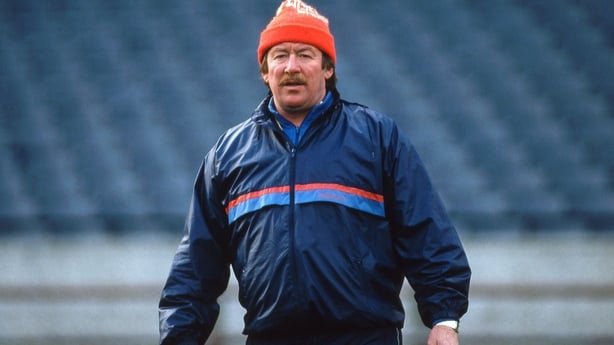
Results
Pool B: Ireland 6-13 Wales (25 May - Athletic Park, Wellington)
Pool B: Canada 19-46 Ireland (30 May - Carisbrook, Dunedin)
Pool B: Ireland 32-9 Tonga (3 June - Ballymore, Brisbane)
QF: Australia 33-15 Ireland (7 June - Concord Oval, Sydney)
Getting a Rugby World Cup off the ground in 1987 was both a drawn-out process and a chaotic rush.
With almost every other major sport having their equivalent, especially Rugby League, whose World Cup went back as far as the 60s, union’s staunchly amateur ethos meant that there was always opposition to a global tournament.
Particularly among the Irish and British nations, the idea of formal competition was often viewed as a Trojan horse to an open game. In Ireland and England, national club competitions weren’t even up and running, while the Five Nations championship didn't even have a trophy.
The game was becoming more and more vulnerable to the already-professional Rugby League. During the 1980s there had been threats of breakaway rebel professional competitions, along the same lines as Kerry Packer’s famous World Series Cricket in the late 70s.
The Rugby World Cup was officially greenlit in March 1985, voted in by the eight members of the International Rugby Football Board (now World Rugby), which was populated by the Five Nations teams, as well as New Zealand, Australia and South Africa.
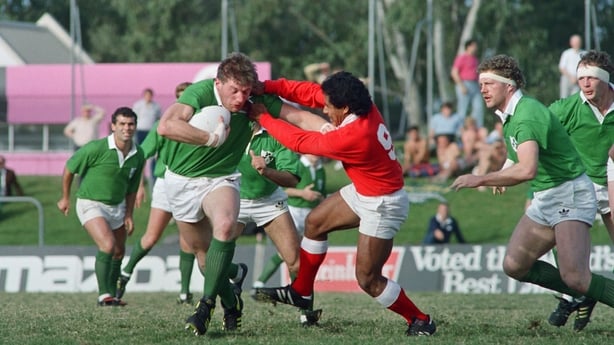
The exact breakdown of the voting appears to be a mystery to this day, with some claiming each of those nations had two votes each, with the vote swung by delegates from England and Wales who broke ranks to go in favour of the proposal.
Others claim each nation just had one vote each, with Ireland and Scotland the only two to vote against, both unions believing it to be a step along the road to a professional game.
There’s also conflicting reports around South Africa’s role in the vote. Some writing suggests the South African union, led by their president Danie Craven, voted in favour of a World Cup even though the boycott against the apartheid regime in their country meant they were never realistically going to be able to play in it. When they finally did feature at the 1995 tournament, they did so as hosts. Against that theory, Brendan Gallagher’s book 'The Rugby World Cup: The Definitive Photographic History’ says the South African union didn’t have a vote.
The next step was organising who would play at the tournament. South Africa would decline their participation, knowing that Australia and New Zealand wouldn’t approve visas to their players, leaving the seven other nations of the IRFB as the initial teams.
France had voted in favour of the tournament on the provision that countries outside the IRFB members would be invited. Italy, Romania, USA, Canada, Zimbabwe, Japan, Tonga, Argentina and Fiji would complete the tournament.

Ireland’s plans were, to put it mildly, chaotic. Having been opposed to the tournament from the start, Tom English’s book, ‘No Borders’, details how the IRFU were reluctant to even stage training camps for their squad in preparation for the tournament, with some players arranging private sessions themselves.
Having been Triple Crown winners with largely the same squad two years earlier, the squad had lost every game in the 1986 Five Nations, and the relationships between the squad and head coach Mick Doyle had soured.
Doyle’s health was also a major issue, with the coach suffering a heart attack at the opening dinner for the tournament, Syd Millar stepping in to lead the team temporarily before Doyle returned in time to see Ireland begin their tradition of quarter-final exits, losing 33-15 to Australia in Sydney.
In the grand scheme of things, Ireland’s performance at the World Cup is just a footnote on their preparations for the tournament. In the month before the World Cup, three of their players, Nigel Carr, David Irwin and Philip Rainey were caught in an IRA bomb in Co Armagh as they travelled to Dublin for training.
All three survived, with Irwin and Rainey even involved with Ireland at the World Cup just a month later, but Carr’s injuries led to him missing the tournament and ultimately ended his career. The targets of the blast, Lord Chief Justice Maurice Gibson and his wife, Lady Cecily, were killed.
Given the gulf in experience between the IRFB members and the invited teams, there were no real surprises in the pool stages, with Australia and England coming through their pool, Wales and Ireland advancing in theirs, and likewise France and Scotland.
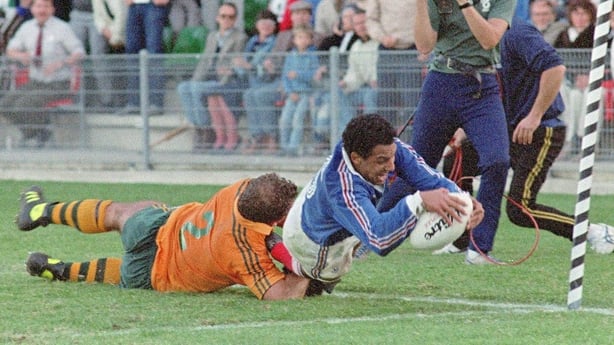
The interesting group was Pool C, where Italy, Argentina and Fiji would be scrapping it out for the right to join the All Blacks in advancing. It provided the only real drama in those opening games. Fiji beat Argentina, before the Pumas recovered to see off Italy, only for the Italians to win against Fiji in the final round of games. And with all three locked on one win apiece, it was Fiji who advanced to the quarters courtesy of their higher try count.
The All Blacks barely broke stride in reaching the final with big wins against Scotland and Wales, and they would go on to face France in Eden Park in the decider, after Les Bleus saw off Australia 30-24 in a thrilling semi. The Wallabies would go on to lose the third-place play-off to the Welsh in Rotorua.
The final didn’t live up to the hype though. France couldn't hit the heights of their semi-final win against Australia, and were comprehensively beaten by the All Blacks at Eden Park, with Michael Jones, David Kirk and John Kirwan all scoring tries, and Grant Fox kicking 19 points in a 29-9 victory.
It may have had an anticlimactic ending, but the tournament as a whole proved to be a resounding success; attendance figures topped 600,000, TV audiences around the world were big, while the tournament itself brought in more than $1million AUS in profit.
It would return four years later in 1991, where the northern hemisphere would get the chance to put on the show.
Top points scorers:
Grant Fox (New Zealand): 126 points
Michael Lynagh (Australia): 82 points
Gavin Hastings (Scotland): 62 points
Top try scorers:
Craig Green, John Kirwan (New Zealand): 6 tries
Alan Whetton, David Kirk, John Gallagher (New Zealand), Matthew Burke (Australia), Mike Harrison (England): 5 tries
Alan Tait (Scotland), David Campese (Australia), Denis Charvet (France): 4 tries
