

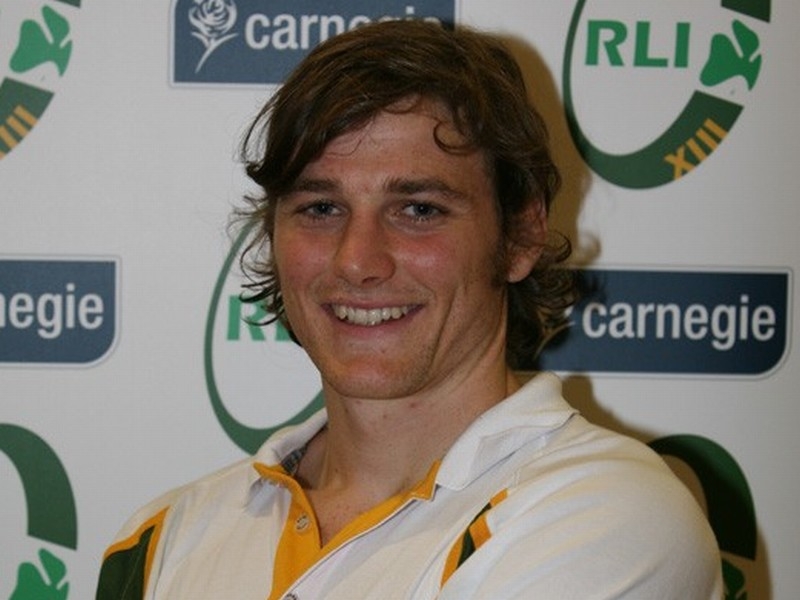
by Tadhg Peavoy
You may not know it, but later this month the Irish rugby team embark on a World Cup odyssey. Not the rugby union team that is, but the rugby league side. Such is the lack of press coverage given to the sport here in Ireland, it is not surprising that many people simply do not know about our qualification for the tournament’s final stages.
Ireland will go to Australia this month to compete in their second Rugby League World Cup. The country only began competing in 1995 and in 2000 qualified for their first World Cup. This was a successful experience in which Ireland qualified for the quarter-finals.
This time around Ireland qualified by winning the Europe Round Two Pool Two qualification group, which included Russia and Lebanon.
Ireland now to travel to Australia to compete in World Cup Pool Three, ‘the group of death’, or ‘pool of pain’, alongside Samoa and Tonga. Should they win the pool they face a potential quarter-final tie with Fiji and potentially, with a bit of luck, a semi-final against Australia.
Much like the Irish soccer team, the rugby league side takes most of its players from the Super League (consisting of English and one French team) and also the NRL (made up of the best teams from Australasia).
There are four Irish-based players in the world cup squad travelling to Australia. Three ply their club trade with Carlow Crusaders: full-back/winger Ross Barbour (as yet uncapped for the senior side), prop Wayne Kerr (3 caps) and hooker/scrum-half Stephen Gibbons (4 caps).
Meanwhile, Brendan Guilfoyle lines-out for the Treaty City Titans. They all made their way out to Australia on Monday.
RTÉ.ie met the Carlow players and team doctor Mick Molloy in Dublin airport before their departure to discuss the team’s chances and the sport in Ireland.
Q: First off, we wanted to know what the team’s expectations were for the trip to Australia.
Wayne Kerr: 'I think we’ve a great chance like. Everybody thinks we’re underdogs and that’s the best way Ireland play; hopefully we’ll get out of the group stage and then see what happens.’
Q: The majority of the Ireland squad is based in England. Does that disrupt the team preparations to a great extent?
Steve Gibbons: ‘I don’t think it disrupts things too much. Yeah, most of the players are based in England, but at the same time they are all very proud to be Irish and of their Irish heritage. I think when we come together as a group, it doesn’t take long to bond as a team. I think it works to our advantage in a lot of cases because you don’t get to see each other too much; the time you get together is quality.’
Wayne Kerr: ‘Most of our training (in world cup build-up) was based over in England, so there was quite a bit of travelling for us domestic guys but no it’s not a huge problem really. I mean, once you get together you’re in camp for two or three days and you quickly make friendships.’
Q: From Ireland’s two pool opponents, Tonga and Samoa, who are the main threats to your chances of winning the group?
Steve Gibbons: ‘Samoa, without doubt, are a very strong side. With big-name, household-name rugby league players.’
Steve Barbour: ‘They will probably have a little bit more class and ability than Tonga. Tonga will still be a great team but they mightn’t have quite the same standard as the Samoans.’
Q: A semi-final appearance would be a huge result. What would that bring to the sport in Ireland.
Steve Gibbons: ‘I think this World Cup is a huge opportunity to raise the profile of the sport within Ireland. There is massive potential within Ireland and it’s just a matter of capitalising on it.’
Q: Do you absolutely fancy your chances of winning your group and making the quarter-finals?
Wayne Kerr: ‘I think we do. I think if we had not had the two big teams in our group (Tonga and Samoa) it would have been easy to get out (of the group). It’s the group of death so we’ll just have to see, you know. I have full confidence in all the players.’
Q: Who do you expect to win the tournament?
Ross Barbour: ‘I think really Australia and New Zealand would be expected to win but sure there could be a bit of an upset you know. I think England see themselves as the only real threat from the northern hemisphere but I suppose Ireland would like to put their foot in the door for that.’
Q: What else other than a good performance does Ireland need for rugby league to grow as a sport in the country?
Ross Barbour: ‘It needs a little more recognition, a little more hype. Like the cricket, when they did well, more people got involved and more kids started playing the game. We also need more coverage on TV and radio. I’m sure there are certain people out there who don’t even know that there is rugby league in the country.’
Steve Gibbons: ‘I think it just needs a lot more investment. As things stand, I think we need our own facilities, when we get that then things can really start to progress.
Mick Molloy (team doctor): ‘This (World Cup) shows a very big-stage progression for us. I’ve been involved since 1995, when we were involved in the Emerging Nations World Cup, which is run at the same time as the World Cup. We did so well then, we graduated into the World Cup proper in 2000.
‘Now, we’ve taken ownership of the Irish team - it had previously been run by the Rugby Football League in the UK. Now it's being run purely here, we’ve developed our own players, we’ve four in the squad now, we’re hoping to build from there.
‘As any field sport you require a field. It sounds very basic but clubs are coming together, they’re being formed by people who are volunteers. There isn’t the money for somebody to go out and to buy a field. What rugby league really needs to develop is to get into a system of partnership with county councils (and) the local sports partnerships, to be able to use facilities that are out there in order to allow teams develop and set up easily.
‘If you look at the prospect of someone setting up a new team in a new area. The chances of setting up a new team are greatly enhanced if you have the field and dressing facilities available.
‘We have a very good league going now. We have 16 teams in a league. It’s developing from the point in 1995 where we had one team only and who used to play against visiting teams from the UK. Now we’ve got a developing league structure which is very strong, evidenced by the fact we’ve got four players in the World Cup squad.
‘It could be a lot stronger but to do that we need assistance really from the sports partnerships to develop using facilities around the country.’
Q: Have there been discussions with rugby union teams to develop ground sharing?
Mick Molloy: ‘At the moment most of the clubs are partnered with rugby union clubs. In Ireland rugby league is a summer sport, (taking place) in the times when the rugby union clubs are vacant, so most of our clubs would rent space from them.
Q: Is there any resentment from rugby union clubs sharing their facilities?
Mick Molloy: ‘I don’t think so. The rugby clubs themselves have generally been very supportive, because some of them view it as an outlet for their players over the summer to maintain fitness levels and develop new skill levels.
‘There are areas where there are no rugby union clubs and yet somebody may want to set up rugby league. In this perspective it is difficult unless you have the co-operation of the county councils and sports partnerships.’
Q: Back to matters on the field, what can the Irish fans expect to see from you as a team?
Ross Barbour: ‘Hard-hitting, fast-running rugby.
Wayne Kerr: ‘Plenty of spirit.’
Q: What appeals to you in rugby league over union?
Wayne Kerr: ‘I think rugby league suits me more. I like to carry the ball and make tackles and that’s what rugby league is all about.’
Steve Gibbons: ‘I played rugby union all my life up until two or three years ago. Since picking up rugby league, I’ve had a lot of good experiences. I’m not too into rucks and mauls and scrums and lineouts. I prefer running and tackling so I prefer rugby league at the moment.’
Q: How much support do you expect to receive in Australia?
Q: Mick Molloy: ‘We have a person in Australia, Matt Fisk, who’s set up a support network for the Irish rugby team a number of years ago. He’s developed that to the point where he’s got 5,000 members of what he calls his ‘Blarney Army’ now and he’s got his own website, www.blarneyarmy.com.au. He’s bulk-bought tickets for the stadium, 3,500 tickets in a block, where they’ll all be dressed the same.
‘We’re probably lucky in that as one of the teams when we land, we’ve got a massive supporter base in Australia already before we even get there and we hope to do them proud.’
Ireland play Tonga on 27 October and Samoa on 5 November in Parramatta Stadium, New South Wales, Australia. If they win their pool, they face a quarter-final with Fiji, France or Scotland on 10 November in the Gold Coast.
If they win that tie they will make history and play in the country’s first World Cup semi-final (union or league) on 16 November in Sydney.
