
It was an easy comparison to make before the game that Ireland and South Africa's Rugby World Cup Pool B meeting in Paris was going to be like a heavyweight boxing match.
Styles make fights, and so that came to pass. The boxing comparisons continued after the full-time whistle, players and coaches on both sides predicting a rematch may well be on the cards.
A lot of rugby still has to be played for that to happen, and while both sides are a good bet to make it to the quarters, France and New Zealand have to be toppled even before a semi-final.
Saturday’s box-office clash at the Stade de France was a perfect example of how not to judge a game off the scoreboard. Only two tries and 21 points in total were shared between the sides, yet there wasn’t a wasted second across the 80 minutes. Both sides played their part in showing just how gripping rugby can be when physicality and skill meet in the middle. If we’re treated to a better game between now and the end of October, we’ll be doing well.
There’s no doubt Ireland rode their luck, and South Africa can point to a handful of 'What if?’ moments that they will surely learn from as they head to the quarter-finals.
Place-kicking was identified as their biggest concern both before the tournament and before this game. The defending champions had missed eight of their 18 shots at goal in their wins against Scotland and Romania, and made just one of five in Paris on Saturday night.
The simple summary is that had Handre Pollard been on the tee rather than Manie Libbok or Faf de Klerk it would have been a different story. Conversely, with Libbok in the side South Africa look a more dangerous attacking force. Swap Pollard in for the Stormers out-half and you may not necessarily get the opportunities to kick those points.
Likewise, while the Springboks missed four kicks at goal, the butterfly effect has to be considered.
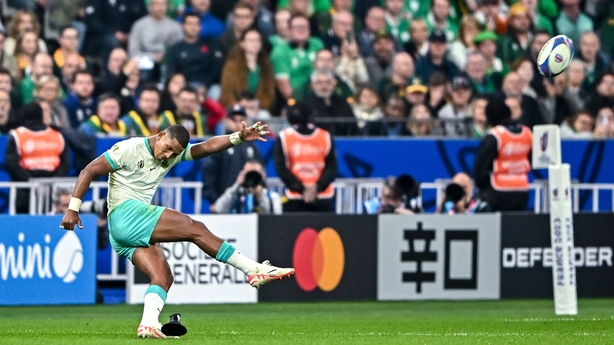
One of those missed kicks saw De Klerk strike the post, with the rebound claimed by South Africa, and it was from that possession in the 22 that they laid the foundation for their try a few minutes later.
Rather than being 7-6 behind, their missed kick contributed to them leading 8-7, and while Libbok’s conversion was also wide of the mark, it’s a conversion that may not have existed had De Klerk’s penalty attempt gone between the posts to begin with.
There are other small moments that had major consequences; Deon Fourie’s crooked throw to the lineout on 70 minutes was the first error in a series of errors that led to Jack Crowley's decisive penalty to seal the game; The scrum that followed led to a free-kick for an early Springbok shove, and a few minutes later, Damian Willemse’s lapse of concentration following Crowley’s drop-goal attempt gave Ireland a five-metre scrum, and from that scrum they won the penalty to allow Crowley make it 13-8.
Crucially, having conceded that earlier scrum free-kick for an early shove, referee Ben O’Keeffe was compelled to upgrade the second offence to a penalty. Errors compounded by errors.
Similarly, Ireland can point to some ‘What ifs?’ of their own, namely losing four lineouts in the opening 10 minutes, each of them coming either in or on the edge of the South African 22. It also could have been a very different game had Caelan Doris not spilled the ball close to the tryline after Hugo Keenan’s break on 12 minutes.
If Ireland are to go all the way in France, they need players hitting peak form this month, and through three games there are a number of players who have timed their run.
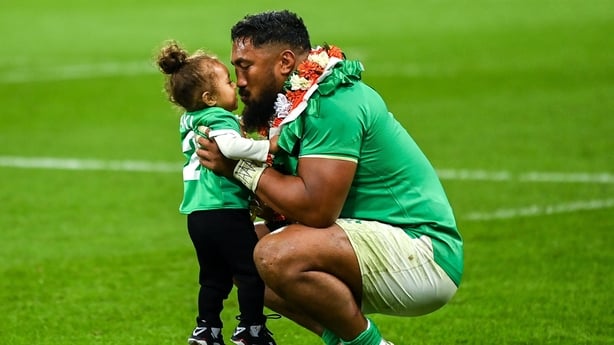
The obvious is Bundee Aki (above), a runaway Player of the Match in the last two games and arguably hard done by not to take that award in the opener against Romania. Similarly, Johnny Sexton is running towards retirement in some of his best form for years. Apart from a few ashen hairs, he seems closer to 28 than 38.
In the pack, Doris has played all 11 games for Ireland in 2023 and was tireless again in Paris, combining for 22 tackles and carries, while Andrew Porter’s ability to consistently play 70 minutes has been invaluable.
Outside of the starting XV, Andy Farrell can look to several big impacts off the bench.
In the last six months, Conor Murray has played some of his best rugby since 2018. Having hit form at the tail end of the season for Munster’s title run, he has carried that over. He was a standout in the warm-up win against Samoa, and a calming presence on Saturday night with vital tackles on De Allende and Du Toit, as well as a steal at the breakdown.
Likewise, Iain Henderson is consistently making Ireland better when he comes onto the pitch, and it was his counter-ruck after Tadhg Beirne’s punt that saw Ireland win a crucial turnover before their final penalty. When Sexton departed on 70 minutes, it was Henderson who took over the captaincy and the sight of him gathering his players together on 74 minutes for a breathing exercise was a fascinating insight into how teams stay composed in chaos.
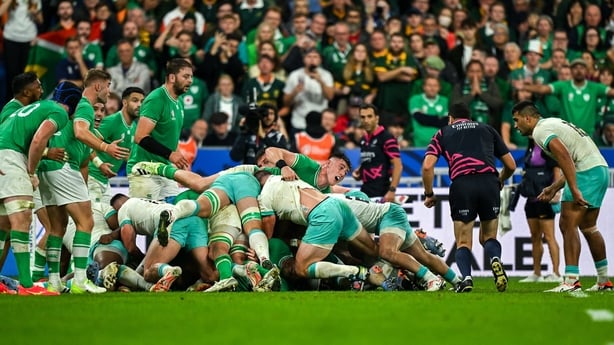
The image of Finlay Bealham swinging around the ankles of South Africans is another enduring piece from Saturday. The Connacht tighthead has impressed every time he’s played in 2023, and on top of making six tackles in his 16-minute shift he shored up a tiring Irish scrum. Just a couple of years ago, Ireland’s hopes seemed to hinge on the fitness of Tadhg Furlong. If Bealham keeps this up, there’s a debate to be had around who wears 3 and who wears 18.
It was also reassuring to see that Ireland can find a way to win even when they’re struggling to generate the quick ruck ball we’re used to seeing.
Just 16% of their rucks were completed under two seconds, while their average speed of 4.83 seconds was the seventh slowest ruck speed of any team in any game, in large part down to South Africa’s power in contact, where they made 30 dominant tackles.
South Africa consistently slowed down Ireland’s breakdown, but forced just three turnovers. Comparatively, Ireland’s seven turnovers won at the ruck is the highest in a game at this World Cup.
With a fortnight separating the win against South Africa from the final pool game versus Scotland, the break couldn’t have come at a better time. Somehow, there don't appear to be any injury concerns from last Saturday, but there will be plenty of sore bodies after an incredibly attritional 80 minutes.
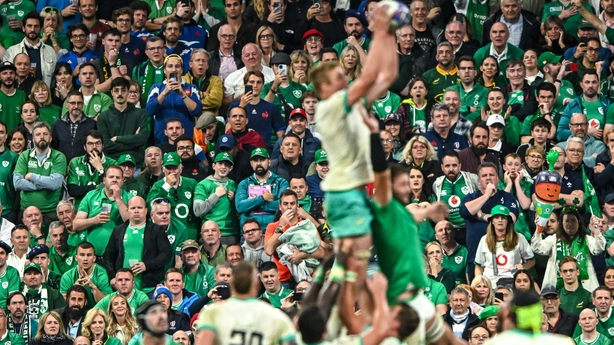
As well as that, Andy Farrell and Paul O’Connell will need plenty of time to pore over the six lost lineouts, which is an issue that has been following the team for several months.
As bad as the lineout was in that opening quarter in particular, the players deserve credit for finding a solution on the fly as they opted more and more for five-man setpieces where they could move Franco Mostert and Eben Etzebeth around.
And it’s that composure and ability to keep a cool-head and dry pants that will be huge for Ireland if they’re to get beyond a quarter-final at this tournament.