


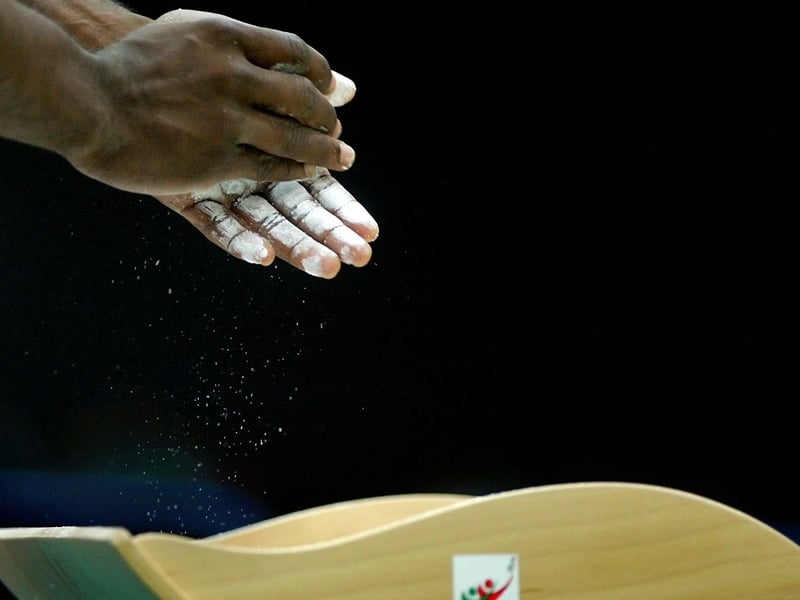
For almost a century, a perfect 10 was the ultimate goal of every gymnast.
At the 1976 Montreal Games, a petite 14-year-old from Romania, Nadia Comaneci, created Olympic history in the women's team competition by becoming the first gymnast to score a 10.00.
At next month's Beijing Games, attaining perfection in gymnastics will no longer be possible.
Just as figure skating was forced to change its age-old 6.0 scoring system following a judging scandal at the 2002 Winter Games, gymnastics' judging had its watershed moment at the 2004 Athens Olympics.
A spate of disputed medals left officials under no illusion that the scoring format had to be revamped.
The old method was consigned to the scrapheap following the 2005 world championships in Melbourne and a new accumulative system of points, awarded for content and execution, will make its Olympic debut in Beijing.
‘We changed the code radically... because the old approach to gymnastics became obsolete,’ former Olympic champion Nellie Kim, who is president of the International Gymnastics Federation's (FIG) women's technical committee, told Reuters.
‘Now the final score could be beyond 10. It could be 12, it could be 17 or whatever.
‘The scores for each exercise are divided into two -- a) difficulty of content and b) execution. The execution score is always out of 10 points so you can say in that we've maintained the old system but the final score will be different.’
The decision to dump the 10.00 format, which had been in place since the 1920 Antwerp Games, was sparked by two major controversies in Athens.
FIG admitted American Paul Hamm had been awarded the men's all-round crown in error after South Korea's Yang Tae-young had been incorrectly docked a 10th of a point from his parallel bars routine.
Despite acknowledging the mistake, the federation refused to redistribute the medals and it came under further attack when chaos erupted during the men's horizontal bar final.
‘People Power’ held up the competition for almost 10 minutes as fans forced the judges to change the score of four-times Olympics champion Alexei Nemov.
‘Before the system took care of (well-executed but) average exercises by gymnasts and we kind of forgot about high level performances... as there was a maximum ceiling of scoring 10 points,’ said Kim, who also earned perfect 10s in 1976.
‘So even if a gymnast had a fantastic routine, they could not score higher than a 10, which is what happened in Athens to Nemov on the bar.
‘Everyone understood that his exercise was much more interesting and risky but judges did not have the tools to appreciate what he had done.
‘It was a signal for us to start doing things differently.’
Critics fear the new scoring system could make the sport more dangerous because gymnasts constantly chasing after higher and higher scores risked injury.
Kim, who helped to develop the new Code of Points (CoP), shrugs off the suggestion.
‘Gymnasts will become more careful as the deductions will be much more strict. If they are smart, they will learn that they would be better off to perform a more normal skill but to do it perfectly.’
Alicia Sacramone, who will be going for gold in Beijing, said: ‘The level of difficulty is higher now but you should be training properly and be well conditioned to do the skills. And if you aren't ready, you shouldn't be performing them.’
While athletes have had two years to get used to the new CoP and scoring format, not everyone is in favour of the changes.
‘I don't really care for it. I think a lot of people identify gymnastics with a perfect 10. It's much easier for the average person to follow and understand,’ Olympic champion Kerri Strug, a member of the Magnificent 7 in Atlanta, told Reuters.
‘In subjective sports there's never going to be a completely perfect scoring system. It's human nature to have biases towards certain things and you do the best you can but there is nothing that is foolproof.’
Her fellow American Sacramone has competed under both codes and says she still has reservations about the new system.
‘I have nothing against it... but I kind of miss the perfect 10,’ the 20-year-old told Reuters.
‘Now it's a little harder to judge if your routine was flawless or not.’
