Name the Irish-born sportsperson who has won Olympic gold, Olympic silver and seven World Championship golds in their sport. Any ideas?
She is a legend born in County Armagh. She was one of the first women inducted into her sport's Hall of Fame. She is one of the most successful sportswomen born on this island, yet few here know her name. With the Winter Olympics on in Italy, it's the perfect time to recall her story.
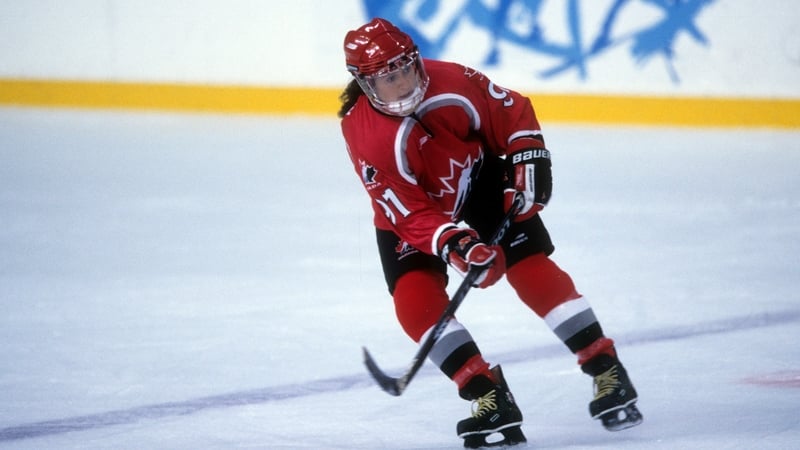
This is Geraldine Heaney and her sport is ice hockey.
Born in Lurgan, in 1967 Heaney's parents moved from the Troubles of the North to the safety of Ontario, Canada when she was just one.
Heaney was a shy young girl but sports brought her out of her shell. She played soccer, baseball, volleyball and Gaelic football, but her passion was hockey.
Playing with her brothers toughened her up, but she had to travel far to progress her career as opportunities in women’s hockey were limited.
She joined her first girls’ team at age 10 and was often playing against girls six years older than her. At 13, she joined the Toronto Aeros, the leading women’s team in the Toronto area.
With the Aeros she was a top defender and helped the team to win many national championships, gaining numerous personal accolades, such as MVP in 1992.
Success with the Aeros caught the attention of the national team. Heaney had a glorious international career but it nearly never happened. As a landed immigrant, she wasn’t allowed play for Canada in the inaugural women’s World Championship in 1990.
After some last-minute rushing, she was cleared to play and she would go on to play a crucial role. In the final against the United States, she scored the winning goal. Rushing forward, she passed the puck through the legs of the defender before firing up over the keeper, flying through the air as she scored.
The dramatic goal reminded many of a famous Bobby Orr goal in the Stanley Cup finals and made Heaney a household name in Canada. Orr, who is one of Heaney’s hockey heroes, shares her Irish roots and his grandfather was a soccer player from Ballymena.
The Canada team, featuring Heaney, would also win seven World Championships in an era in which they dominated the sport.
Women’s ice hockey was only introduced to the Olympics in 1998 at Nagano, Japan. Canada were hot favourites but surprisingly lost the final to the United States. Devastated at the defeat, Heaney and Canada got redemption in 2002 against the USA on American soil. Heaney finally had her hands on the much coveted Olympic gold medal.

The Canadian men’s team also won the Olympic gold in 2002 and on their roster was Owen Nolan.
Nolan was born in Belfast, but his family moved to Canada when he was seven months old.
Nolan was the last of six Irish-born players to play in the NHL. He is also perhaps the most successful of the six, considering his longevity in the NHL.
Drafted by the Quebec Nordiques in 1990, he is mostly associated with the San Jose Sharks, with whom he spent eight of his 21 playing seasons.
He captained the Sharks for a time and enjoyed career high points with them. He became something of a cult hero among hockey fans for his called shot at the 1997 All star game, in which he indicated to the goalie where he was going to hit the puck.
Among the other teams he played for are the Toronto Maple Leafs, finishing up his NHL career with the Minnesota Wild and then retiring after a year playing in Switzerand for ZSC Lions.
Nolan also played internationally for Canada in the late 1990s and early 2000s.
While Nolan rarely speaks of his Irish heritage, Heaney is fiercely proud of her Armagh roots and is a regular visitor.
Heaney’s mother Kathleen and aunts played camogie back in Lurgan. Her father Mike, who passed away in 2017, played Gaelic football and she herself played Gaelic football for the Le Chéile club in Toronto.
Heaney's mother played an important role in her life, something she noted in her Hall of Fame speech.
Her mother's stroke just before the 2002 Olympics almost resulted in Heaney missing the Games, but Kathleen was determined that her daughter played and she recovered enough to witness her winning gold.
Heaney retired in 2004 after 27 years of playing at the top level. Two years later, the Aeros retired her 91 jersey.
She was the third woman inducted into the Hockey Hall of Fame in 2013, and among those inducted that year was Brendan Shanahan, whose father was from west Cork and his mother came from Belfast.
Heaney is at the forefront of female coaching and coached the Toronto Six women’s team to Isobel Cup glory in 2023, in the female version of the Stanley Cup.
She was strangely snubbed when a new women's league commenced the following year. She is now involved as a youth coach, nurturing the next generation.
Samuel Kingston is a sports historian from Clonakilty, west Cork