


Each year when the Canadian Grand Prix comes around, it brings back fond memories of what remains, for many reasons, my favourite Formula One race weekend.
Ile Notre-Dame was a uniquely atmospheric setting.
A man-made island in the middle of the vast St Lawrence River, it had originally been created for Expo 67 before being further developed for the 1976 Montreal Olympics.
The Olympic Basin, built for rowing and canoeing, lay between the mainland and the circuit. Each morning, arriving at the track meant crossing it - sometimes by boat, other times by pontoon.
Those journeys often prompted conversations among the RTÉ team about two Irish athletes who came heartbreakingly close to Olympic glory in Montreal in 1976.
Seán Drea competed in the men's single sculls and came agonisingly close to delivering Ireland’s first ever Olympic rowing medal. He led for much of the final before missing out by the narrowest of margins.
Ireland would have to wait another 40 years before Paul and Gary O’Donovan finally won silver in the lightweight double sculls at Rio 2016.
Drea was not the only Irish athlete to suffer heartbreak in Montreal. By 1976, Eamonn Coghlan was already among the world’s leading middle-distance runners, and with Ireland still waiting for its first athletics medal since Ronnie Delany’s gold in Melbourne 20 years earlier, expectations were high ahead of the men’s 1500 metres final.
But Coghlan just missed out on a medal, and Ireland left Montreal empty-handed.
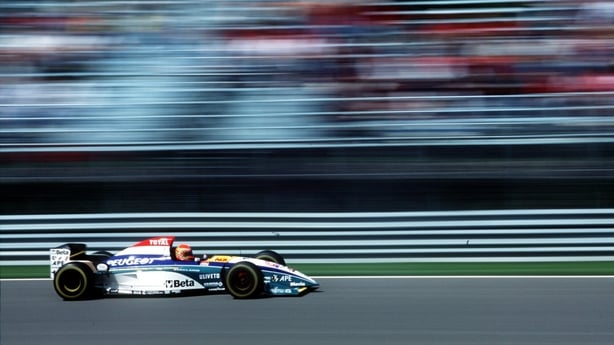
So when we arrived at Île Notre-Dame for the 1995 Canadian Grand Prix, we did so more in hope than expectation that Jordan, Ireland’s Formula One team, might finally deliver the podium finish that had eluded our Olympians almost two decades earlier.
Five races into the 1995 World Championship, Benetton, Williams and Ferrari were the regular pace-setters. McLaren led the chasing pack while Jordan, powered now by the works Peugeot engine, were also looking competitive.
Qualifying went well for the Irish team, Eddie Irvine taking eighth position with Rubens Barrichello ninth. In 1995, only the top six scored championship points, so progress would need to be made during the race.
Michael Schumacher started from pole position for Benetton and very quickly established a commanding lead.
Mika Hakkinen's McLaren and Johnny Herbert’s Benetton didn’t complete the first lap after clashing at the Montreal hairpin. David Coulthard was gone by the end of lap two when he careered off into the gravel. By lap three the Jordans were now running fifth and sixth.
Schumacher was disappearing into the distance and as Damon Hill struggled for performance in his Williams, two flying Ferraris in the hands of Gerhard Berger and Jean Alesi emerged as the main contenders to fill the remaining podium places.
Berger then ran out of fuel but managed to coast in to the pits for a top-up. His chances of a podium now were remote. The Jordans were running fourth and fifth. They had the pace, but reliability was proving a major factor for others.
Would the Peugeot engine last the pace? These were just some of the questions coursing through my mind as the race entered its latter stages.
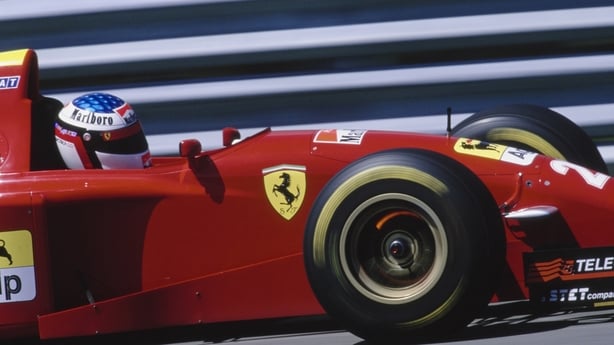
Then Hill's Williams ground to a halt on the main straight. It meant Barrichello was in third spot, behind Alesi and long-time leader Schumacher. But even the leading Benetton wasn’t bulletproof.
Schumacher’s car developed a gear selection issue with 11 of the 69 laps remaining. Although the problem was remedied in the pits, his hopes of another win were dashed.
Alesi had never won a Grand Prix but was now leading. Such was his popularity, every fairminded observer would have been willing him on to finally achieve a victory in his 91st Formula One race.
But far bigger from an Irish perspective was the presence of the two Jordan cars in second and third. Could the team that Eddie built achieve a double podium for the very first time?
Over the remaining 10 laps everything was crossed in the RTÉ commentary box on that memorable June Sunday.
Alesi, on his 31st birthday, finally got the win he craved his entire career and Jordan showed they were no makeweights among the F1 elite.
They’d beaten the might of Williams, McLaren and Benetton on a day when Ile Notre Dame finally delivered some real joy for Ireland.
