



It's a forward’s world these days.
No one wants to grow up to be a Gary Neville - that was a quote used by Sky Sports pundit Jamie Carragher on his fellow defender.
It was harsh but what he meant was kids grow up dreaming of being the one scoring, like Messi or Ronaldo, rather than the one getting a block in or playing a simple pass. I see it with my own kids now out on the lawn, living their fantasy through these players. They will even mention some of the top goalkeepers before they mention the solid full-backs.
The truth of it is that we’d all love to have the success of a Gary Neville and secondly, these teams don’t win without the likes of a Neville in their teams. All successful sides have their unsung heroes.
The most possessions I got myself as a midfielder with club or county were those from the warriors in the full-back line who did all the hard work, got the turnover and a nice handy pop pass for me then to move it onto the next line or more often than not straight into the full-forward line.
In the NFL they always say, offence wins you games, defence wins you championships.
There was a time in hurling when defenders knew their job – mark your man and stop him scoring. The trust was that the structure around them would hold; full-backs stayed deep, half-backs guarded the flanks and if the opposition scored heavily the blame lay in one place and one place only – the backs. The modern game looked at that, tore it up and said 'that’s not how we’re playing this game'.
I rarely feel sorry for rivals, but if there is one group of players I feel for in this game it has to be the defenders and mainly those that we call our full-back line.
To be handed the number 2,3 or 4 jersey is probably the most exhausting role on the pitch, mentally and physically. The physical demands are huge, but the real challenge now lies in their decision making.
Every play presents a new problem for them. To stay or attack the incoming ball? To follow the runner or protect the space inside? To step out or stay connected to the defensive structure?
All these decisions are made within the blink of an eye during the fastest game in the world. More often than not, there is no correct answer and a wrong decision will always be punished, severely at times.
The biggest difficulty that these defenders face is the sheer volume of space they are often asked to defend. It may look structured from the stands, but from up high where I often find myself you can really see the space and the reality is often far more chaotic.
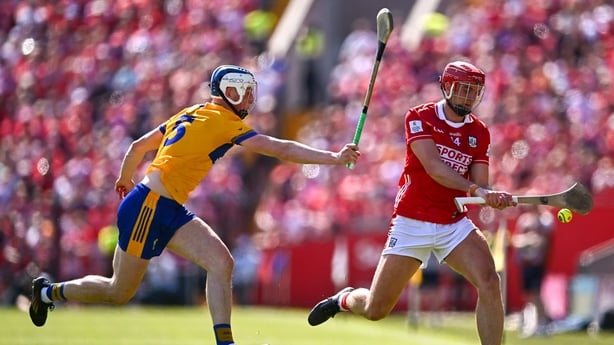
As I watched on from level three of the South Stand in SuperValu Páirc Uí Chaoimh on Sunday, I witnessed this in real time.
The Cork half-forwards pulled out the field, bringing their Clare markers with them. What remained was a vast open space of 50 yards for the visitors to defend. Then to add salt to this wound the ball in was invariably perfect, one hop inside the 45, a beautiful ball for an onrushing William Buckley or Brian Hayes to collect and they have the defender turned nearly before the ball is fully in their grasp. It was a matter of what the score was rather than if there would be a score.
The same was evident in Limerick and the genius that is Aaron Gillane. The Patrickswell man is arguably the best in the business at turning his man after a number of runs just to show for it. He is an expert at shielding the ball from his opponent, with one hop inside the 45 again.
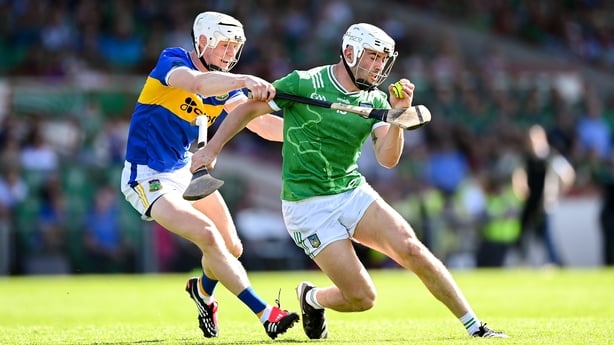
That buys him the extra split second to decide where in the net he will hang it up or if the point is the best option for that play. How easy he makes all this look is the worry for the rest of us.
As good as Gillane is, it’s the delivery that is the launchpad. More often than not, it’s a diagonal pass, struck in from the area between the opposition 45 and midfield line. It will be delivered not in the air, but rather at head height at an angle, hop once just inside the 45 yard line to an onrushing attacker who has made not one but most likely three runs to get there and the rest looks routine.
Any forward will tell you they would prefer this ball all day long rather then that ball that is drilled head height, straight at them with the defender right up behind them. I learned that from two of the greats in the form of Larry Corbett and Eoin Kelly.
They would rather that ball floated than drilled in, so that’s what I tried to do when able. Our coach Eamon O’Shea (pictured below) was, as I have always said, ahead of his time in terms of visualing space.
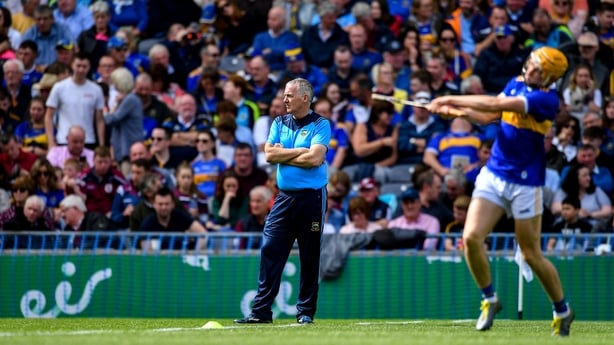
He would have us puck the ball across the pitch at Semple Stadium to one another with the focus being on it hopping once into the opposite players hand, the type of delivery that is now the nightmare of every defender and the dream of every attacking player.
Forwards are coached so well and so game-smart themselves now to exploit this uncertainty of sticking or going, diagonal runs, dummy runs and overlapping support play.
Backs are no longer reacting to one opponent, but rather to an attacking unit moving at pace. Players train in their systems that are rehearsed to death until they just become automatic on match day.
When the hurler of the year gong gets handed out, I honestly feel the metrics of scoring goals and points should be outweighed by the split-second decisions the people at the other end of the field.
Who was the player that operated in the full-back line to win Hurler of the Year? Most recently JJ Delaney in 2003 and before that, Brian Lohan in 1995.
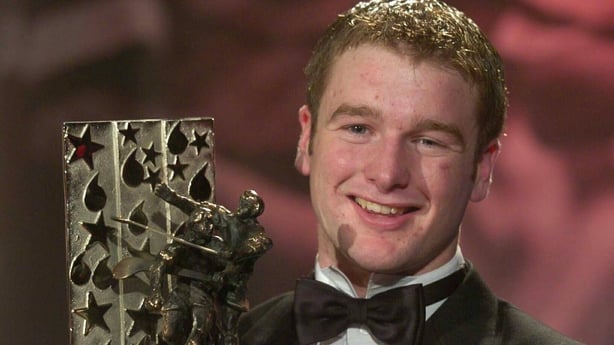
The game has changed considerably since then and the full-back line, to my mind, has now become the most difficult place on the pitch to play and should be rewarded for this degree of difficulty.
A forward may score five points from 10 plays and dominate the headlines, while these inside defenders can perform brilliantly for 10 plays only for that one missed decision to define public opinion on their performance.
This is the brutal reality of defending these days in hurling, in particular at inter-county level. In a sport that is dominated by systems and structures, defenders are required to show spatial awareness and composure under relentless pressure.
Defenders are no longer just stoppers or spoilers, they are top-class decision makers operating in organised chaos.
Perhaps the full-back line has now become one of the hardest jobs in Irish sport and should be rewarded as such when we consider the bits crystal after games or at the end of the year.
Watch The Saturday Game from 9.50pm and The Sunday Game from 9.30pm on RTÉ2 and RTÉ Player. Follow a live blog on all matches on the RTÉ News app and on rte.ie/sport
