


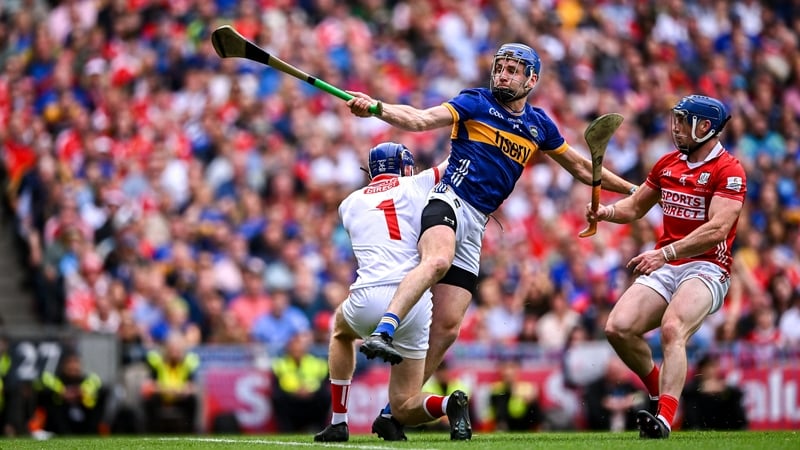

Hurling people had a slightly disorientating experience in 2025.
Gaelic football's legislative makeover may have counted for little in the Presidential election though there can be little doubt it was an astounding success on its own terms.
Even some of the most distinguished tribal elders of hurling nation were forced to concede that their brother code was no longer entirely unwatchable in certain conditions.
Gaelic football becoming flavour of the month opened up a vacuum for the nation's critics, who suddenly found themselves in urgent need of a new punching bag.
Amazingly, hurling briefly became so, with the narrative growing that the 2025 provincial round robins were a bit humdrum compared to previous years.
"Fairly turgid going between Dublin and Galway. Could have been three red cards as well. Is there a football game on at all?" journalist Michael Foley tweeted in late May, summing up the mood of the moment.
The spirit of rampant experimentation that consumed Gaelic football even rubbed off on hurling during the league.
In the spring, there was a strange clamour for the introduction of VAR in hurling, which might have surprised those who've observed its operation in soccer.
While the idea struck many as terribly radical, the motivations of those pushing it were in fact quite old-fashioned, namely, to provide another bulwark against fellas getting sent off.
As the debate progressed, it was clear its advocates saw the technology as functioning best as a kind of real-time version of the CHC, which could get lads off red cards before they were even sent to the line, let alone suspended.

It was the spate of red cards handed out in the Kilkenny-Tipperary league game that prompted Babs Keating to advocate secession, not for the first time.
It would be ironic if at the very moment the LGFA and Camogie Association were seeking to merge that hurling should decide to detach itself from the GAA, Velvet Divorce style, though the prospects of this ever happening are incredibly remote.
Tipp sweep up as Cork enter world of pain
The 2025 hurling season will be best remembered for the surreal last 35 minutes of the All-Ireland final, which nearly wiped out the memory of all that preceded it.
Tipperary went from being the sick man of the Munster hurling championship to All-Ireland champions in the space of 14 months.
It was a transformation almost as miraculous as Heffo's Army in 1974 except there has always been a sense that hurling's blueblood counties are never that far away from the summit, regardless of their condition. Perhaps the more apt comparison is Cork in 1990, who went from losing to Waterford in the 1989 Munster semi-final to winning a remarkable All-Ireland title the following summer.
Liam Cahill's side had emerged from such a pit of depression in 2024 that it never quite felt like they were real bona fide All-Ireland contenders until very late in the day. Best case scenario, this was assumed to be a year of rejuvenation and renewal, rather than a season in which they landed the big one.

Some of the younger Tipp crowd had played a couple of seasons without a single championship win, save for a facile trimming of Offaly in the 2023 All-Ireland preliminary quarter-final. Now they are lords of all they survey.
As if the traditional hurling man didn't have enough on his plate what with Gaelic football hogging all the acclaim, he then had to endure the spectacle of a team playing with a sweeper winning the All-Ireland final.
In the lead-up to the decider, we were treated to one of the most audacious acts of managerial mis-direction in GAA history.
During Tipp's All-Ireland final media day - held almost a full fortnight before the final and while 'scoreboard-gate' was still raging outside - Cahill set about outlining his many grievances with the media coverage of his first two years in charge, chief among them being the scurrilous allegation that he was partial to a sweeper.
Not alone did Cahill insist he had never played a sweeper, he sounded fit to burst anyone who suggested he might.
All the while, Tipp were preparing to deploy what was euphemistically described as "an extra defender" or a "plus-one" - the 'sweeper' word is still taboo in large swathes of the country - in an effort to stem the flow of ball into the previously rampant Cork full-forward line, in particular Brian Hayes.
For years, the purists had held that it was an iron law of the universe that you couldn't win an All-Ireland final with a sweeper - as opposed to a quarter-final or a semi-final, both of which could be won in that fashion, curiously enough.
The key items of evidence adduced here were Clare's abandonment of the sweeper for the 2013 All-Ireland final(s) and the 2017 All-Ireland decider when Galway's scoring power was too much for the Waterford back-line.
The long-held notion melted away in an instant last July and, ironically, at a moment when the tactic itself was presumed to have fallen out of fashion and the debate over its usage had largely died down. The only saving grace for the traditionalists was that it wasn't Derek McGrath or Davy Fitzgerald who were responsible for disproving the maxim.
Cork appeared to be thrown by the gambit, though they still held an uneasy six-point lead at half-time, which was flattering on the balance of play.
There is much debate as to whether Cork's All-Ireland final implosion should be understood primarily as a tactical disaster or a mental one - or both. More high-minded analysts tend to be wary of the mental explanation, feeling that the charge of 'choking' is excessively personal and also smacks of the bar-stool.
Still, the second half tally of 3-14 to 0-02 suggests there must have been some sort of generalised panic running amok in the Cork ranks.
Remarkably, they mustered only 12 attempts on goal in the second half, numbers which would have been deemed on the low side in 1987. That four of those hit a combination of the post and crossbar wouldn't have done much to quell the sense of stunned fatalism that was fast enveloping both the team and their supporters.
A traumatised hush descended on Cork in the aftermath, all the more striking given the hype that pervaded the county all summer.
Tattoo removal surgery briefly became a growth industry down south.
'Forwarded many times' whatsapp rumours - a regular staple in the aftermath of an All-Ireland final collapse - went viral in the subsequent days. The most lurid of which was a barely decipherable account of how the Glen Rovers contingent had launched a mutiny in the dressing room at half-time.
(There's nothing new under the sun as regards this stuff. In the aftermath of the 2015 All-Ireland hurling final, when wild rumours of a half-time bust-up in the Galway dressing room swirled around, one commenter on a popular forum piped up with the reply: "1981 called and it wants its rumours back.")
Regardless of how fabulous the tale, this gained enough traction that it was put to Pat Ryan and Patrick Horgan in later interviews. The former reacted angrily, the latter was inclined to laugh it off.

After the trauma from the final abated somewhat, the legendary Horgan finally called it a day for his inter-county career after 18 years. The all-time leading scorer in championship, he will assuredly go down as the greatest hurler without an All-Ireland medal.
While it might be bittersweet if Cork can go one better in 2026, in the first year after Horgan's departure, one does wonder if the great man's exit will have the effect of lifting some of the baggage from the rest of the squad.
In the wake of this year's final, there was a nagging sense that the rampant 'win it for Hoggie' sentiment was adding pressure to a team who have quite enough of it to contend with already.
Either way, it brings to an end one of the great careers of modern times.
4-21... no wait, 4-20...?
Before all that, the 2025 championship gave us the semi-final scoreboard controversy, where the GAA suffered a mild embarrassment and narrowly avoided a major one.
Oisín O'Donoghue's opportunistic swipe in a forest of hurls had swung a compelling semi-final in Tipp's direction in the closing stages of what was their first match in Croke Park in this decade.
It was apparent to most in the press box and many watching at home that something was amiss when Noel McGrath's late wide was chalked up as a score by the Croke Park scoreboard operator, who was no doubt swayed by the triumphalistic roaring from the Tipp crowd as the game entered injury-time. That one of the umpires raised his hand to catch the ball as it bounced off the netting behind the goal may also have been a factor.
The scoreboard - which erroneously put the margin at four - clearly conditioned the final minutes of the game, with Kilkenny desperately attempting to manufacture goals far too early, when there was easily enough time to rustle up three points.
Strangely, referee James Owens initially indicated after the game that the final score was 4-21 to 0-30 before revising this verdict on mature recollection. There were red faces in the aftermath, though it could have been much, much worse.

In the final seconds, with Kilkenny still under the impression they trailed by three points, John Donnelly lashed a shot from 21 yards which beat Rhys Shelly but was blocked by corner-back Robert Doyle on the line.
What would have happened if it wound up in the net? Given that the incorrect scoreline was originally confirmed, is it possible that we would have embarked on an extra-time period before some bright spark in the press box alerted everyone to the fact that Kilkenny had won by a point?
Doyle finished the year with an All-Star, one of seven for Tipp. He may also be due some clandestine special award from the GAA for preventing what was already an embarrassment from reaching the full-blown scandal stage, much like Father Ted was by the church hierarchy when he organised the escape from the lingerie department.
Provinces - Limerick's reign in Munster ends
The 2025 season saw Limerick's unprecedented reign in Munster come to an end before they abruptly ran out of petrol in shocking fashion in the All-Ireland quarter-final.
John Kiely's side looked to be back to their best with a vengeful demolition of Cork in the round robin phase. They led 2-18 to 0-09 after a starling first half display, Aaron Gillane burying 2-07, Adam English notching 1-02, while Cian Lynch - Marty's favourite - flitted around between the lines, popping deft passes like a 1970s Welsh out-half.
In the lead-up to the Munster final, Kiely noted, with satisfaction, that the notion that they were past their best had been "debunked."
However, that 16-point win turned out to be their last win of the year. A month later, Cork edged them out in the penalty shootout in a tense Munster final which was higher on drama than quality.
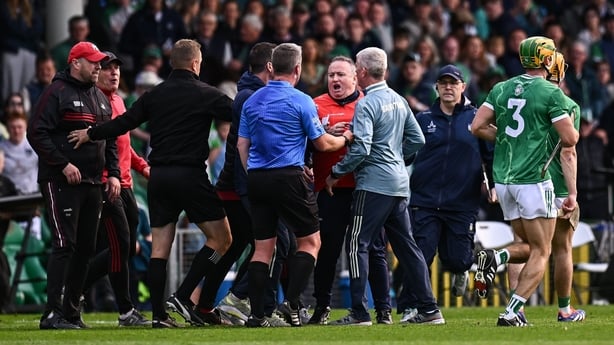
It was assumed by all and sundry they'd meet again in July but Limerick didn't even reach the last-four.
In a result that defied all known form and logic, they were eliminated by an inspired Dublin side who'd been beaten handily by Galway a few weeks earlier. The result would have been shocking enough even had the Dubs not played most of the match with 14 men.
As a result, there is some uncertainty around a Limerick team, most of whose leading lights have huge mileage accumulated.
It's not all bad news. In the off-season, it was confirmed that their sports psychologist and all-round zen mother Caroline Currid is returning to the fold for 2026. She's been the common denominator for all five of their wins since 2018, while has been absent in years they've missed out.
As with their last All-Ireland title defence in 2014, Clare were one of the first teams gone from the championship, their elimination confirmed before a valedictory final round win over Limerick in a dead-rubber fixture.
This time around, there was perhaps slightly more mitigation in the form of injuries, with 2024 Hurler of the Year Shane O'Donnell initially thought to be ruled out for the season. By the time he made a celebrated - but not wholly surprising - return to the fray in the second half of the rousing near-comeback against Tipperary, the damage had mostly already been done.
Waterford, despite an encouraging win over Clare in their opening round robin game, again failed to escape the Munster league for the sixth time. Their best two seasons since the introduction of the current format were the two years during Covid when the round robin system was suspended and we returned to knockout.
They're close to the end of their tether with it, manager Peter Queally bluntly appealing for a change to the format so that more teams - most especially his own - might be able to hurl deeper into the summer months. His Limerick counterpart, Kiely, in his pre-Munster final Zoom conference, disagreed as gently as he could, saying that beauty of the current Munster championship format lies in is savagery.
By contrast, the Leinster hurling championship continues to plod along in pedestrian fashion, the wide gulf in quality between the top and the bottom still militating against any sense of jeopardy or competitive balance.
Wexford's dip since the departure of some influential veterans of the 2019 Leinster championship win isn't helping matters. On the flipside, Dublin had a progressive year under guidance of club All-Ireland winning manager Niall Ó Ceallacháin, before being buried under a blizzard of goals in the semi-final.
Galway, with Micheál Donoghue having made up with the county board and now back at the helm, are still said to be deep in transition, though what it is they're transitioning towards remains unclear. The narrative is undermined by the fact that they remain alarmingly reliant on the aging 2017/18 cohort, in particular the elegant Cathal Mannion, who collected his second All-Star this year, 10 years after his first.
The Leinster final, in particular, seems to exist at this stage to be compared unfavourably to its Munster counterpart and there is a growing consensus that Croke Park isn't a suitable location for it, especially regarding the default match-up of Kilkenny and Galway.
The Leinster Council has resorted to desperate measures in an attempt to jazz things up. Next year, for the first time in the history of the round robin, the Kilkenny-Wexford and Galway-Dublin games will not be played in the final round of fixtures.
2026?
What of the runners and riders for next season?
With Ben O'Connor in charge, can Cork recover from the 2025 final trauma? Can Clare bounce back from their post-All-Ireland fallow year?
Will Kilkenny, now officially in their longest All-Ireland drought since the turn of the 20th century, break through the semi-final barrier? Their performances this year suggested they aren't far away, though TJ Reid can't have much time remaining...
Have Limerick, still reliant on the same core group, gone over the hill or will they get another wind?
Will the clamour for VAR start up again? Will there be a call for another re-working of the National League format?
It's customary at this stage for Tipperary haters - a very broad constituency, consisting of those counties with whom they share a border (aka, most of Hurling Nation) - to bring up their failure to go back-to-back since the mid-1960s, when Hell's Kitchen were still flaking all around them.
However, as of the end of 2025, Tipp may be content to savour this latest one-in-a-row, given how unlikely it seemed at the start of the year.
