


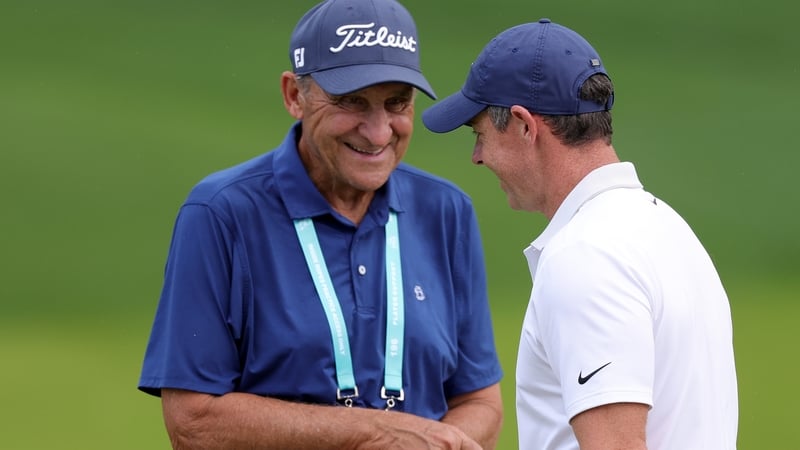
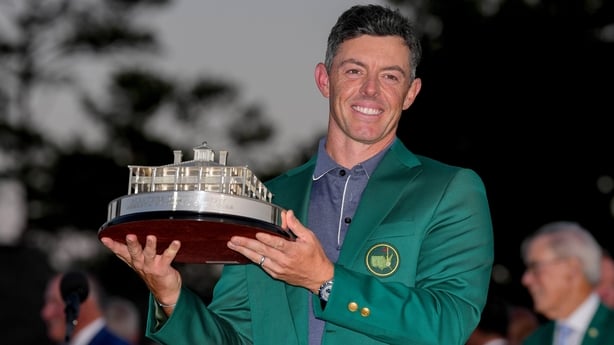
Rory McIlroy's Masters victory and the completion of the career grand slam was undoubtedly one of the great sporting feats of the modern era.
Part of his long-awaited success at Augusta was down to talent, but sheer resilience after suffering a litany of on-course setbacks over the years was certainly another.
One of the key figures behind the scenes that helped him towards achieving his dream was Dr. Bob Rotella, the renowned sports psychologist who has worked with a host of golf's leading talents.
This week, he spoke in depth with Greg Allen on RTÉ Radio 1's Inside Sport and shared an insight into what he and McIlroy worked on during the 2025 Masters.
We need your consent to load this rte-player contentWe use rte-player to manage extra content that can set cookies on your device and collect data about your activity. Please review their details and accept them to load the content.Manage Preferences
Rotella explained that anticipating the possibilities and pitfalls was key to how they navigated that fateful week.
Coupled with that was being able to respond to those eventualities with a "great mindset and great attitude".
"The week before, I sent him a fairly lengthy text about all we were going to talk about that week and to the amazement of most people, we didn't talk about winning the Masters, we didn't talk about the Grand Slam completion," he said.
"Because I already knew he really wanted it really badly. We spent all of our time talking about where your mind has to be, where your emotions have to be.
"We spent our time talking about all the crazy things that could happen during the week, all the things that might not go his way. In other words, 'it might not go the way you dreamt it up'.
"And of course, when you look at it on video afterwards, you go, 'Yep, it definitely didn't go the way he dreamt it up'. But he got the outcome that he was dreaming of."
Rotella said that every morning in a building next to the practice facility at Augusta, they would go over those points for about half an hour prior to each round.
"A big step towards winning was on Friday," he continued.
"If you remember on Thursday, on 15 and 17, he hit two beautiful golf shots that both ended up in the worst possible places and he made double bogeys.
"And man, we talked Friday morning, 'OK, beautiful, let's start all over again. It's going to be how are we going to respond to Friday morning - he was four under, ended up even - it's a little bit heartbreaking when that happens.
"'Now we've got to be tougher than nails, we've got to be really strong and we've got to go out there and have a great mindset'. And he went out and played a great front nine and a great 18 holes and got himself back in contention.
"And then the rest of the week was magical. Most people give up before the dream happens. Rory didn't."
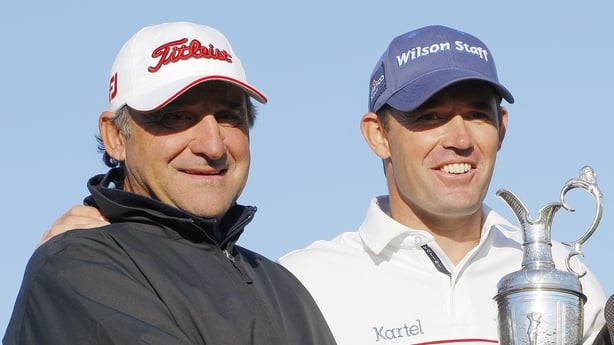
Pádraig Harrington is among the others Irish golfers Rotella has worked with and that experience has given him a sense of admiration about sportspeople emanating from this island.
"I think Rory, and I'll say this for most of the Irish guys that I've worked with, you're doing something really right in Ireland because they're all really down to earth, good people," he said.
"They treat other people really good. They don't have an ego about them. And that's the challenge; can we be really confident and yet when we leave the golf course, be down to earth people?"
Rotella also recalled his first impressions of McIlroy, dating back to their first encounter in 2010.
"The first time I met him was in his first Masters and he wanted to talk to me and he told me how he grew up reading my books and how much he liked them," he said.
"We spent some time that week talking on and off for years. I always enjoyed him and liked him.
"I thought he was a very thoughtful, intelligent, young man."
The following year, McIlroy put himself in a great position to win the Masters. However 2011 ended up being remembered as disastrous as the Holywood man shot an 80 and saw his hopes of closing out a four-shot overnight lead fall apart.
The experience could have destroyed many players but Rotella said the signs were there that McIlroy was not so perturbed.
"I think other people use words like imploding. I never heard him say that," he said.
"I don't think he looks at it that way. I think he looks at it like 'wow, now I know I can win the Masters'.
"If you look at his interview on Saturday night at the US Open five weeks later, the first question was about that. 'How are you going to respond tomorrow after having a chance to win on the back nine five weeks ago and falling apart?' Or something to that effect.
"And Rory's answer was, 'I'm going to have an attitude. I've realised I've got to have a little bit more confidence, I've got to have a little bit more of an attitude, I've got to get lost in my own little world and I've got to stay in my world and play my game'.
"So if you think about it, how Rory actually responded was five weeks later winning the US Open. So that's a real positive response.
"Are there people who would have just pulled all the negative out of it and been destroyed by it? Probably. But he didn't choose to do that."
Rotella added that in 2024, McIlroy agonisingly missed out on victory at the US Open, with Nick Faldo saying that it would haunt him for the rest of his life. However, the following year, the long-awaited Masters win would come and Rotella said that "it's almost like whenever he faces adversity or a setback, he ends up getting stronger and tougher and more resilient".
