


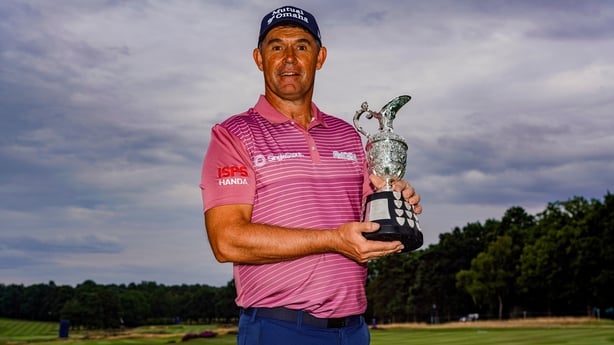
Pádraig Harrington has reflected on a hugely successful year on the Seniors circuit as he sets some lofty goals for 2026 - and top of that list is a return to the 'regular' Major winner's enclosure.
Harrington won two majors on the over-50s tour this year, the Open Championship and the US Open, but - after a campaign in which he feels he "didn't even play that well" - the Dubliner insists he's still a threat when it comes to the game's mainstream grand slam events.
In an exclusive interview with RTÉ Sport's Greg Allen for RTÉ Radio One's Saturday Sport show, the three-time major champion betrayed a hunger that seems as strong as that which took him to a wonderful hat-trick of Grand Slams in 13 glorious months from July 2007 to August 2008.
Harrington famously bridged a 60-year gap at Carnoustie in 2007 when he won Ireland's first major title since Fred Daly's 1947 Open Championship triumph.
He followed it up by successfully defending his title a year later at Royal Birkdale before a month later snaring the PGA Championship with a back nine for the ages at Oakland Hills.
The Stackstown golfer has added three senior majors in total since his elevation to the veterans tour. But it's clear the 2006 European Tour Order of Merit winner isn't ready for semi-retirement just yet. He's in the field for every major except the Masters in 2026 - and Harrington sees gold in them there hills. Including, perhaps, at next year's US Open venue.
"Shinnecock Hills plays like a links. US Opens tend to have been my most consistent events over the years," Harrington said of a tournament in which he finished tied-fourth in 2012 at San Franciso's Olympic Club.
"Really tough challenge, good short game, good decisions. So I see myself with a few opportunities."
Tom Watson, famously, came within one heavy 18th-green bounce of winning the Open Championship at Turnbery at the age of 59. Stewart Cink, who eventually saw off Watson in a playoff, would later (half)-jokingly describ himself as "the least popular Open winner of all time".
Watson, whose timeless swing aged like wine, came from pretty much nowhere to almost shock the golfing world 26 years after winning his eighth and final major at Royal Birkdale in 1983. Harrington, however, feels if he's going to become a major champion on the regular circuit again at the age of 54, he's going to need form on his side.
"I don't necessarily think I'm gonna go in and win one on the blind, like a Tom Watson. I think if I'm going to win one, you'll see me in contention in some regular events going into it.
"I don't see myself jumping in there and having an out-of-body experience and winning. I see myself playing well, getting my game in good shape and building my way into those events and playing well, getting myself in contention. I know I can do it if it's down the stretch.
"But if I'm going to compete, I'll have played in the regular events before them and shown some form, put it like that. I'm not looking for a lucky week. I'm looking to get my game in good shape that I'm an outsider going into it - 'what about him?' sort of thing.
"I don't expect to be the favourite going into it, but I need to move myself into that category of 'don't write off Harrington, he could do okay this week', and then get myself into position with nine holes to go.
"I feel like I can compete with anybody in that situation."
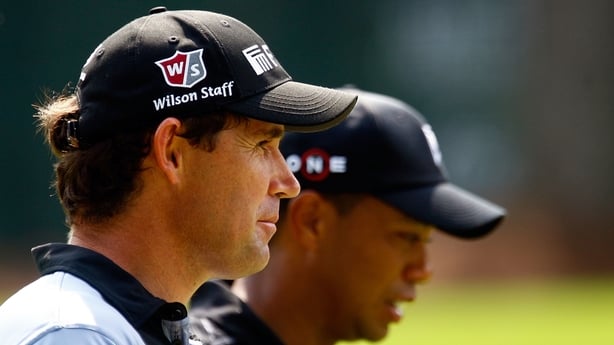
No slouch off the tee in his prime, Harrington is regularly one of the longest hitters on the senior circuit and, even now in his mid-50s, still holds his own in the increasingly crucial distance game. The analytics-driven modern game has embraced the big-driving phenomenon shamelessly.
Harrington was ahead of the curve in that regard and considers the attitude towards longer hitters in years gone by as something akin to 'bullying'.
"I'm in the same place relative to where I was 20, 25 years ago against the field in 'ball striking in distance'. So there was always a few long hitters back in the day," Harrington said.
"They were generally bullied into being bad players. The whole golfing world, the media bullied Tiger Woods into thinking he was a bad driver. In his heyday, there was nobody better off the tee than Tiger Woods. Just he hit it so far... he was hitting it a good 30 yards past the [other] longest players actually.
"But he was cutting all the dog legs. So if you miss by 10 yards, it will look like you're in the middle of the woods because you've gone through the fairway. If you're a little bit off to the right or you pull it, you're catching the tree on the corner so you can look like you're crooked.
"But he was as straight as could be, just there was a higher premium or higher level of difficulty on his shots. Most people nowadays think Tiger was a bad driver of the ball. Pretty much everybody... he was the straightest hitter out there.
"It's just he was hitting much tougher shots. You could see later on in his career, the weakest part of the game became his driving."
Listen to Greg Allen's 'Saturday Sport' interview with Pádraig Harrington in full at the top of this article
