

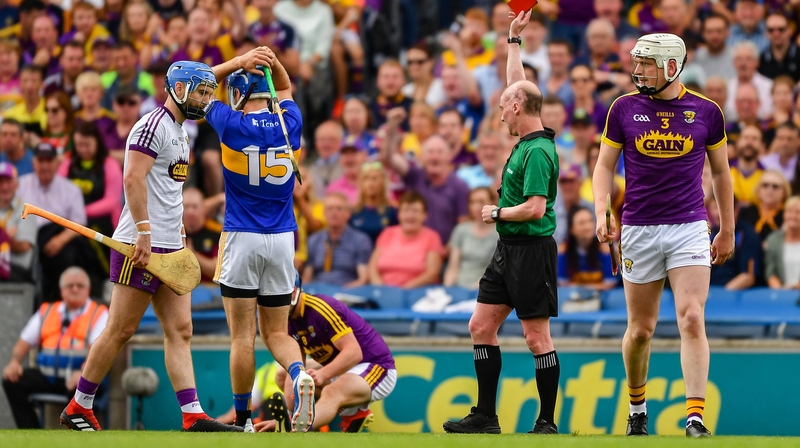

Perusing the internet last night, it became clear that one of the chief objections to Donal Óg Cusack and Derek McGrath's modern tactics discussion was that it wasted valuable screen time which would have been better used slating the ref.
When the programme did get around to refereeing matters, the resultant discussion was seemingly far too empathetic for the public's tastes.
It was argued, as it has been many times before, that the game had become too quick, too frenetic for one man to handle and that the possibility of adding a second referee should be examined.
'It's not him being all over the place, the game is dragging him all over the place' - The panel ponder whether hurling is too fast for one referee to handle pic.twitter.com/xPBdiYd0ue
— The Sunday Game (@TheSundayGame) July 29, 2019
In suggesting this, they seem to have run into some opposition.
It's worth remembering here that a very large proportion of the hurling community remain fanatically opposed to change of any sort.
We don't have to go back too far to find examples to support this claim.
It's all forgotten now of course, but had the elite hurling counties gotten their way in October 2017, then this new hurling format, these days universally regarded as a glorious development, would never have passed through Congress. It took the otherwise uninterested football counties, presumably acting purely at the behest of Croke Park, to vote through the new format and save hurling folk from themselves.
So, many hurling people's default position is resistance to change. They begin from the starting point that the game couldn't possibly be any better than it is already. 'Innovative' thinkers within the game must reckon with this phenomenon.
That's not to say there aren't leftfield thinkers out there.
My own favourite comment on RTÉ social media channels read - "2 referees? For God sake, they get in the way as it is" - which suggested that the commenter was of the view that the game might be improved if there was no referee at all.
This is, I think, worth exploring. No referee. Perhaps it might be worthy of a trial run in next year's National League.
Think about it.
Before the game, Brian Cody - or if he's not available we could have an impersonator in a peaked cap - strides out into the middle of the field, blows the whistle, then symbolically swallows it, before swiftly departing the fray, leaving the thirty men on the field "at it".
For some, this would surely represent a state of hurling nirvana, of manliness unshackled.
And who knows? It may become a reality if the storm of abuse that is routinely dumped over referees' heads grows any more intense.
The GAA, by all accounts, is permanently concerned about the difficulties of recruiting referees at all levels of football and hurling.
Only last March, Tipperary GAA had to cancel a recruitment course for new refs because only three people signed up.
Mid-Tipperary chairman Jonathan Cullen told the Irish Examiner that "as things stand, it will be just a matter of time before games will not be played due to lack of referees."
In the circumstances, they're doing an admirably good job in finding refs. Given the level of bile online, it's quite amazing that so many are still willing to do the job. A spell in the stocks in front of a rotten-fruit wielding mob looks like more fun.
Waterford Whispers today published an article entitled 'GAA Launch Witness Protection Program For Referees'. At the moment, it remains only a joke.
Words like 'scandalous' and 'disgrace' are tossed around with the usual abandon on social media. And of course, 'biased'. '16th man' is another. We've noted before that 'bad for both teams' is about the most lavish compliment a referee can expect to receive nowadays.
At the start of the summer, Brian Gavin said he was worried the standard of reffing was slipping and the talent was no longer coming through at county or provincial level.
In the last couple of years, the panel has lost a number of very experienced referees, notably Gavin himself and Barry Kelly, both of whom refereed four All-Ireland finals apiece since 2006. Diamuid Kirwan and James McGrath, each of whom reffed two deciders, have stepped away for different reasons.
This has left a relatively inexperienced panel in place, with Fergal Horgan and James Owens the only two to have overseen the biggest game of the year.
The two referees at the weekend, Alan Kelly and Seán Cleere, had never refereed an All-Ireland semi-final before.
Kelly shipped what we might describe as a modest amount of abuse for his handling of the Limerick-Kilkenny game, which essentially amounts to a par score (modest abuse is standard, anything less is an absolutely glowing review).
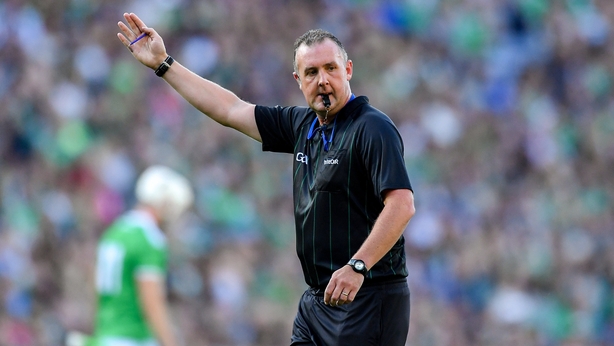
Cleere was less fortunate with the Tipp-Wexford game and has attracted a rather more hysterical brand of abuse, which can't be fun but obviously isn't unheard of either.
The criticism meted out to Cleere was unusual in that it came primarily from the winning team, with the ref having disallowed three Tipperary goals, the last of them particularly contentious as he failed to avail of the advantage rule seconds before Jake Morris put the ball in the net.
Liam Sheedy, to his credit, was measured and generous in his comments on Cleere's performance, albeit magnanimity is probably easier to display in victory.
Provided it doesn't scar them unduly, the experience of refereeing their first semi-final should be of benefit to Kelly and Cleere in the future, when they're handed the whistle for another big game.
In the meantime, those who habitually berate referees online while loftily proclaiming that the standard of officiating just isn't up to scratch these days, might reflect on the potential reasons for that.
In his end of year report last December, Tipperary chairman Tim Floyd warned that the abuse doled out to referees was making it increasingly difficult to recruit men and women willing to do the job and he paid tribute to those who still put themselves forward.
"It is amazing that anyone would sign up to be a GAA referee under these circumstances. We should be extremely thankful to those who do and for their bravery and commitment and we should praise and encourage them all we can. There is a massive mindset change required in the GAA and it must come from the top down."
