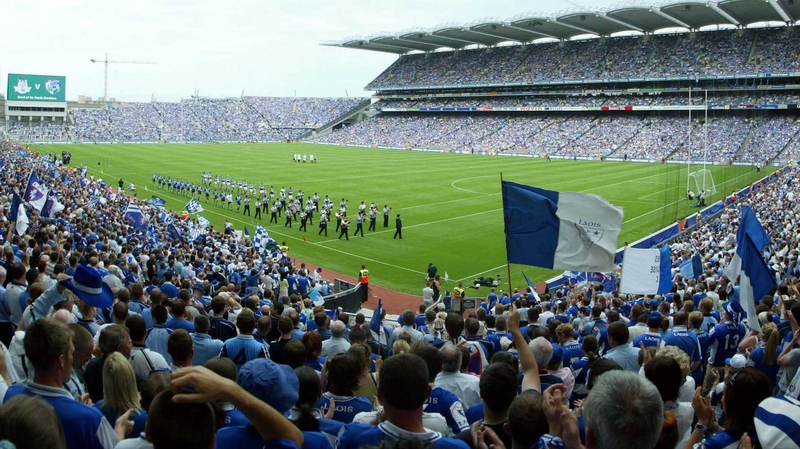
Former GAA president Séan Kelly last week publicly stated what many have suggested in recent times; that the increasingly non-competitive provincial championships need to be replaced by a tiered structure.
This year, Kerry and Dublin cruised to victory in Munster and Leinster respectively, while a dogged Fermanagh were no match for Donegal in the Ulster decider.
Kelly said that without a change in structure there could be "a serious fall off in participation and attendances".
"Cause for serious worry about the hammerings too many @officialgaa football teams are getting at all inter-county champioship levels," he posted on Twitter.
"Grading according to abilty, with more than one tier essential.
"Otherwise there will be serious fall off in participation and attendances. Urgent!"
While there has been great discussion in recent years over the one-sided nature of many games, is the trend getting worse?
Are Kelly’s fears over dropping attendances already in evidence?
We decided to trawl back through the records since the turn of the century to take a closer look.
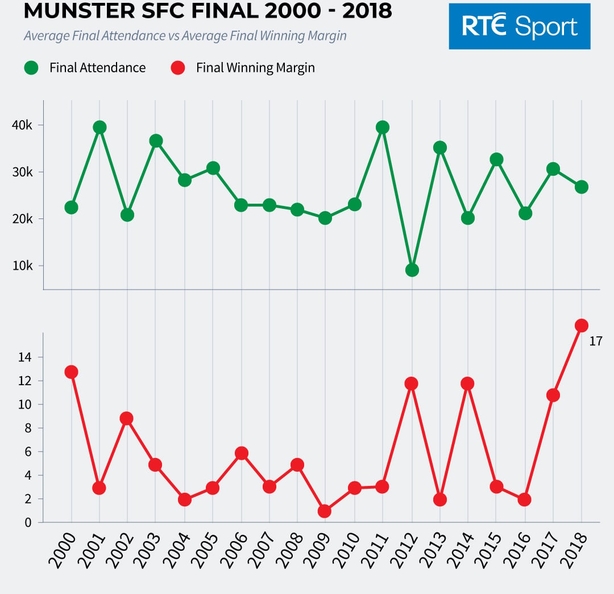
There are, of course, other factors at play, with each province having its own nuances. A Munster final outside of Cork and Kerry has a significant impact on attendances, while replays of a final swell the figures.
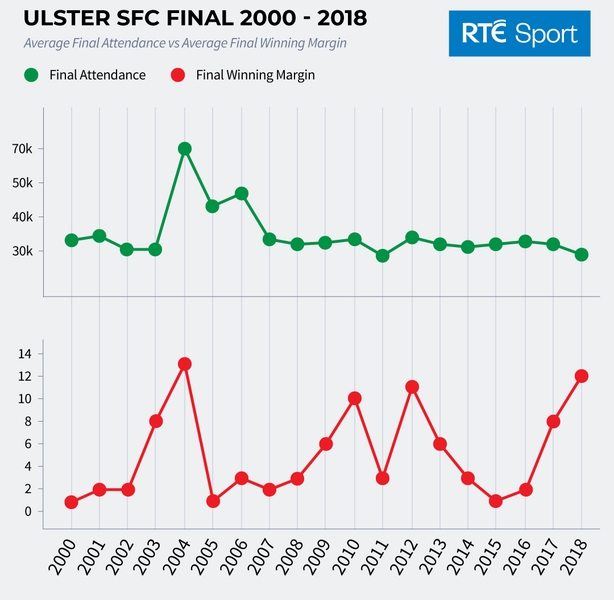
Ulster, for example, saw a spike in attendance figures when the finals were played at Croke Park.
Our research has also been limited to games in Ireland, so matches in Ruislip and New York have been excluded.
Here are the findings.
The provincial championships
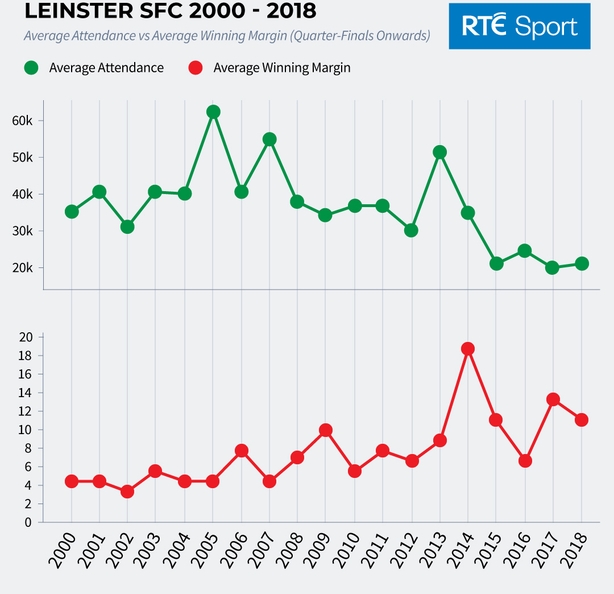
Given the lack of recent competition in the province - Dublin have won 13 of the last 14 titles - it will come as little surprise that the average attendance in Leinster has dropped significantly since the start of the century.
The drop can partly be explained by a reduced number of Croke Park double-headers (for purposes of graphs, both matches at a double header given the total attendance at the stadium) and the recent policy of taking the Dubs on the road for one match.
In the same period there has been a steady influence in the average winning margin, with the figure peaking in 2014 (17 points), which was more than four times the figure 2000.
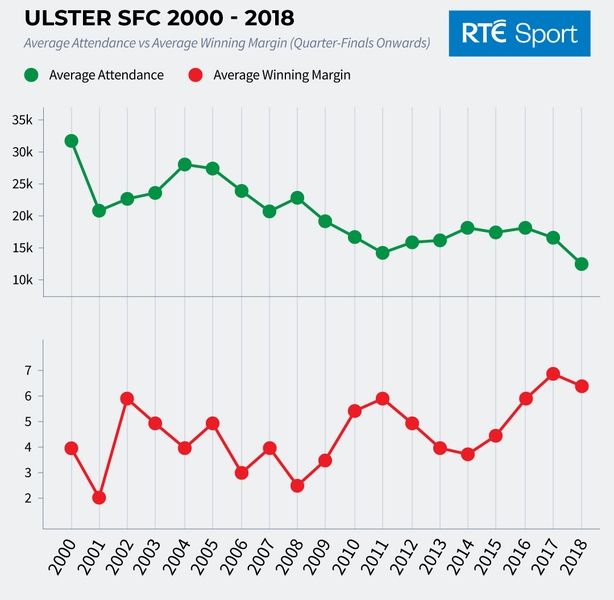
Ulster takes a jump between 2004 and 2006 when he deciders were played in Croke Park but has slipped steadily towards a low this year when the average attendance was under 13,000.
*Please disregard graphic below's average attendance for Ulster in 2000 which is incorrect due to an error in production - it was in fact 23,537.
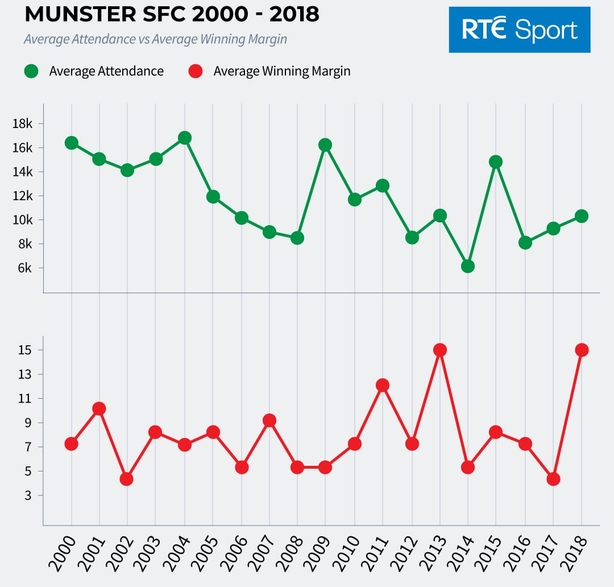
Cork v Kerry replays in 2009 and 2015 were a shot in the arm for Munster attendances which have continued to dwindle. In 2000, the average attendance was 16,698. Eighteen years later and that figure has dropped by 37%, while in three of the last five years the figure has been below 10,000.
Not surprisingly, 2018 has seen the biggest spike in average winning margin, but on the whole the figure has remained steady enough, aside from 2011 and 2013. That is not to say it is competitive, merely it is consistent.
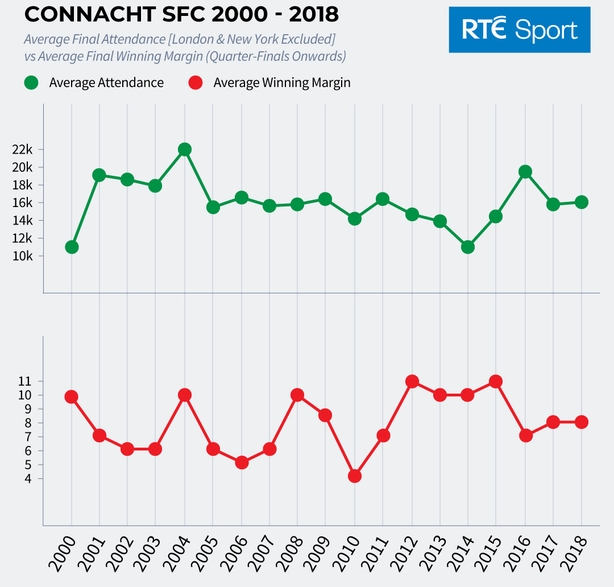
Connacht is the province with the fewest peaks and troughs in terms of attendance, and is the only one where the average figure is higher today than it was at the start of the century.
Aside from the relatively low figure of 11,080 in 2000 – only 2014 was lower – the figure remains steady, while the average winning margin has been up and down.
The past three years, perhaps coinciding with Mayo’s early exits, have seen lower figures than in previous seasons.
Provincial Finals
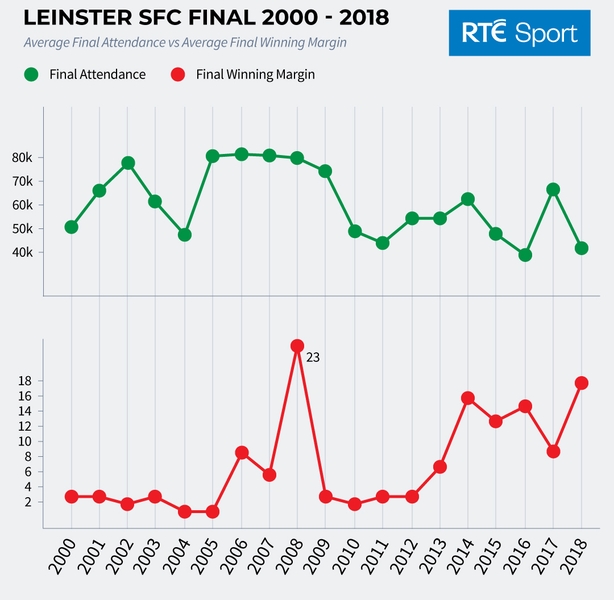
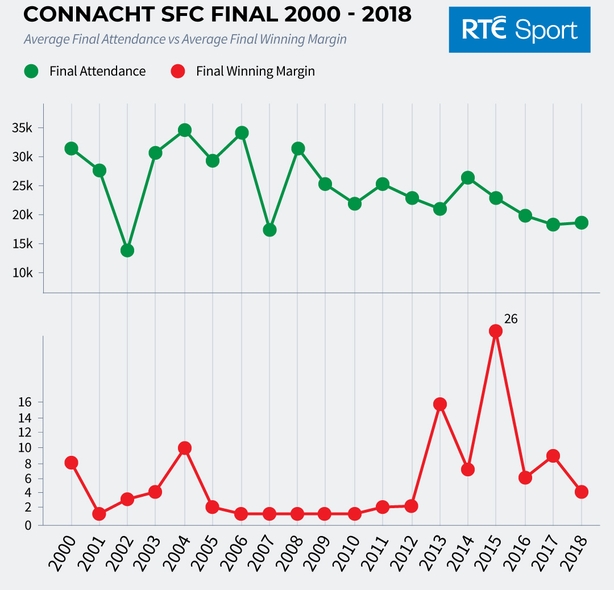
A closer look at the provincial finals reveals that the winning margins are rising - sharply in the case of Leinster and Ulster - while Connacht, with the obvious exception of Mayo's 26-point massacre of Sligo in 2015 - is by far the most consistent.
Kerry's annihilation of neighbours Cork last weekend jumps out on the Munster graph, but the fixture has been peppered with big wins.
In terms of attendance, Leinster is well down on the figures of the mid 2000s, while Ulster remains a beacon of consistency, aside from the Croke Park years when the Tyrone/Armagh rivalry was at its peak.