


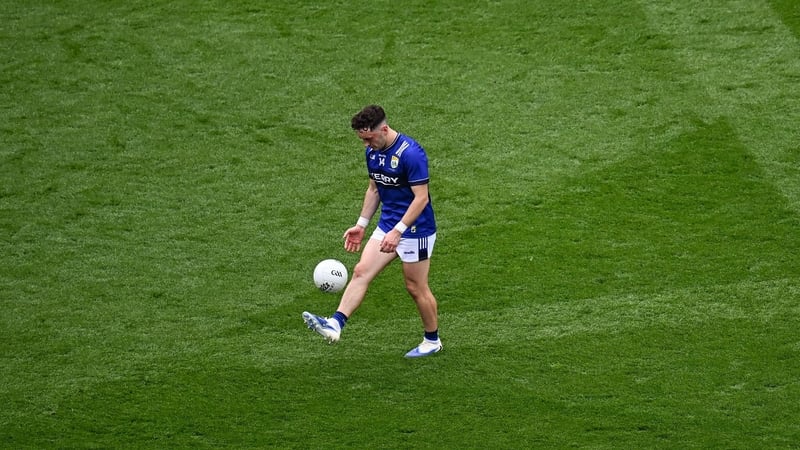
"I get it, it's part and parcel of the game. It’s a tactic that managers are using, but it’s terrible to watch and spoiling our game as a spectacle."
RTÉ GAA analyst Peter Canavan speaking on the long bouts of possession that have often been bringing the tempo of games down to walking pace.
After a weekend when the league finals re-ignited such criticisms, it should be noted that Canavan’s comments came back in 2023, before the hooter was ever introduced in the men's game.
That particular rule enhancement hasn’t eliminated the problem. Indeed, the alteration for 2026 that sees the half end on the buzzer has arguably exacerbated the issue with teams cleverly running the clock down long enough to ensure that being hit on the counter is impossible.
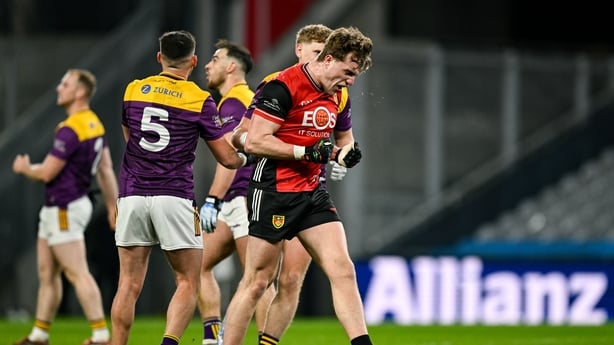
In Saturday’s dramatic Division 3 final against Down, the last Wexford player to touch the ball in normal time was Cian Hughes who blocked down an Adam Crimmins shot with 66:56 on the clock.
One minute and 52 seconds of keep-ball later, Down’s Tom Close found himself in prime match-winning position, with the Clonduff man making a mess of what should have been the coup de grace on that protracted period of possession.
If it had went over - and fortunately for the Hilltown man it didn’t cost his team as they prevailed in extra-time - it would have been viewed as a fantastic piece of play to secure a national title, at a coaching level anyway. At an entertainment level, less so.
It remains an ongoing issue, as demonstrated by Canavan’s comments after Roscommon had held the ball for six minutes at the end of the first half of their All-Ireland round-robin game against Dublin three years ago.
But how can it be fixed? Can it actually be fixed? Does it need to be fixed?
What of a limit on the amount of hand-passes a team is allowed before they must kick or shoot?
"I would not be a fan, I'm not sure it would do anything for the game and teams are putting up massive scores already," replied Gerry McGowan, who was on the sideline at Croke Park on the day that the Rossies held the ball for about 9% of the game back in 2023.
Part of Davy Burke’s Roscommon coaching ticket, he saw his players string together 77 passes before Diarmuid Murtagh scored a point to leave them four up at the break.
"That was planned, Roscommon could do that, they had a huge amount of ability," said the former Sligo footballer and current Corofin head coach.
Having access to such quality is a crucial point and, for McGowan, a reason why there shouldn’t be an expectation on a team to always race out and try to force a mistake.
'Like a prison sentence' - Some of those who watched Down v Wexford may have felt they'd done hard time, with ponderous, deliberate, handpassing attacks holding sway
— The Sunday Game (@TheSundayGame) March 29, 2026
📺 Watch: https://https://t.co/AKAre5FHdN pic.twitter.com/YTdqQFNv6y
The Tourlestrane man said that county teams are continuously running end-game scenarios, and feels Down were particularly well prepared in that department at the weekend
"The two-pointer has scared the bejesus out of everyone," he said.
"Break it down: why would you keep it in the first place? Why would you disrupt it in the first place? Now, how do you disrupt it? What are the risks to disrupting and what are the positives to disrupting from a coaching perspective?
"You've got to have all these kinds of things worked out, but, no matter what you say, it still falls back into the scenario that you find yourself in in the closing 10 minutes.
"You're three up, you're 10 up, you're five up, you're five down, you're two down, you're one down, you're level. The wind is with you, the wind is not with you - because that's such a big factor.
"You've got to have the scenarios run...I think there's no one size fits all answer."
Probed on what he would have done if in Wexford’s shoes in those final minutes against Down, the reply was essentially "much the same".
"In training, we'll always practise under fatigue," he says. "We fatigue one side versus the other side just for this scenario and the chances of a mistake goes through the roof.
"How many times in training can anybody keep the ball for three minutes? It's very rare.
"Wexford were probably being patient and waiting for that silly mistake and then countering on the other side, especially at the end of a new-rule 70-minute game when the fatigue is at its highest and the chances of a mistake are at their highest. I think Wexford did the right thing."
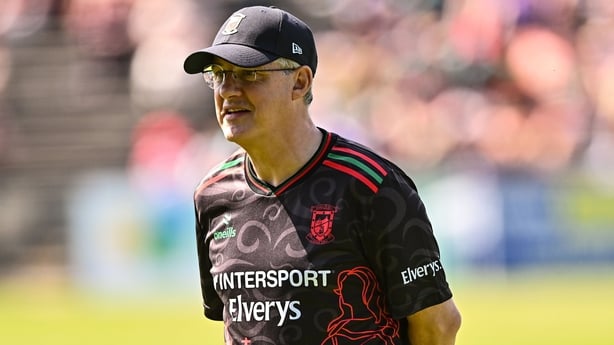
For Leitrim manager Steven Poacher, a possible solution to the problem may come from further evolution of the goalkeeping position – while he also thinks intentional breaches can’t be ruled out.
"Obviously you want to try and create a plus one, so you're defending with 12 against 11, the goalkeeper included, so do you use the goalkeeper? Do you get the goalkeeper to come out and sit on someone and literally take that gamble of trying to double up on the ball carrier and trying to put pressure on the pivot?
"I don't know if that's the right thing to do or not and then you're vulnerable and your goal is left open but it may be something the teams may start doing where the goalkeeper comes out.
"I know (Gavin) Mulreany did it yesterday for Donegal where he came out and sort of swept and I know Blaine Hughes has been doing it for Armagh to try and create a plus one.
"It's a risk and reward, it's a high risk but, you know, you are at that stage, frantically and urgently looking for the ball back.
"The other one is that, as mad as this sounds, if you're one down with two minutes left and you sense that the opposition's keeping the ball – like Down were the other night for three and a half minutes – rather than a slow death do you go out all guns blazing?
"Do you take the hit and pull men across the halfway line and create a deliberate breach and concede the point and take your chance on trying to get the ball back from your kick-out?"
Like McGowan, Poacher would have strong objections if a hand-pass limit was ever floated, but does feel a backcourt rule - where teams can't pass the halfway line and return - would have more merit.
"It would be a disaster, it would be a disaster to police as well.
"What do you do, three hand-passes then a kick? Sure the kick could be two metres.
"Backcourt - like in basketball - a dotted line across halfway and you can't travel or bring the ball back across the halfway line and there is your solution."
Éamonn Fitzmaurice’s time with the football review committee has come to an end with a new expert advisory group, chaired by Kevin McStay, now set to oversee any tweaks to the game – including any potential revision of the hooter system.
Speaking on the RTE GAA podcast, Fitzmaurice denied the deeply-held suspicion that the hooter rule was altered on account of David Clifford’s after-buzzer two-pointer against Donegal at the end of the first half of Kerry’s 2025 All-Ireland triumph.
The 2014 Kerry All-Ireland winning manager also feels that regardless of what method is chosen to end a game, teams are going to throw the ball back and forth to waste time as the conclusion nears.
"I don’t think, within the FRC, that any of us felt those possession periods would be eliminated just by moving the hooter to the absolute 35 minutes," he said.
"We understood that teams would start doing that two or three minutes out anyway, regardless of whether the hooter signalled the last play or it signalled this was the end of the first half.
"I think, with the way the game has gone, even if it’s just a final whistle and the old injury-time, teams will do that – they'll try to suck down the clock in the last two to three minutes."
Éamonn Fitzmaurice weighs in the keep-ball problem at the end of closely-fought matches 🎙️
— RTÉ GAA (@RTEgaa) March 30, 2026
'I don't think, within the FRC, that any of us felt those possession periods would be eliminated just by moving the hooter to the absolute 35 minutes.' 🗣️ pic.twitter.com/zcZJNRRqqW
Fitzmaurice, who like Poacher agrees that goalkeepers could provide the ticket to turnover pressure, also said that criticism of Down – and Kerry at the end of last year’s All-Ireland final – was unjustified.
"Teams have freedom to do that, it’s within the rules and they have every right.
"I don’t think there’s any point appealing to the coaches or the players, the better side a point up, ‘come on lads, keep going for entertainment purposes’," he added.
And there lies the nub of the issue. Teams are there to win, not entertain. It was an issue in 2023, it’s an issue in 2026. We’ll be back here in 2029.
Listen to the RTÉ GAA Podcast on the RTÉ Radio Player, Apple Podcasts, Spotify, or wherever you get your podcasts.
