


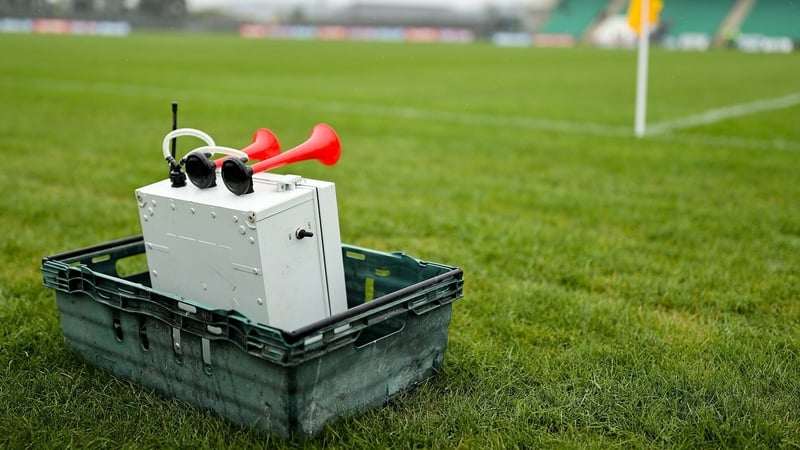
Central Council has decided that the hooter in league and championship Gaelic football will signal an immediate end to games next season.
The rule change follows a recommendation from the Football Review Committee (FRC), which published its final document ahead of October's Special Congress where this year's trialled rules were permanently enacted.
The closing minutes of several matches during the 2025 season often extended well beyond the hooter until the ball went dead.
Across 23 All-Ireland series matches, this period proved decisive, and committee notes show seven scores materialised after the final hooter, and 14 more after the half-time hooter.
The Football Review Committee (FRC) observed an issue with these prolonged endings to games.
While the rule could create exciting finishes for spectators, the FRC noted that it encouraged teams to adopt a deliberate strategy of retaining possession after the hooter, effectively slowing the pace of the game to prevent their opponents from mounting one last attack.
The FRC concluded that this retention tactic undermined the committee's goal of fostering free-flowing, attacking football, which was the intent behind the wider suite of rule changes.
In advance of October’s Special Congress, the FRC tabled its final recommendation, and Central Council has agreed.
However, recognising the potential risk of suddenly cutting off an awarded scoring opportunity, Central Council has included specific caveats.
A player can still take a penalty, a free, '45, or a sideline kick if it has been awarded when the hooter sounds, but only on the condition that it is a direct, uncontested shot at goal.
No team-mate is permitted to touch the ball.
Any ball that is already in flight when the hooter sounds will have its resulting score stand, providing no other attacking player touches the ball.
The FRC and Central Council hope that the immediate conclusion will result in greater urgency, encouraging teams to push for scoring opportunities instead of prioritising possession retention.
Meanwhile, in the women's game, the Ladies Football Central Council is set to meet next week to ratify 12 rule changes ahead of the 2026 season.
A Special Congress will take place in spring 2026 to decide which of the trial rules will be permanently implemented ahead of the inter-county and club championships, with an earlier review period pencilled in during league action.
Six of the 12 changes to be implemented are from the Football Review Committee's rule enhancements in the men's game, namely the kickout mark, the two-point scoring arc, the requirement to keep three players in the opposition half at all times, the solo and go, and frees being brought forward for tactical fouling or dissent from the sideline.
However, short restarts within the 40-metre arc will still be allowed.
Several of the other changes pertain to the tackle, in an attempt to permit more physicality in challenges, with the goal of a more free-flowing spectacle.
A lack of consistency in implementing existing rules on the tackle has frustrated players for many years, and 92% of female inter-county players polled in a recent Gaelic Players Association survey were in favour of trialling rule changes.
Watch the Leinster club finals, Athy v Ballyboden St Endas in football and Ballyhale Shamrocks v St Martin's in hurling, on Saturday from 4.15pm on RTÉ2 and RTÉ Player. Follow a live blog on the RTÉ News App and on rte.ie/sport
