


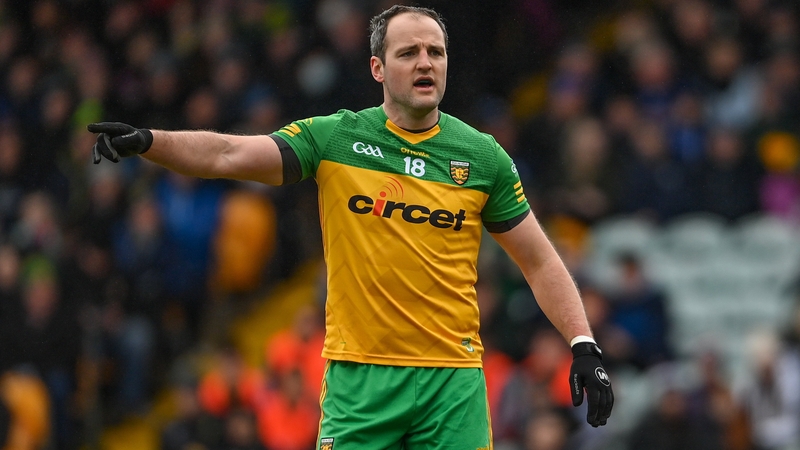

Last June, as the Donegal players slouched off the pitch following their abject loss to Armagh in Clones, it had the definitive feel of the end of an era.
It certainly does now.
Five months later, Michael Murphy, unquestionably Donegal's greatest modern footballer, announced his retirement at the age of 33, saying that he felt he "no longer had the energy and capacity to reach the performance levels to give my best to Donegal."
For 15 years, beginning in the doldrums and rising to unimagined heights, Murphy bestrode the inter-county scene like a colossus, recognised as one of the great forwards of the game from his teenage years onwards.
A player of magnificent, selfless versatility, Murphy operated in several different guises across a glittering career - ruthless inside-forward, bustling midfield ball-winner, visionary link player. Dynamic, cerebral, elegant.
The modern history of Donegal football famously began in late 2010 when Jim McGuinness sat the players down in a hotel and asked them why they were only ranked 19th in the country. Aside from anything else, it was certainly the most consequential set of county power rankings ever committed to print.
Murphy's own inter-county career pre-dated McGuinness by a few seasons - virtual antiquity in Donegal terms - beginning in 2007 under the regime of Brian McIver.
In a testament to his longevity, the text message informing him of his first county call-up was received on a Nokia (as he told Donegal Live's Alan Foley last night).
While the county continued to bob along irrelevantly in mid-table for a couple of years, Murphy established himself as an outlier in an otherwise grim environment.
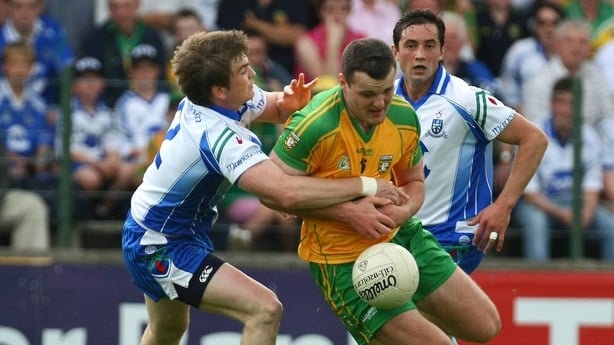
Still only 19, he was already nailed down as Donegal's leading score-getter in the 2008 championship, albeit with the team still an afterthought this was generally out of sight among the wider public.
He would properly announce himself on the national stage on an otherwise dark day for Donegal football, when John Joe Doherty's side were brutalised by Cork in the 2009 All-Ireland quarter-final. The match is a reminder of a different world. Cork were gunning for an All-Ireland and duly ran riot, Donegal were branded a rabble. Murphy, however, rustled up 0-06, instantly earmarking himself as the county's officially designated 'marquee forward'.
Donegal would execute the most abrupt gear change in the modern history of Gaelic football in the early 2010s. McGuinness - less resembling the Jesus Christ figure of his playing days and more in the mould of Daniel Day Lewis method acting the part of messianic GAA manager - arrived with a highly defined set of ideas and set about revolutionising the sport.
Murphy, a central figure on McGuinness's Under-21 All-Ireland finalists in 2010, was installed as senior captain at just 22.
Over the spring and summer of 2011, Donegal swiftly became the most despised team in the sport, the punditocracy aghast at their style of play, which was deemed several notches more offensive than Mickey Harte's Tyrone.
Nonetheless, Donegal, previously cast as cavalier underachievers, were suddenly engaged in the unfamiliar business of eking out indescribably ugly wins.
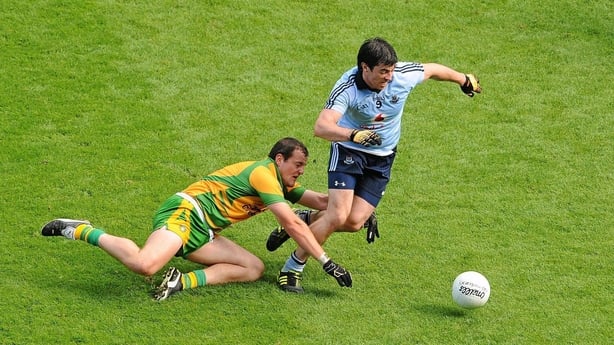
During the 'Shi'ite' football semi-final against the Dubs, McGuinness pushed the defensive approach to new extremes, outraging the general public in the process.
"It was the audacity of Jim McGuinness," marvelled journalist Paddy Heaney later on the 'Jimmy's Winning Matches' documentary. "You thought, is he seriously doing this?"
Murphy, a willing labourer in the defensive cause, observed "We wanted to just win matches and win them by any means possible."
This time, McGuinness refused to retaliate against his multitude of baying critics, all grieving for the state of the game, and instead entered a priestly, reflective mode. Kevin Cassidy, arguably Donegal's primary leader aside from Murphy, was famously exiled after being a touch too candid in his contribution to a book by journalist Declan Bogue.
They returned as a fine-tuned entity in 2012, delivering a counter-attacking dimension to complement their rigid defensive template. A second Ulster title was won in emphatic style, Down the poor whipping boys in the decider.
Their momentum was now irresistible. In the quarters, they stuck the final nail in Jack O'Connor's second stint, subsequently avenging their '09 humiliation against a highly fancied Cork in the semis. Though the 2012 final is often in retrospect, painted as one in which Mayo entered as favourites, there was, at the time, a forbidding air of destiny about Murphy's Donegal.
It was as if they had cracked a new code on how to win football matches. Team after team was swallowed into the black hole of their system. Their puritan mentality inspired awe. The controversial nature of their style was intimidating in and of itself, as if signalling how far how they were prepared to go to win.
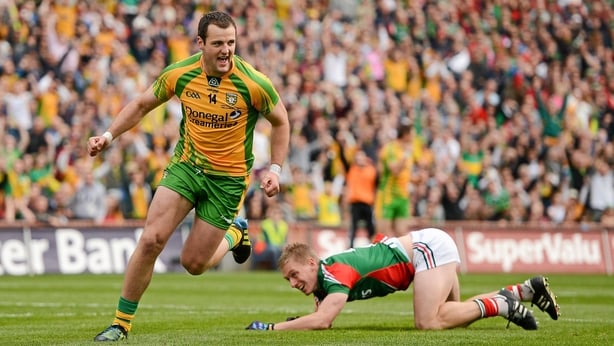
The 2012 decider was vintage early-stage Murphy. In a novelty-laden final against a relatively callow Mayo side, Donegal would make the killer thrust in the opening minutes, Murphy, isolated in the square, collected the ball ahead of Kevin Keane, rattling home a shot of shuddering power. A goal for the traditionalists to salivate over. When McFadden added a second a couple of minutes later, the ball squirting under David Clarke's dive, the decider appeared to be consigned to the ashes.
While Mayo rallied in the second quarter, they were always kept at arm's length, four points the margin in the end.
It was the crowning glory of his career. Murphy had mustered 1-04 of Donegal's tally of 2-11. Amid riotous scenes of joy at full-time, he became the second Donegal man to lift Sam after Anthony Molloy and was presented with the Man of the Match that evening.
His first All-Star would arrive that winter. In total, he picked up three, adding further awards in 2014 and 2019.
The Sigerson Cup was his plaything that winter. One astonishing point against UCD - in which he clipped a ball past Rory O'Carroll, collected on the other side of him and screwed it over with the outside of his foot from the sideline - went viral that February.
While his greatness as a footballer was never questioned from any quarter, his exact stature in comparison to his fellow galacticos was the subject of the usual culture war skirmishes.
Typically, this broke along provincial lines. See Brolly's thunderous argument with Spillane/O'Rourke after the Ballybofey ruckus with Tyrone in 2015.
He was more workhorse than show pony in the landmark win over Dublin in 2014, arguably McGuinness' greatest managerial coup. However, Donegal were confounded in the final when Kerry set up to mirror them.
As McGuinness departed and Dublin's imperial phase arrived, Donegal's rigidly defensive model became set in concrete as teams gradually began to work it out.
Murphy's own particularly selfless role in the McGuinness, and later Gallagher, system was often subject to frenzied debate in those years, another flashpoint in the perennial war between purists and modern theorists.
A devastating presence in the inside-forward line, Murphy was often engaged in more humdrum, blue-collar activity out the field. The 'why won't they layve him on the edge of the square' gang shifted their attention from Joe Canning to Murphy.
Further provincial success arrived at the end of the decade, as 1992 hero Declan Bonner, returning for a second stint, launched a more gung-ho style. Murphy collected a couple of Anglo-Celts in 2018 and 2019.
Like other attacking greats (Joyce, McDonald, etc) Murphy was increasingly re-cast as a creative half-forward string puller, as the athletic powers waned but the cerebral abilities increased.
Another tilt at an All-Ireland was often predicted but never materialised and Donegal crashed out in the Super 8s two years on the trot. Murphy, in particular, cut a forlorn figure after they were sickened by Mayo
By now 32, his enduring importance to Donegal was emphasised by his absence after his first-half sending off in the straight knockout campaign against Tyrone in 2021, the hosts' challenge withering badly as he watched from the sideline after a rare missed penalty.
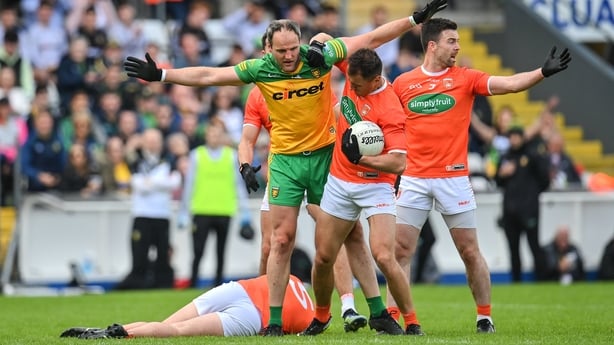
Tyrone's subsequent opportunistic gallop to a fourth All-Ireland title a galling reminder of what might have been in a year marked by tumult and change at the top.
Donegal wilted in extra-time of the 2022 Ulster final against Derry, ironically against the old McGuinness/Gallagher system dusted down for a new era. The campaign petered out with a heavy loss to an insurgent Armagh side in the last-12, a jarring note on which to end Murphy's often glittering inter-county career.
"Life changes and life moves," Murphy told Foley last night.
"It's definitely not the end of the road for me. I’ll move onto something else and Donegal will keep going. If I can help Donegal in any other way, I will. I love the county and I love the people here. That will always be with me. It was an honour to represent those people and all I ever wanted to do was represent them as best I can."
Donegal, running out of puff at the top level for a while, look bereft without him. For the incoming managerial duo of Paddy Carr and Aidan O'Rourke, 2023 looks like Year One of a rebuild job.
Murphy, himself, may be one day soon be part of an attempted re-build, bluntly admitting his managerial ambitions, though he didn't put a timeframe on it.
"I'll help out there in any way I can. Maybe in the years ahead, I’ll find new ways to offer something more to my home county. That hunger is there. It might not happen in the coming months or even years. Let’s see…"
