


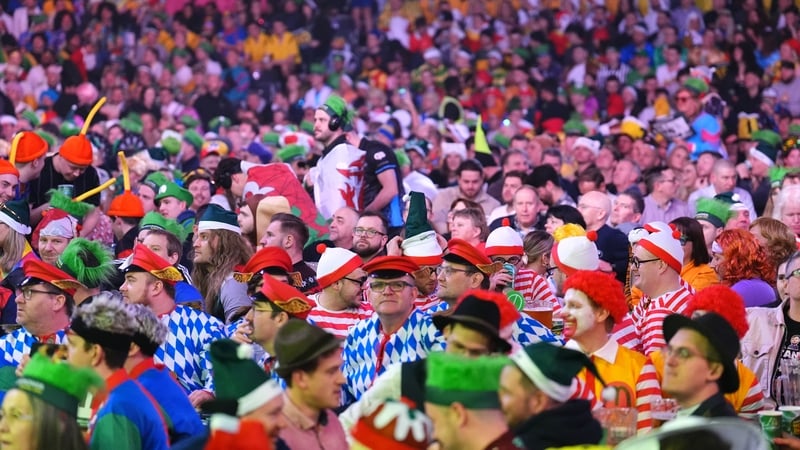

We're over halfway through the World Championship and, as usual, the darts has delivered.
Across the course of 95 games, 1,486 legs, 45,552 darts thrown, and over a million points scored, according to PremiumDartdata, we've been once again spoiled by the spectacle.
We've had big fishes reeled in, bigger fishes going home and new cult heroes taking centre stage at Ally Pally.
We’ve come to expect nothing less from a tournament that constantly creates the most dramatic tungsten thrills.
And if darts is the sporting soundtrack of Christmas, then the commentators are the conductors, escorting the viewers up and down, side to side, through the symphony’s slings and arrows as the pendulum swings wildly between visits, legs and sets.
Darts is one, if not the most, repetitive sports to view. On paper, it shouldn’t really work.
It’s overwhelmingly right-handed men throwing at fixed target seven foot, nine and a quarter inches away.
There’s a robotic element to it, and that’s why the TV production and commentators have to be on point.
Sid Waddell was the original 'Voice of Darts’ and such was his impact on the sport that the World Championship silverware is named in his honour.

With his distinctive north-east English accent, he spawned some of sports commentaries most memorable lines.
"The atmosphere is so tense, if Elvis walked in with a portion of chips, you could hear the vinegar sizzle on them," is probably the pick.
Waddell passed away in 2012 but his legacy lives on.
Weekly Dartscast presenter Burton DeWitt recently said the old and the new was like comparing apples with an Apple computer, specifically in reference to Sky Sports’ Dan Dawson, his depth of darting knowledge, passion and timing, and easy manner with whomever he is paired with.
His colleagues Rod Studd, Stuart Pyke, and Abi Davies dovetail seamlessly alongside former professionals Wayne Mardle, John Part, Glen Durrant, Mark Webster, and Laura Turner, who is still active on the women’s circuit.
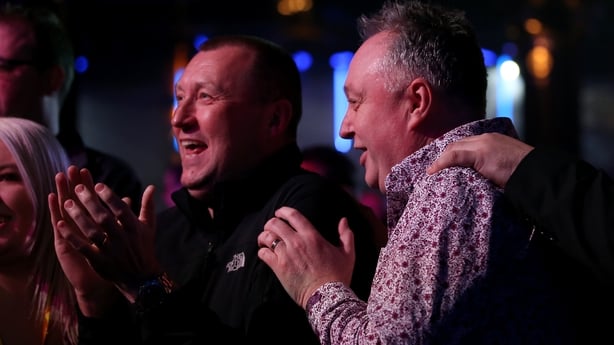
Like all good sports commentary, those who excel at it make it look and sound easy.
"Somebody said to me, the key is to disengage your brain and put your mouth into gear," Studd tells RTÉ Sport.
"You have to have some knowledge of what's going on, an understanding of the sport, a statistical understanding, some knowledge of the history of the sport and what's happened before, and all the things that go with the sport.
"But there's a certain element of it being [a conversation].
"If you came into the press room or we were watching a game in a pub, you'd hear something pretty similar to what you hear on air.
"It's two mates discussing the darts match."
Studd, who is working on his 16th PDC World Championship, sat alongside Waddell for years.
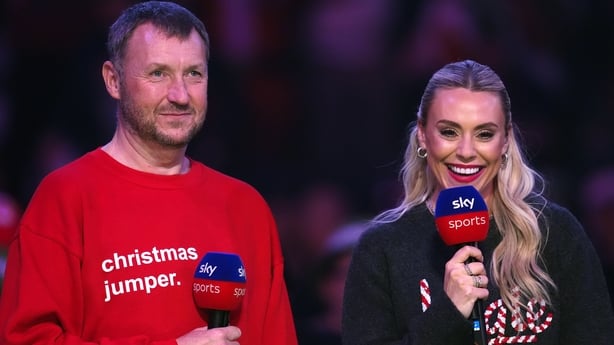
"If you did a match with Sid, the last thing he would say to you before the match started was always along the lines of, 'enjoy yourself, kid, enjoy it'.
"Myself, Wayne, Pykey came into the darts commentary following in the footsteps of people like Sid and John Gwynne and the great Dave Lanning.
"These were brilliant people to follow and wise men to learn from.
"I think we see ourselves as trying to manage the entertainment and be part of the entertainment as the action's unfolding, as well as describing."
The most famous darting commentary accompanied the most famous leg of all time – Michael Smith’s nine-darter along the way to winning the 2023 world title.
Mardle screams: "That is the most amazing leg of darts you will ever see. I can’t spake, I can’t spake!"
But it’s not always like that. Indeed, that was exceptional.
"If [Luke] Littler and Michael van Gerwen are rattling in 11-12 darters every other leg, 170s, nine attempts, then it's difficult to make a mess of it.
"If you're watching a game where the players are averaging 80 or 82, and it's really stretching out, and it goes deep into the match, and neither player is playing particularly well, and they're both finding it, as Wayne would say, a chore.
"Then that is where the commentator really ought to be trying to make it entertaining, and trying to earn their money, and make sure the viewer isn't sitting there going, ‘God, this is crap, I'm going to turn off’.
"We've got to make it sound big at that point. And that is an art, definitely."

Durrant, the three-time BDO world champion and a Premier League winner in 2020, made the transition from thrower to talker soon after his retirement two years later.
"I was looking at my transferable skills from when my darts career finished," explains the affable Middlesbrough man.
"I knew how to throw a dart and I knew how to allocate council houses because I worked in a housing office for 30 years.
"I think a good grounding was a neighbourhood residence meeting where you had to stand in front of disgruntled residents and explain the situation.
"So I was used to words but I think there's a clear difference between a commentator and a pundit and you've got some of the great commentators right now.
"We've seen fantastic pairings and combinations over the years, from Sid Waddell and John Gwynne to Wayne Mardle and Rod Studd. I think the best duo right now is Dan Dawson and Wayne Mardle.
"I think it's really important to get that dynamic right.
"I don't have that journalistic background, but at the same time, I always tell myself they don't know what it's like to be going up to a double 16 to win a Premier League."
Darts on the TV has been an exponentially growing phenomenon since the Professional Darts Corporation’s revival of the sport after the breakaway from the now defunct British Darts Organisation in 1993.
Between Phil Taylor’s swansong and Rob Cross’s World Championship win, Fallon Sherrock’s glass-ceiling shattering and the emergence of Littler, the entire landscape of the sport has changed.
The colour of the crowd and the fast-paced action make the spectacle a real feast for the eyes but, as unlikely as it seems, it works as aural medium as well.
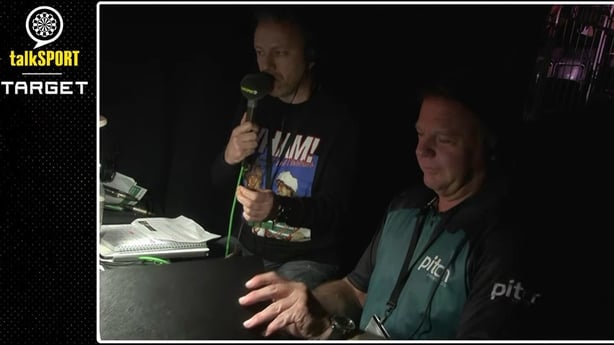
Paul Nicholson, the 2010 Players Championship Finals winner, is another who made the transition from the oche to the other side of the line.
The Geordie is part of the talkSPORT radio comms team alongside ex-pro Chris Mason and commentators Ian Danter, Chris Murphy and Mark Wilson.
The concept of ‘darts on the radio’ sounds a bit like ‘snooker on a black and white TV’, but, for some reason, it works.
Why?
"Is there any reason why football should work? Is there any reason why horse racing should work on the radio?" replies Nicholson.
"And they've been working for a very long time.
"The technology is so good these days that you can hear what's going on in the background.
"You can actually hear the thud of the dart on the board.
"You can hear the reactions of the referee, the reactions of the crowd, the reactions of the players.
"So if you close your eyes and you listen to darts on the radio, you feel like you're there. It's as simple as that.
"We paint the picture with our words and we have gathered this monstrous fan base over the last few years, especially at Christmas time. Because now, the biggest tournament of the year, you don't have to watch it.

"One of the things that you do with TV commentary is that you allow the picture to tell the story.
"Our responsibility as commentators is to just add that little bit of extra seasoning to what you can see.
"What we have to do with radio is paint a picture with a select amount of words in a short space of time.
"So if something really ridiculous happens, I have one chance to communicate to the audience: what's been hit, how it's been hit, and what the reaction is all in one sentence.
"It becomes a bit of a skill to do that because if we talk all the time incessantly without allowing the audience to breathe, it becomes too jumbled.
"We have to choose our words and we have to do it effortlessly. And that's what we've tried to do and cultivate over the last eight years of coverage on talkSPORT.
"I think as each year goes by, we get better at it and we've had nothing but positive feedback over the last few years."
If you haven't tried it, it's well worth a listen.
The tournament stops for a three-day breather but returns on Saturday with an afternoon session followed by an evening card with defending champion Littler coming up against Mensur Suljovic.
Josh Rock is the last remaining Irish player in the draw after Daryl Gurney and Willie O'Connor were knocked out on Tuesday.
The Antrim man faces Callan Rydz on Monday evening.
Get ready for more darts drama, all embellished by the top tungsten talkers.

