


By Tadhg Peavoy
Hercules Club can be found on Lurgan Street in Dublin’s city centre; just off Bolton Street. As one approaches from the street, the clang of metal from weights hitting the ground can be heard from outside. One enters the gym to to see huge muscle-bound, monsters of men, lifting gigantic weights above their heads; the very bars that support the weights flexing under the pressure.
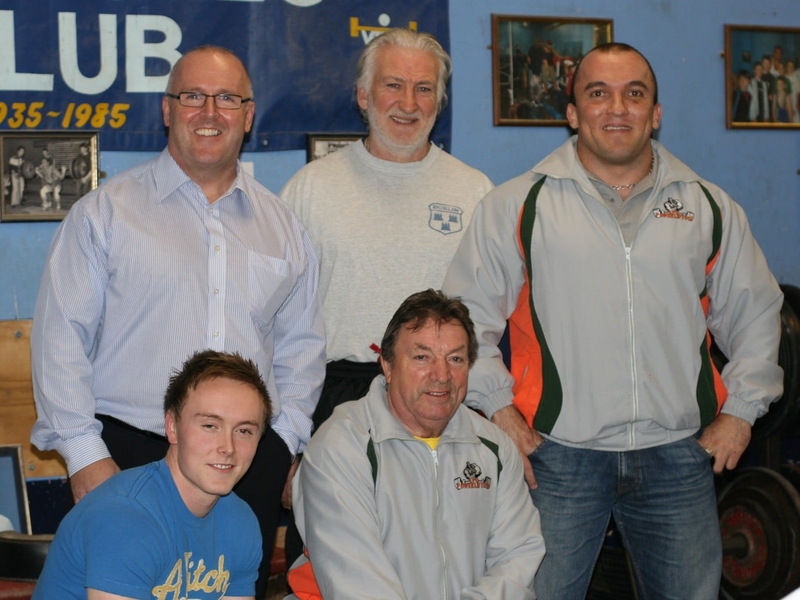
Hercules Club (established in 1935) has five athletes that will compete in the World Powerlifting Championships in Vienna from 13-16 November. They are three-time world champion David Smith, competing in the 100 kilos masters competition; two-time world champion Bernie Delaney, competing in the 90 kilos open; Martin Dillon also masters, 90 kilos class; 63-year-old Billy Kidd, competing in the masters 75 kilo class and David’s son Ger Smith, an under 23-junior, 75 kilos class.
So what is powerlifing exactly and how is it different to weightlifting. The sport consists of three lifts; the squat, the bench press and the dead lift. Each competitor has three different attempts on the platform at each discipline. The competitor must get at least one attempt from each discipline, the best goes towards a total; the athelete must get at least one attempt of each discipline.
 To give you an idea of the weights these guys lift: Delaney lifted 300kgs squat, 245kgs bench and 307.5kgs deadlift at the 2006 World Championships; David Smith hopes to lift 340kgs squat, 235kgs bench and 280kgs deadlift at the forthcoming World Championships.
The principal of powerlfiting is that it covers the whole body; weightlifting is a lot of legs and shoulders.
Weightlifting has probably a little bit more flexibility than powerlifting, powerlifting is a lot more brute strength but it covers the whole body.
The squat covers the leg and some of the back, while the bench press covers mostly chest and some shoulders, the dead lift covers mostly back but there are some legs involved in that. The whole body is worked in full competition.
As I entered Hercules Club I was greeted by Bernie Delaney and David Smith, two men clearly bursting to share their powerlifting experiences. Smith is hugely succesful (World Champion 2004, ’05, ’06) and no doubt an unoffical leader and icon in the sport here in Ireland, however, he fell into the sport as a younger man; almost by accident.
‘I broke my leg about 27 or 28 years ago and there were plates  and pins put in it, after a year they took them back out. The physiotherapist told me to join a gym to build the muscle back up and it snowballed from there basically.
‘I got into the weights and then into just general bodybuilding type fitness. Then I found out I could lift heavy weights more than other people in the gym so that really got me going,’ David tells me.
The man is a collossus in the sport and the love he has for the sport has been passed down to his son, Ger. In his early twenties, Ger appears somewhat of a poster boy for the sport. He has old school Brian O’Driscoll-type blonde hair, an African-style earring and an easy manner. Like other sporting families, he was inspired by his father to start the sport and revels in powerlifting competition.
 Ger explained: ‘I suppose it would be my father started me off. I started training for general fitness as well, but I take after my Da mostly, I think I have his genetics in that I am stronger than most people my age and he gave me the inspiration to do it you know.
‘I dabbled in a bit of rugby, football - but this is my forte. I train four days a week and sometimes I would do an extra work-out, but a minimum four sessions a week. The work-outs vary, they could be two hours or 45 minutes.’
It is a hectic schedule and one not for the faint-hearted or those lacking commitment. It is also very important to ensure your days off are used as physical rest days, as double world champion (2005, ’06) Bernie Delaney spelled-out: ‘With powerlifting, you have every other day off. Each day off is just as important as every training day.
‘You would only do one body part a week. On a Friday you would do your legs and then leave it a week before training your legs again.
‘Even the last few weeks coming up to a competition, you would probably only train three days a week; because the weights get bigger, the poundages get bigger and recovery time is paramount.
‘The last week and a half before competition you wouldn’t train at all, as it’s all about keeping yourself fresh for competition.’
So many sports in this modern era are dogged by drugs and cheats; cycling, athletics, swimming and many others have had to instigate doping witch-hunts to protect the good name of their competitions. In Hercules, the emphasis is on clean competition, on competing fairly and being an honourable and drug-free sportsman.
Veteran lifter Martin Dillon elucidated this: ‘By going to Vienna we  hope to encourage the young lads (in general) and the young lads in the club to compete cleanly. We are going out there to show young lads you can go out and compete, get involved and do it without drugs.’
My initial thoughts on powerfliters would be that they would plough themsleves full of bucket loads of creatine and any muscle mass supplement legally available, but this is also not the case. Diet, is also very flexible for these athletes.
 The chatty and relaxed Bernie Delaney explained: ‘It really depends on your weight class, I eat a lot of protein but I eat well - I eat a lot of food. And the only time I would really watch my diet is coming up to a competition.
‘I am like a boxer, I have to compete in the 90 kilo class, so I would have to weigh 90 kilos or under. Generally, it is better to train heavier than you compete, but in the last four weeks I have dropped eight to ten kilos in order to compete.
‘I eat five to six to seven times a day with protein and also carbohydrates are very important; the only days I would eat very clean is the last four or five weeks before competition.’
Ger Smith explains to me that there are supplements required, however, and what he takes: ‘There are a lot of new supplements on the market; mostly what I would take is protein supplements. At college and work, trying to get the meals in is difficult, so protein shakes fill in the gaps, two, three, four scoops a day.
‘Training days are different, you try and eat a bit more carbohydrates. So there you are going into more supplements in the sense of mogdextrin, waxy maze starch – they are carbohydrate based and give you a lot of energy. Other than that I take creatine for four weeks out from competition.’
So, four or five training sessions a week, seven meals a day plus protein boosts. It’s certainly not cricket and I ask David Smith if this has any strain on his family life.
David Smith: ‘With two powerlifters in the family (his son Ger and himself), it’s very difficult on the wife. Now Gerard in fairness cooks his own meals but my demands are a bit more; she is very good though.
‘She knows the sport, has been with it for 20 years but would rarely come to a competition; she just let’s us do our own thing. As far as I’m concerned we’ve no problems with powerlifting in our house anyway.
‘After work I’ll come straight down to the gym. I’ve been doing this for 27 years. I did gymnastics, gaelic, soccer and basketball before then.’
Ger is what every sport looks for and tries to market in these halcyon days for sport advertising - young, good looking and talented. Being a powerlifter lends him prestige amongst his circle of friends too.
‘I have a lot of friends who play rugby and they come to me looking for advice on how to be strong.
‘I can’t tell them how to play rugby but I can tell them how to be strong. In that respect they are able to come to me. They enjoy hearing what I’m doing and vice versa,’ he explains.
With more and more protein supplements on the shelves and training regimes filling the pages of men’s magazines, I ask former world champ Bernie what he would recommend to amateur weights enthusiasts to strengthen their abilities.
‘With the squat, the main focus is on your legs and your back, coz you need to be very strong there. You need to train your legs as much as possible. That comes with leg squats, curves and extensions.
‘A lot of people ask me how would you improve your bench, to me, the advice I would give you is bench, bench and more bench.
‘There is a certain amount of assistance you can do but a lot of the work is just practice on the bench, with poundages and all that. A lot of free weights, most powerflifting, you use some machines.’
Clearly there are huge demands placed upon the body and mind during lifting and competition day is incredibly draining.
Bernie described the event: ‘You warm up for the squat, you squat, you go straight into the bench and warm up for the bench, and as soon as that’s finished you warm up for the deadlift.
‘Basically, you are lifting non-stop solid for the three and a half hours. It’s exciting but it’s a relief when its all over. To do it all in one day, the next day, the next week, after competition you feel like you had been hit by a car. It’s hard but its great.’
The other key element to powerlifting is keeping a close eye on competition.
David Smith expounded: ‘You have to see what the opposition are doing as well. What they are lifting and doing, it may come at the end, that all you need is two and a half kilos to win, so you have to know whether you need two or 20.’
 Coach Patsy Convoy said: ‘It’s like football, you keep any eye on the opposition, so you have to advise your athlete the best way to compete. I am watching the weights and what they are taking from the start of competition.’
Like any sport, injuries do occur and while they can be just niggles, these men are optimum athletes who are at risk of far more serious injuries.
Ger said: ‘I tore my pec(toral muscle) which went into the insertion of the bicep, I picked it up in February; I did a lot of therapy and physio and I’m back on track for the World Championships.’
Bernie Delaney has been very badly affected over the years: ‘I’ve never been into a competition where I’ve never been carrying a small injury. Good technique will play a role in avoiding injuries. If you develop bad technique and form throughout the years you probably have more of a chance of being injured than someone with good technique.
‘I’ve had two bad ones, I tore my quad this year, I was out for about two months with that and I did my back not too long ago and I was out for three weeks with that. I’ve had four hernia operations and a cortisone injection in my wrist, the rest is just rehab and physio.’
However, injuries are not always the norm, as 63-year-old  masters competitor Billy Kidd explained to me: ‘I am sixty-three and training all my life. I am very happy with it. I never get any injuries at all. I’m lucky in that respect.’
Pain and gain are the balance of power that these men weigh up every day in training and competition but of course, victory is the nectar that keeps them battling through injury and pain.
David Smith said: ‘The first time time I won was five years ago in Atlanta, 2003. After 24 years of training, to win the world title was fantastic; I think the first thing I did was to ring home and tell everyone I did win the World Championships.
‘I think the best thing was to to have the Irish flag flying and the national anthem playing, I normally see that on TV and to have that for me, was absolutely fantastic.
‘So the first time was probably the be all and end all. The first time that you win is always the best.’
Bernie Delaney added: ‘It’s an honour. Unfortuntately, we don’t get much recognition in the country. More people would probably know myself and Dave outside the country than in the country.’
Until (and if) powerfliting becomes an Olympic sport, Hercules Club and any others like it won’t receive any government funding and will remain in the same situation financially as they were in 1935.
However, the attitude of the members impressed me. They did not begrudge the fact they had no funding but instead displayed a resolve to use their own resources well. In this respect Hercules is self-run and financed; members work as volunteers in running the club. Every penny they get from subscriptions is spent directly on the club. It’s a non-profit organisation and the committees are elected every year.
Coach Patsy Convoy explains: ‘It’s a good club, very good atmosphere. There is more advice here than you get in any gym with a hundred staff members. You have a lot of experience, from powerlifters to bodybuilders, to marathon runners, to extreme marathon runners to hammer throwers. Nick Sweeney, John Menton, Terry McHugh, Phil Conway trained here.’
The five athletes head out to Vienna on Wednesday. They will hope to come back as World Champions.
Click below to visit the Hercules Club website:
To see Ger Smith in action log on to his videoblog:
RTÉ.ie is not responsible for the content of external websites.
