


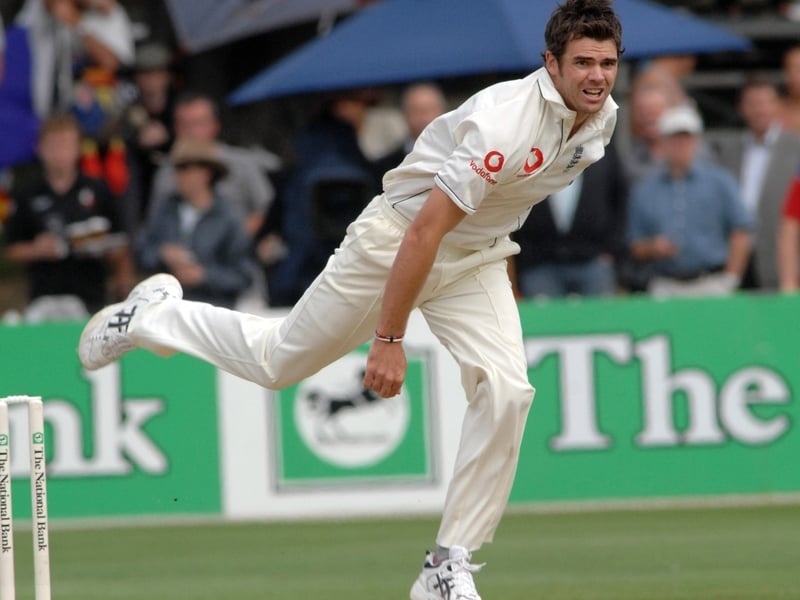
England's decision to retain a young and vibrant attack paid dividends after they exploited seamer-friendly conditions to plunge New Zealand into trouble in the opening Test at Lord's.
England kept their faith in the line-up that had won the last two Tests on their tour of New Zealand rather than opt to recall the experience of Yorkshire seamer Matthew Hoggard.
It was a decision fully vindicated with James Anderson claiming three wickets and Stuart Broad claiming a further two before a defiant innings of 97 from Brendon McCullum guided the tourists to 208 for six when bad light ended play after just 52.1 overs.
Captain Michael Vaughan had used his pre-match press conference to challenge his young attack to deliver the type of performances which would condemn the likes of Hoggard and Steve Harmison to a lengthy spell on the county circuit waiting for a recall.
It was a message which galvanised both Anderson and Broad into superb early spells and left New Zealand reeling on 76 for four after England once again exposed the inexperience in their top order.
Entering the Test with just 51 caps between their top six - including McCullum's 32 - New Zealand were always liable to struggle if England's attack found the right line and lengths.
That was exactly how it proved with debutant Aaron Redmond unaccustomed to such high-class swing bowling and lasted just five balls before edging a short delivery from Anderson low to Alastair Cook at third slip.
Anderson followed that early success by removing the other opener six overs later with Jamie How edging an outswinger behind while he could have had a third early wicket with James Marshall being caught behind off a no-ball.
Lancashire seamer Anderson should also probably have run out Marshall following a mix-up with Ross Taylor over a quick single, but missed the stumps with the batsman stranded at the other end.
Those reprieves failed to cost England, however, with Broad entering the attack to remove the dangerous Taylor, who had clearly taken a view that conditions were too treacherous to bat cautiously and went on the attack.
He raced to 19 off 20 balls before mistiming an attempted pull off Broad and allowing Paul Collingwood to run back from slip to take the catch while Marshall's determined innings was ended with an edged push to slip.
Facing potential embarrassment, New Zealand found a willing saviour in McCullum, who curbed his naturally aggressive style to try and salvage a competitive total.
He was kept company for eight overs by Daniel Flynn, the second debutant in the tourists' line-up, but once he was bowled off his pad by Anderson the responsibility fell on McCullum's shoulders.
England knew all about his powerful hitting after his stunning one-day performances against them earlier this winter while he recently lit up the Indian Premier League by hammering 158 off 73 balls for Kolkata Knight Riders against Bangalore Royal Challengers.
This, though, was a more restrained McCullum in partnership with all-rounder Jacob Oram, who reached the tea interval having reached an unbeaten 36 off 54 balls.
But immediately after the interval McCullum came to life and quickly began accelerating towards reaching a Lord's century, which was denied him by just four runs back in 2004.
Left-arm spinner Monty Panesar was launched down the ground for his first six and Broad was also picked up, this time over long off, in the next over to clear the ropes and move him into the 90s.
With his century in sight, however, McCullum perhaps became too anxious to reach three figures before the bad light closed in and attempted to clip Panesar off his legs for the boundary he required.
On this occasion, McCullum mistimed his stroke and the ball bounced off his pads and onto his stumps to leave him stranded on 97, having hit 13 fours and two sixes in his 97-ball innings.
His acceleration had been frightening having added 61 off 42 balls after the tea interval, and was a timely breakthrough for an England attack who had lost their way during his assault.
It also tipped the scales firmly in England's favour and probably left McCullum regretting his rush of blood to the head with bad light being offered and accepted just two overs later to halt an opening day's play already disrupted by early morning rain.
