


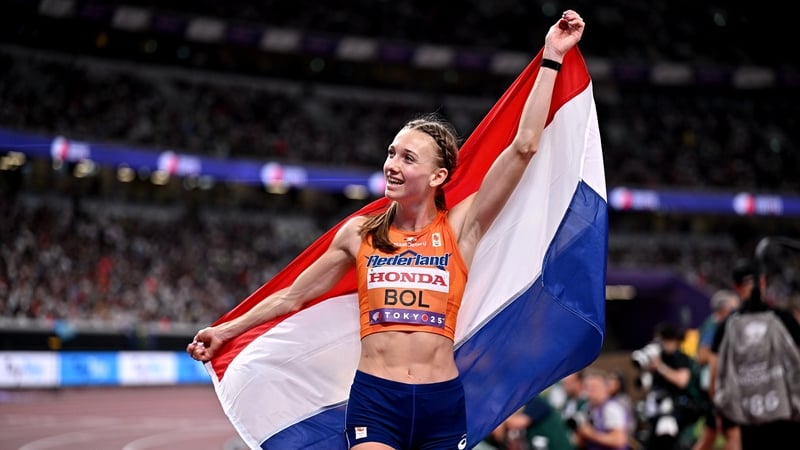
One of the most annoying questions long sprinters get asked, seemingly since Hamlet was written, is: "Have you thought about moving up?"
But it clearly didn't annoy Femke Bol who is about to commence her foray into the 800m event at the World Indoor Tour meeting in Metz, France this afternoon.
Today's meet in the north of the France will indicate whether Bol's switch to the middle distance event - though some call it a 'long sprint' - will justify all the hype.
Bol holds impressive personal bests of 50.95 for the 400m hurdles, 49.17 for the flat event and 1:05.63 for the lesser run 500m.
In October, just a month on from winning gold at the World Championships in Tokyo, Bol announced her intention to move up in distance and the athletics world was abuzz imagining the scintillating match-up with 2024 Olympic 800m champion, Keely Hodgkinson.
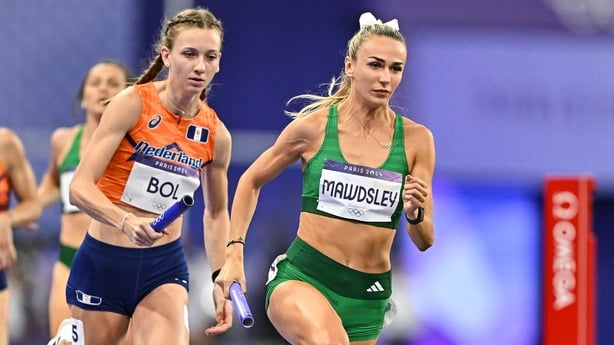
That mouth-watering head-to-head will come quicker than expected, with Bol now confirmed as an entry over 600m in Lievin on 19 February, which seems a more level playing field for their expected rivalry to begin.
Hodgkinson, the world record holder in the non-championship distance, will open her season in the northern French town, and if not firing in all cylinders could struggle to stay with Bol who has reportedly run close to Hodgkinson’s record in training and has superior 400m speed.
Bol, no stranger to hurdles of a literal sort, now has to manage the complication of an extra lap, a bit more physicality and a change of physiological profile to ensure she is ready to handle the additional distance.
Doubling the distance is harder than it sounds. There is a significant increase in the aerobic component of 800m running compared to 400m, especially in women.
Studies indicate that there may be a 25% increase in the contribution from the aerobic energy system for females moving from 400m to 800m, but it seems likely that Bol and her coach are well aware of the difference and will have planned accordingly.
The main question will be, is just over four months enough time to develop that additional 20% that may be required to meet the mark over two laps, or in this case, four under a roof?
Bol has stuck by long-term coach Laurent Meuwly, who hinted to media after the announcement that the pair were going "all in" with the plan to race the longer distance.
Her endurance-based training may mean she is better suited than most to make a successful transition.
Several high-profile female 400m hurdlers have attempted the two-lap race, but world heptathlon champion Anna Hall, admittedly not a specialist, is among the most impressive in recent years clocking a 2:01.23 for the 800m with a best of 54.42 for the hurdles event also to her name.
The journey of Anita Horvat, unlikely to have registered with Irish audiences, offers an interesting insight into how quickly the rise to fast times can happen for ex-sprint specialists.
Originally a 400m and 200m runner, the five-time Slovenian record holder made the final of the women’s 800m at the World Championships in Oregon in 2022, her first appearance on a global level in the event.
Horvat then went on to run 1:58.70 in 2023, not an earth-shattering time by the event’s current standards, but one that would consistently make global finals and European podiums over the last ten years.
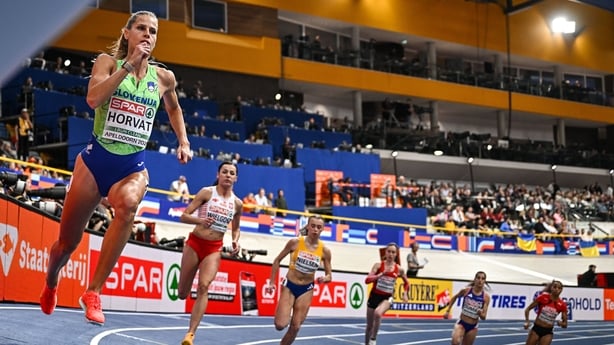
She went on to make the podium at the European Indoor Championships in 2023 and again in 2025, which may help to confirm the suggestion that short track 800m running may be more suited to those who were 400m specialists in another life. Where a sharper start is advantageous.
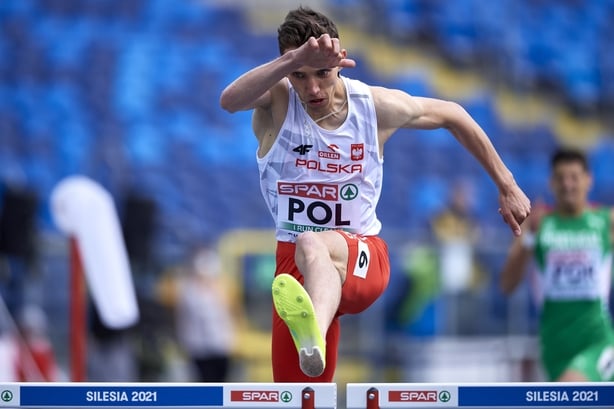
Polish athlete Patryk Dobek is a male 400m hurdler who made a seemingly quick and successful transition.
Dobek won gold at the European U23 Championships in 2015, making a world final the same year, before becoming a senior European Champion over 800m indoors in 2021 and adding Olympic bronze five months later.
Since then, his form has faltered, but his sudden change of events after the 2020 season, with little transition may show that Bol's "all in" tactic is possible.
If a mere world finalist - at least by Bol's standard - can win an Olympic medal 12 months later, then the Dutchwoman's potential is off the charts.
While flat 400m runners may choose to transition out of the event the complexity and technical nature of hurdles may mean that is a difficult balancing act.
In an interview with the Dutch national broadcaster NOS earlier this month, Bol stated there was a chance she may never run the hurdles event again, but the flat race will likely still be in her locker especially for relay opportunities.
Sydney McLaughlin-Levrone, the 400m hurdle world record holder and Olympic champion, who also claimed the flat event global title in Tokyo, announced this month that she was expecting her first child.
This understandably leaves the hurdles wide open for the inaugural World Ultimate Championships in September, where there could be no McLaughlin or Bol topping a global podium for the first time since 2019.
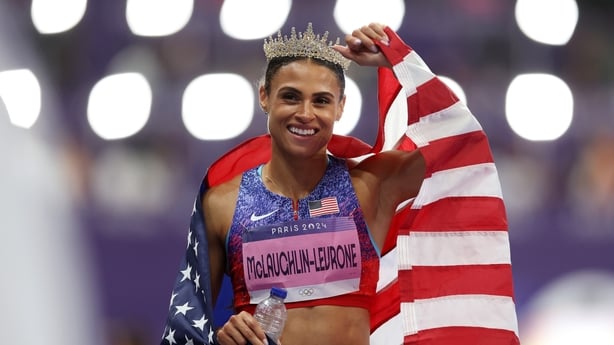
Although Bol holds a wild card entry for the event, she has stated she intends not to take it up, the "all-in" mantra being sang from both coach and athlete’s hymn sheets it seems.
Speed won’t be a concern for Bol, who’s 49.17 clocking for 400m indoors is also a world record, but controlling that speed in the opening lap will be.
Run too fast in the opening 200m and even with her sprint prowess, there could be Bambi legs on the home straight, which we have seen from Bol before in her famed face-plant finish on the final leg of the mixed 4x400m relay in Budapest in 2023.
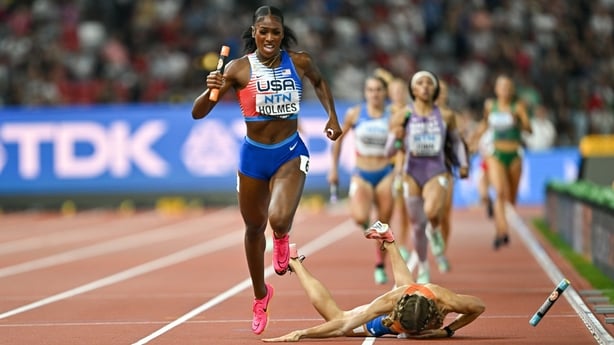
Videos emerged on Friday of the Dutch athlete completing a pre-meet training session in Metz, where use of the venue’s wave light pacing technology were in action specially for her training session.
Speed control is clearly on coach Meuwly’s mind given the use of the technology for the run shown in the video, and his shouts of encouragement that can be heard in the background.
Roughly, from the less than 100m shown, Bol looked to be running at 1:54 pace. Some 56 seconds through the first 400m may be the requested split, hence practicing at that clip, but no word on the pacemakers’ orders from official channels yet.
Final preparations ✨
— Owen (@_OwenM_) February 6, 2026
Femke Bol 🇳🇱 is in Metz, preparing for her professional 800m debut on Sunday!
⏰ 5.46pm CET
📺 European Athletics Website
🎥 Olivier Lardy pic.twitter.com/GmT9hRk71g
The 25-year-old’s personal best of 2:19.51 from 2017 won’t be hard to beat, but just how fast can she go?
With so much attention on the official debut, there may be some disappointment if two minutes isn’t broken, but as with most things, time is the most important ingredient, both for viewer interest and patience required in letting Bol grow into the event.
Wild numbers have been thrown around as to what is possible for the triple individual European champion.
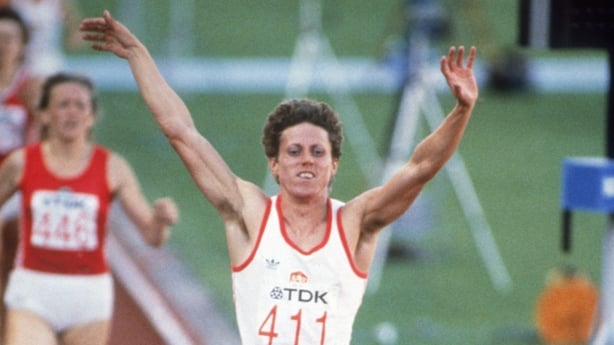
Challenging the long-standing world record of 1:53.28, set by Jarmila Kratochvilova in 1983, has been suggested.
Kratochvilova claimed the 400m 800m double in 1983, and has a personal best of 47.99, in the former, just over a second quicker than Bol.
For the first race, a sub two-minute clocking at a minimum might be a considered a modest start for Bol based on her pedigree, 1:59 low is possible but will be totally dependent on pacing and preparation.
Even a 2:01 or 2:02 today would be a solid start, just not the fireworks people are expecting.
As this author knows all too well, the wheels can easily come off in the final 200m if pacing isn’t sound.
Staying switched on mentally between 400 and 600m is also key to a positive indoor experience, which can at times be hard to crack.
Regardless of the first outing, this venture of Bol’s will keep athletics fans engaged with some much-needed excitement in a sport where novel scenarios like this are few and far between.
And much to the dismay of 400m runners everywhere, the question of "when are you moving up?" may only increase tenfold if her feat is successful.
