


To listen to RTÉ.ie's radio and podcast services, you will need to disable any ad blocking extensions or whitelist this site.

0
00:00
00:00
Episode Notes
Derek Mooney presents a special programme examining the inextricable link between humans and house sparrows, how the development of early agriculture led to sparrow settlements in Ireland, and why ringing sparrows can help us monitor their populations. We find out how a Dutch domino attempt proved to be fatal for one sparrow, and the reason that Mao's Great Sparrow Campaign was so catastrophic for both sparrows and the Chinese people. We learn about sparrow 'dust baths', why the "Cockney sparra" may well become a thing of the past, and we find out how ornithologists in Northern Ireland are working with farmers to help conserve house sparrows...
The house sparrow was once such a common and familiar bird to people all over Ireland that it needed no introduction. Often overlooked or considered "drab" or "boring" – the quintessential "dull little brown bird" – house sparrows are actually rather attractive birds when viewed at close quarters.

A Female House Sparrow (Photo: Michael Finn / BirdWatch Ireland)
Both sexes have chestnut-brown backs and wings, streaked with black, contrasting with light dusky grey bellies and cheeks. The female has a fairly plain head, with a brownish crown and a beige stripe curving back behind each eye.

A Male House Sparrow (Photo: John Fox / BirdWatch Ireland)
The male is altogether more showy. The chestnut of his back extends up his neck on each side of the head in a broad curl to meet the eye, bordering a contrasting patch of grey on the very top of his head. The eye itself is surrounded by a thin black "mask" that runs forward to meet the short, stubby, conical bill: the distinctive bill of a seed-eater, that has evolved to crush the strong husks of wheat, oats and other grain. The male’s bill is yellowish-grey during most of the year, but during the height of the summer breeding season it turns jet black. Most striking of all, flaring out from the chin to the middle of the breast, the male house sparrow sports a large black "bib", more extensive in some individuals than others.

The Male House Sparrow's Black 'Bib' (Photo: Neil van Dokkum / BirdWatch Ireland)
The extent of this beard-like black patch is controlled by the amount of the hormone testosterone in the sparrow’s body: the more testosterone he has, the larger the patch and the more aggressive and dominant he is. It shows his rank in sparrow society, and also plays a large role in his attractiveness to females: the bigger, the better, as far as the ladies are concerned!
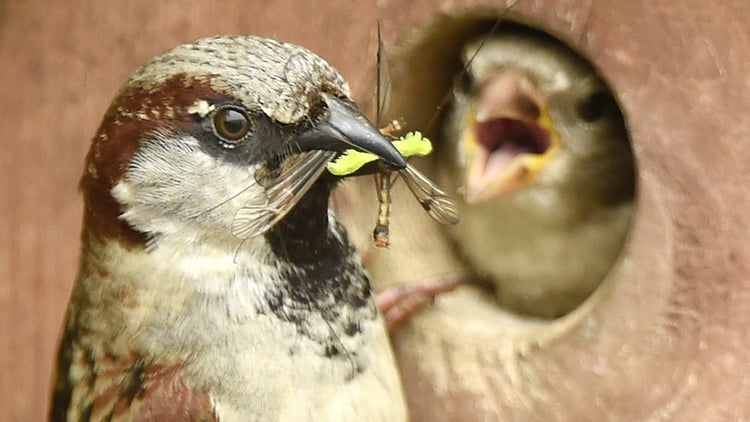
A male sparrow returns to the nest box with food for the chicks but the female blocks his entry (Photo: Tony Margiocchi/Barcroft Images / Barcroft Media via Getty Images)
More distinctive than the house sparrow’s appearance, however, is its behaviour. Most of our songbirds are highly territorial, at least during the breeding season, with males singing aggressively to defend the best possible nesting territory from their rivals. House sparrows are quite different. They much prefer to nest colonially, in large flocks, without any clear territorial boundaries between pairs. They have far less need than other songbirds for vocal prowess, therefore, which is why their song is so basic: just a simple "chirp . . . chirp . . . chirp".
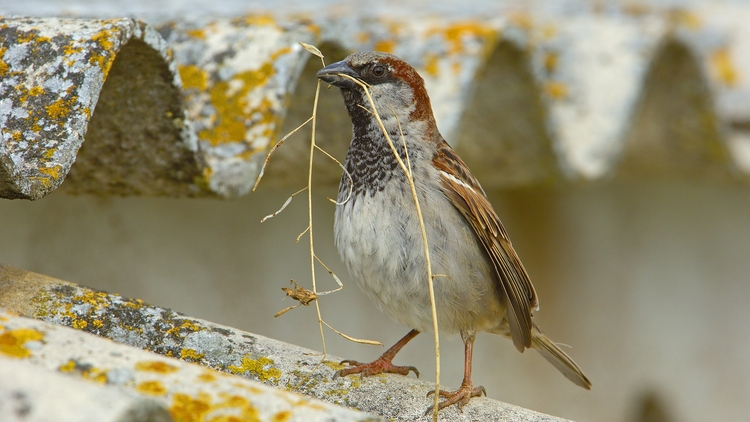
House Sparrow (Photo by: Education Images/UIG via Getty Images)
There is another aspect of house sparrow behaviour that sets them apart. Of all bird species, this is the one that appears to be most dependant on human activity for its survival. Across its wide range, it is almost always found in close proximity to man, taking advantage of the food we make available and nesting in and around our dwellings: the name "House Sparrow" is a very apt one.
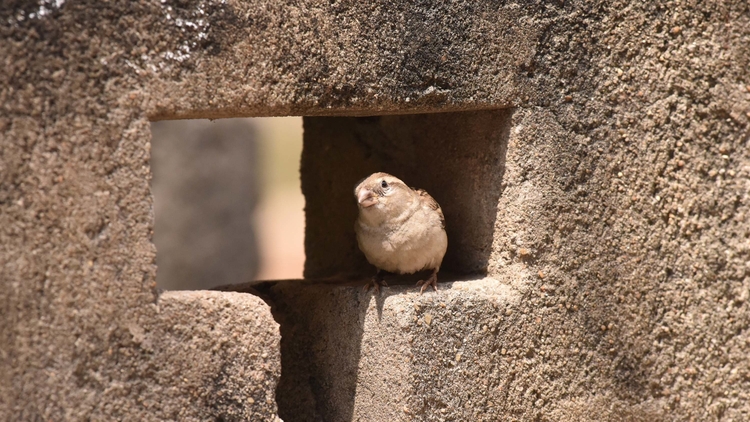
House Sparrow (Photo: Anuwar Hazarika / Barcroft Images / Barcroft Media via Getty Images)
Before Homo sapiens came on the scene, nesting sites for house sparrows, and therefore the number of sparrows themselves, were much scarcer. Today, they strongly favour building nests inside cavities in man-made structures. Gaps between bricks, holes under roof-slates, spaces formed behind gutters and drainpipes: they are not fussy. If they can find a suitable opening they will take advantage of it. We can tell quite clearly that this habit, indeed compulsion, for nesting in human buildings is one that developed quite recently in evolutionary terms.
Niall Hatch is Development Officer with BirdWatch Ireland. A keen observer of sparrows for many years, he met up with Derek on New Row Street, close to St. Patrick's Cathedral, to show him why it is one of the best places to find house sparrows in Dublin...

Dr. Ronan O'Flaherty (l) with Niall Hatch (r) at Ferns Priory in Wexford
A new type of stone-age farming society reached Ireland around 4,000 B.C., which featured long houses and a grain-based economy. Around 2,000 years later, the sparrow followed. Dr. Ronan O’Flaherty is an archaeologist and heritage expert based in Wexford, and is the lead consultant for all cultural heritage projects with Crane Bag Consulting. He met up with Niall Hatch at the monastic site of Ferns Priory, where he explained that monastic sites such as this played a pivotal role in the development of agriculture, and where the grain was, the sparrows followed...

Niall Hatch (l) with Bláthnaid ní Chofaigh (r)
Our gardens are in increasingly important haven for the species. The radio and television presenter Bláthnaid ní Chofaigh has a healthy population of sparrows in her suburban Dublin garden. She invited Niall Hatch out to her Monkstown home to ask why in the hot weather, the house sparrows who call her garden home have been taking "dust baths"...
An example of a house sparrow taking a dust bath
Keen to discover more about the association between house sparrows and town gardens, and to learn about efforts to monitor the species and its fortunes in Ireland, Niall Hatch met up with bird ringer Sean Kingston, who rings sparrows in his parent's garden in Templemore, Co. Tipperary...

Sean Kingston
For further information on BirdWatch Ireland's Countryside Bird Survey, click here, and for more information on the Bird Atlas 2007-2011, click here.
Sparrows are related to an African and Asian group of birds known as the weavers and, like them, they weave domed globe-shaped nests out of dry grass, usually in trees and bushes. These roofed nests provide extra protection both against predators and the elements: they take more time and effort to construct than a regular basket-style nest, but for most sparrow species, nesting in relatively exposed conditions, that extra hassle is worth it.
For the house sparrow though, it is not worth it at all. They nest inside secure, dry cavities in brickwork and other solid structures, yet still they pointlessly build a domed roof over their nests. They do this because their genes tell them that they must: evolution appears not yet to have caught up with the species’ recently-altered nesting behaviour.

Male House Sparrow (Photo: Ronnie Martin / BirdWatch Ireland)
In London, one of the birds most closely associated with the city is the sparrow. According to the RSPB, "the cockney sparra has lived alongside us for hundreds of years and was once a regular fixture in our London gardens, parks and squares. It was so beloved by Londoners that it was incorporated into cockney rhyming slang - bow and arrow." In recent years though, the number of sparrows in the English capital has been in decline - 68% of the city's sparrows were lost between 1994 and 2000. In 2002, the RSPB and London Biodiversity Partnership launched the 'Where have all the sparrows gone' survey. The organisations asked Londoners to report any house sparrows in their gardens or local green spaces. The results painted a sad picture, with a stark absence of sparrows in the centre of London. Ten years later, the RSPB, together with London Wildlife Trust, GiGL and other members of the London Biodiversity Partnership, ran the Cockney Sparrow Count; a repeat of the original citizen science survey. According to the RSPB, 'there's been no dramatic change, in fact the 2012 results reinforce what we found in 2002. Sparrows are more scarce in central London and increase in number as you head towards the suburbs. Interestingly, there was a very slight bias towards the east. but you'd expect that for a bird dubbed the 'Cockney' sparrow'. For more information about the results, click here.

Left: Dr. John Mallord (photo: RSPB); right: Female House Sparrow (photo: Michael Finn / BirdWatch Ireland)
Dr. John Mallord is Senior Conservation Scientist, Conservation Science, with the RSPB in Cambridge. He told Derek why attitudes towards sparrows have changed over time, and outlines some of the reasons why house sparrow populations have declined... For more information about Dr. John Mallord and his work, click here, and to read his article Testing assumptions of a supplementary feeding experiment aimed at suburban House Sparrows Passer domesticus, as published in the journal Bird Study, click here.
In the past, sparrows were often considered a serious agricultural pest in their native European and Asian ranges, often misguidedly. The most alarming example occured in China, where in 1958, Chairman Mao launched his infamous Four Pests Campaign, one of his first actions in his Great Leap Forward. The aim was to eliminate several pest species that he believed were hindering his nation's progress - and chief amongst them was the sparrow. Both house sparrows and closely-related tree sparrows were known to be serious consumers of rice, wheat and other grains and farmfields. Birds were declared Public Animals of Capitalism, and were to be eliminated.
The Chinese government mobilised virtually the whole population of the vast country, sending them out into the fields to chase sparrow flocks, banging pots and pans and preventing them from getting any rest or respite - causing the small birds to become so exhausted that millions upon millions of them dropped dead. Sparrows became practically extinct in China and the campaign was deemed a success. But without sparrows to prey on their larvae, numbers of locusts and other insects very quickly soared. A vital biological control had been removed, and the vast clouds of insects reeked far greater havoc on farm crops and food stocks than the sparrows ever could have done.

Left: the Domino Sparrow; right: Richard Collins (l) with Kees Moeliker, Director of the Natural History Museum in Rotterdam (r)
Sparrows have also suffered unjust persecution for more trivial reasons. The most notorious is probably that of the so-called Domino Sparrow, which met an ignominious and highly controversial end in 2005 thanks to its disruption of a domino-toppling event in the Netherlands. Dr. Richard Collins met up with Kees Moeliker, a Dutch biologist and director of the Natural History Museum in Rotterdam, to find out how the bird ended up stuffed and mounted on a box of dominoes...
To listen back to the MGW documentary The Domino Sparrow - Revisited, click here.

Dr. Kendrew Colhoun
People often develop a real affection for house sparrows, and thankfully a sparrow recovery may be on the horizon. In Northern Ireland, things are on the up for the house sparrow, and its close relation, the tree sparrow. Derek visited Portmore Lough Nature Reserve in Co. Antrim to meet up with Dr. Kendrew Colhoun, Senior Conservation Scientist, Reserves Team with RSPB NI. Kendrew is a firm believer in agri-environment schemes, where farmers are rewarded financially for taking steps to benefit nature. He explains why tree sparrows are doing well at Portmore, and across Northern Ireland, thanks to these agri-environment schemes... To read more about this, click here, and to read Dr. Kendrew Colhoun's article Agri-environment scheme enhances breeding populations of some priority farmland birds in Northern Ireland, which was published in Bird Study, click here.
The fortunes of humans and house sparrows are inextricably linked. No bird is so strongly dependent on us for its survival and we have a duty to make sure that it remains part of our lives. To find out more about the house sparrow, Passer domesticus, visit www.birdwatchireland.ie.
First Broadcast 27th of August 2018
Repeated RTÉ Radio 1, 21st of April 2019
Mooney Goes Wild presented by Derek Mooney airs Monday nights 10PM RTÉ Radio 1. Please visit our programme archive at the top right of this webpage for previous programmes, documentaries and podcasts. You can contact us at Mooney@rte.ie