


Panel: Richard Collins, Matthew Jebb & Niall Hatch
Reports: Terry Flanagan, Eric Dempsey & Éanna Ní Lamhna
All this week, from Monday to Friday, at 22:00 Derek Mooney and his Mooney Goes Wild team of experts are bringing you Nature Nights LIVE, a celebration of Ireland's rich flora and fauna with a special emphasis on nocturnal wildlife. This year, we are also teaming up with the Tree Council of Ireland to celebrate National Tree Week 2026.
Each night, we will share updates from events happening around the country and highlight the trees we often overlook. We will be placing a special focus on Ireland's native trees, all of which support insects, birds and mammals, store carbon and play an essential role in keeping our ecosystems healthy.
We will also hear from researchers who work after dark as nocturnal animals begin their nightly routines and we open the phone lines so listeners can ask questions directly, with an expert panel in studio ready to offer advice and insights.
If you have any nature-related queries for our panel of experts or would like to share your wildlife observations with fellow listeners you can do so in the following ways:
- By email to naturenights@rte.ie
- By WhatsApp to 087-6806206
- By text message to 51551
There was something in the air last night
Did you hear the third programme in our 2026 Nature Nights LIVE series, which was broadcast on Wednesday 11th March? Much of it revolved around the distinctive and evocative scents of nature at this time of year. Highlights included:
- Éanna Ní Lamhna pointing out some of the most distinctive natural aromas of spring, which she said is "a great time of year for smells".
- Richard Collins apparently dreaming about poo!
- Niall Hatch and his fellow panellists making the case for the creation of more National Parks across the country, in an interview with Minister for State for Nature, Heritage and Biodiversity, Christopher O’Sullivan TD.
To listen back to last night’s programme, visit https://www.rte.ie/radio/radio1/nature-nights/2026/0311/1562962-nature-nights-wednesday-march-11th-2026/.
To listen back to Tuesday programme, visit https://www.rte.ie/radio/radio1/nature-nights/2026/0310/1562716-nature-nights-tuesday-march-10th-2026/.
You can also listen back to Monday’s programme, the first in this year’s series, at https://www.rte.ie/radio/radio1/nature-nights/2026/0309/1562405-nature-nights-monday-march-9th-2026/.
Let’s go spy a kite
We love it when our listeners contact us to let us know about the wildlife they have spotted, just like Mike on his bike did recently when cycling past the RTÉ campus recently. Looking skyward, he saw a gorgeous Red Kite soaring overhead, something that would have seemed utterly impossible just a few years ago.
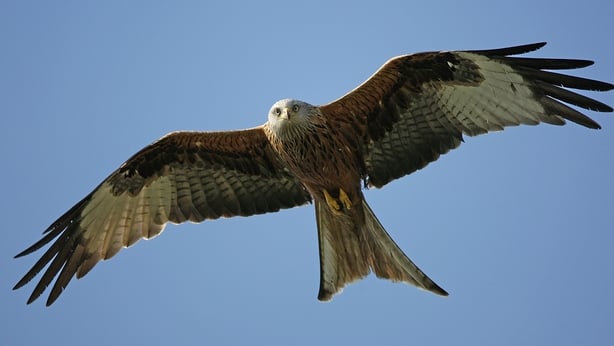
The Red Kite is perhaps Ireland’s most distinctive bird of prey, on account of its russet plumage, pale grey head and long, deeply forked tail, all features which immediately separate it from the similarly sized Buzzard. Formerly common across Ireland, until the species was shot and poisoned to extinction, these magnificent raptors have made a remarkable comeback over the past couple of decades.
The return of the Red Kite to our skies is all thanks to an ambitious reintroduction project which saw kite chicks from Wales being reared in captivity and released at key sites in Counties Wicklow, Dublin and Down.
For more information about Red Kites, visit https://birdwatchireland.ie/birds/red-kite/.
Back to the poo-ture!
We had quite the reaction to our item on excrement on last night’s programme. This was kicked off by listener Leo Mc Garry from Co. Antrim, who sent us a photo of a substantial scat – or animal poo, if you prefer – that he found in his garden. He helpfully put a pound coin beside it for scale, as you can see in the photo here.
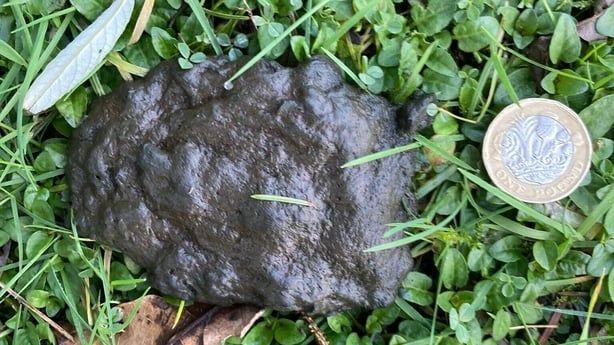
There was much debate amongst our panellists as to which creature could have produced it. Some listeners suggested it could have been a horse... how small are the horses where they come from, we wondered? Dog, cat and fox were all mooted, but as we conclude on tonight’s programme, the most likely candidate is a Badger that had been feeding extensively on worms. Lovely!
For help in identifying animal droppings, visit https://www.wildlifetrusts.org/wildlife/how-identify/identify-poo.
Celebrating the "in-between time"
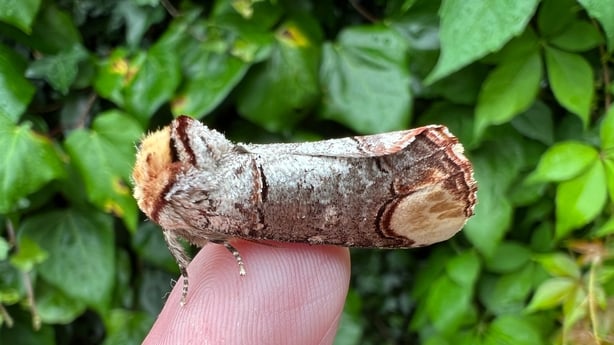
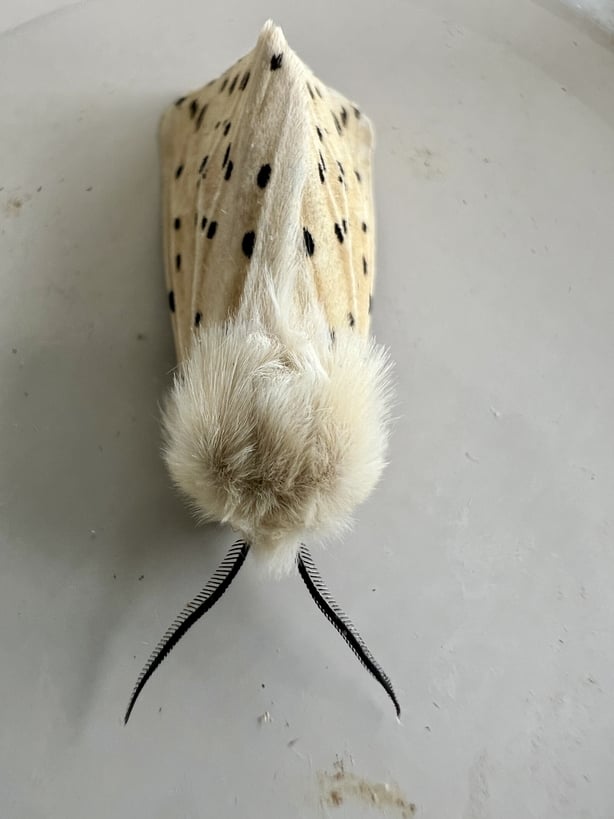
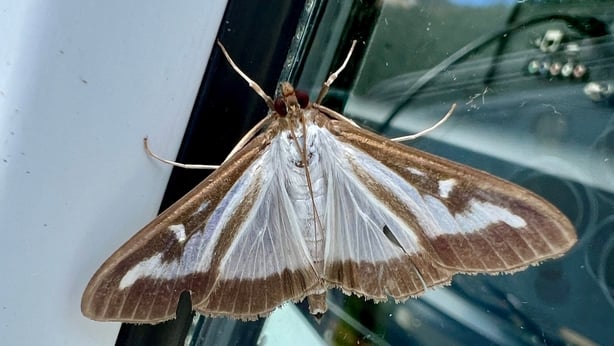
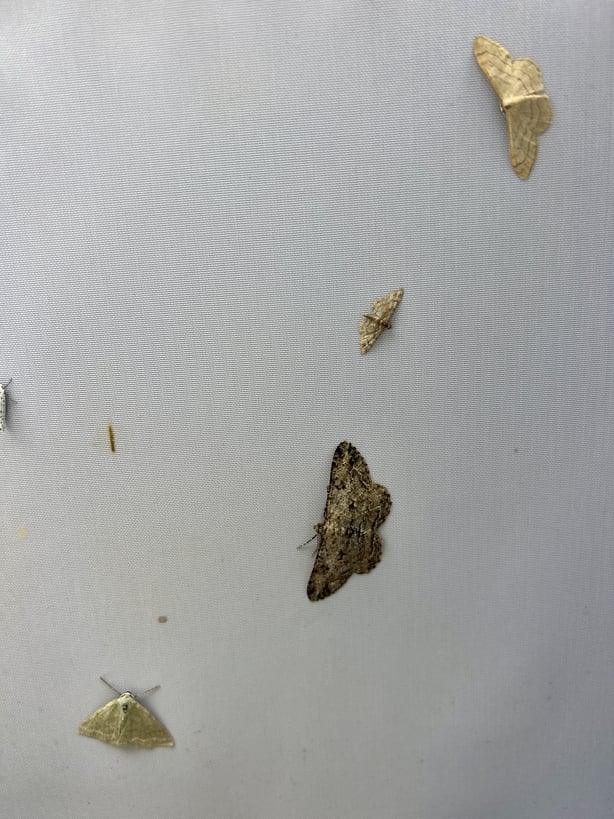
Naturalist, author and broadcaster Eric Dempsey is best known to radio-listeners as the "Birdman", but did you know that he is also extremely interested in moths? On tonight’s programme, from his home in Co. Wicklow, he and our roving reporter Terry Flanagan chat about moth-trapping.
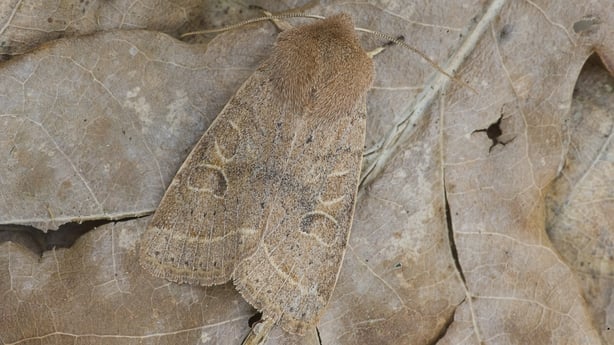
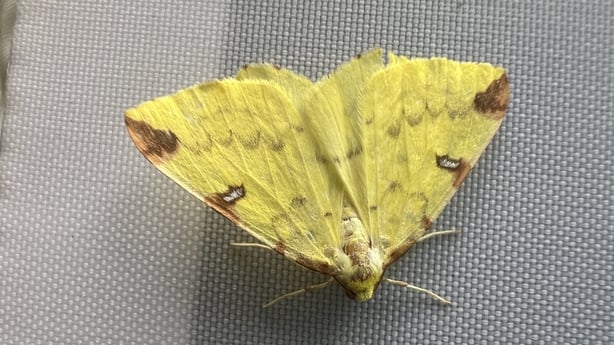
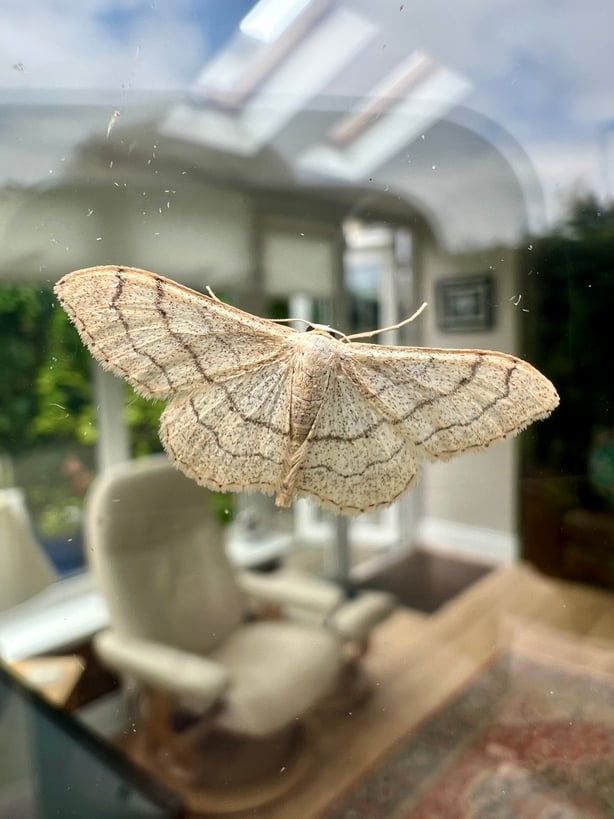
The mothing season is only beginning, and Eric and Terry had caught just one specimen – a Common Quaker – before coming on air. They were still holding out hope, however, for the real lepidopteran speciality of early spring, the aptly named March Moth, though only the males are ever going to fly into a moth trap... as the females are completely wingless!
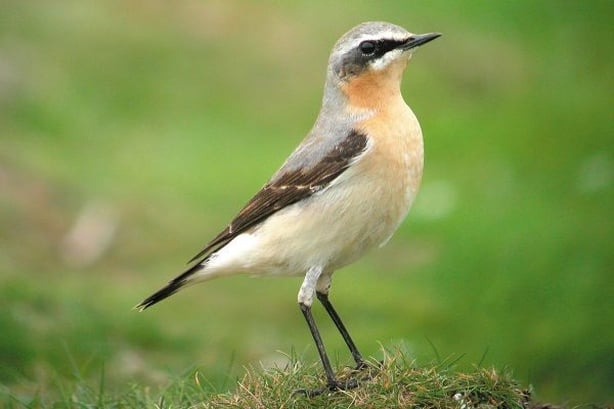
Eric describes this period of the year as the "in-between time’, which is the perfect way to think of it from a naturalist’s viewpoint. Winter species are vanishing, but the summer species have not yet arrived. They are on their way, though, and just in the next week or two our first migrant breeding birds, such as the Wheatear and the Sand Martin, will reach our shores from Africa.
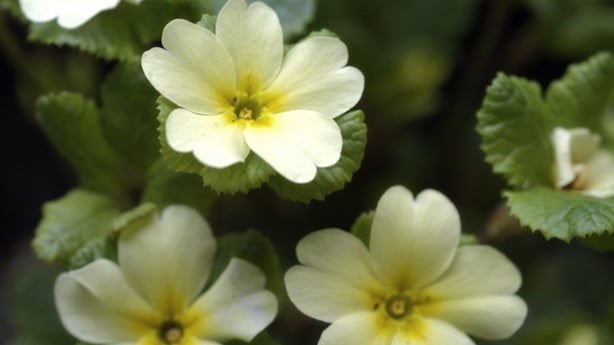
It is a time of change when it comes to plants also. Have you spotted your first Primroses of the year yet, for example? These beautiful pale yellow flowers are starting to come into bloom right now, so keep your eyes peeled.
For more information about the Common Quaker moth, visit https://www.irishmoths.net/pages-moth/m-2187.html.
For more information about the March Moth, visit https://www.irishmoths.net/pages-moth/m-1663.html.
For more information about the Wheatear, visit https://birdwatchireland.ie/birds/wheatear/.
For more information about the Sand Martin, visit https://birdwatchireland.ie/birds/sand-martin/.
For more information about the Primrose, visit https://www.wildflowersofireland.net/plant_detail.php?id_flower=214.
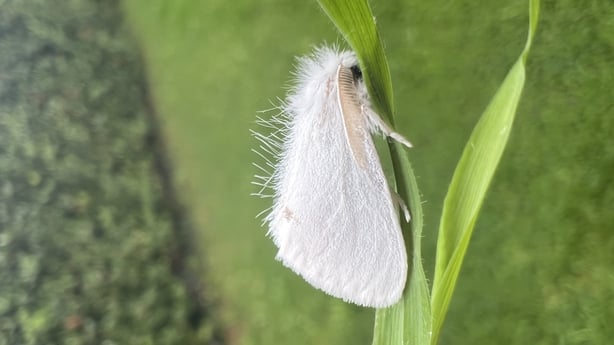
Keeping an eye out for invasive alien species
Trees and other Irish plants are constantly under threat from the accidental introduction of invasive alien species that might hitchhike with shipments of imported animal feed, stowaway on container ships from far-off lands or sneak in with deliveries of stock to garden centres and nurseries. Insects such as the Emerald Ash Borer, Colorado Beetle and Oak Processionary could wreak havoc on both our wild and our cultivated plants, should they gain a foothold here.
Vigilance is paramount, as Éanna Ní Lamhna discovered when paid a visit to the laboratories of the Department of Agriculture, Fisheries and the Marine situated at Backweston, near Celbridge, Co. Kildare. There, she spoke with plant pathologist Shane Kirk, an Inspector in the Horticulture and Plant Health Division of DAFM, about the steps being taken to minimise the threat of alien invasive species taking hold. As Shane explains on tonight’s programme, he and his colleagues conduct diagnostic tests of samples collected at ports, airports, plant nurseries and other high-risk areas. He even shows Éanna his reference collection of creepy-crawlies that need to be kept out of our country.
For more information about DAFM’s laboratory campus at Backweston and the biosecurity work undertaken there, visit https://www.gov.ie/en/department-of-agriculture-food-and-the-marine/services/laboratory-services/.
National Tree Week 2026: how to get free trees
Sunday 8th March saw the start of National Tree Week 2026, which will run until Sunday 15th March. Organised by the Tree Council of Ireland and Coillte to promote tree-planting, biodiversity and environmental awareness, this year’s theme is "Growing a Greener Future Together".
National Tree Week events are taking place up and down the country, and there are bound to be some happening near you. So, if you have ever wanted to know more about Ireland’s native tree species and the vital roles they play in our ecosystem, now is your chance.
To learn more about National Tree Week 2026 and to find details of events taking place in your area, visit https://www.nationaltreeweek.ie/.
Griffon Vulture in Spain
We have received a great many videos from Nature Nights LIVE listeners this week, and one of the most striking of all is this stunning clip that was kindly sent to us by Philip Connolly from New Ross, Co. Wexford (and formerly from Co. Monaghan), showing a stunning Griffon Vulture performing a close-range flypast.
You probably don’t need us to point out that Philip didn’t take this video in Ireland. As he tells us, he filmed it a few days ago while on holidays in the Extremadura region of western Spain – in Monfragüe National Park, a true haven for vultures and other birds of prey – and could hardly believe his eyes when the bird flew so close.
Griffon Vultures are truly enormous birds. With wingspans of up to 2.8 metres, they can soar for hours on rising thermals of warm air, allowing them to travel long distances each day in search of carrion to eat with minimal effort and energy consumption.
For more information about Griffon Vultures, visit https://4vultures.org/vultures/griffon-vulture/.
For more information about Monfragüe National Park, visit https://www.spain.info/en/nature/monfrague-national-park/.
What do plants do at night at this time of year?
Our good friend Dr. Matthew Jebb, former Director of the National Botanic Gardens, is a man who really knows his plants. He joins us in-studio for tonight’s programme and begins by explaining how in springtime a great many plants are incredibly busy during the night.
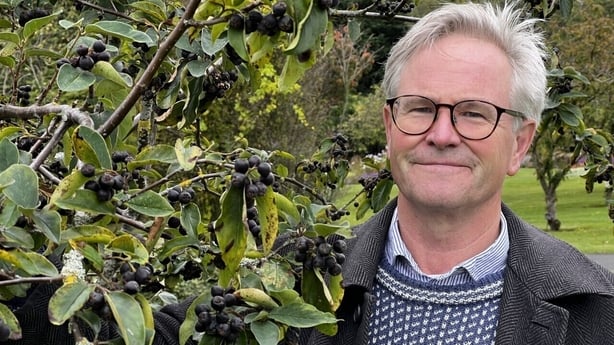
In particular, plenty of species – the honeysuckle being an especially famous example – emit great waves of scent after dark. This is done in an effort to attract nocturnal pollinating insects such as moths and midges, and it all happens while we humans are sleeping, oblivious to what is going on.
As Matthew explains, legendary biologist Charles Darwin noted that a great many moth-pollinated plants had white, star-shaped flowers that emit scent only at night. He knew of an orchid from the great hotbed of evolution that is the island of Madagascar that fitted this description, but which had exceptionally long nectar tubes. Darwin predicted that this species – the Madagascan Star Orchid – had to be pollinated by a moth, and also that such a moth would need to have an extraordinarily long tongue, or proboscis, in order to reach the nectar and be dusted with the pollen. The only problem was that no such moth had been discovered, so his prediction was dismissed by many botanists and entomologists.
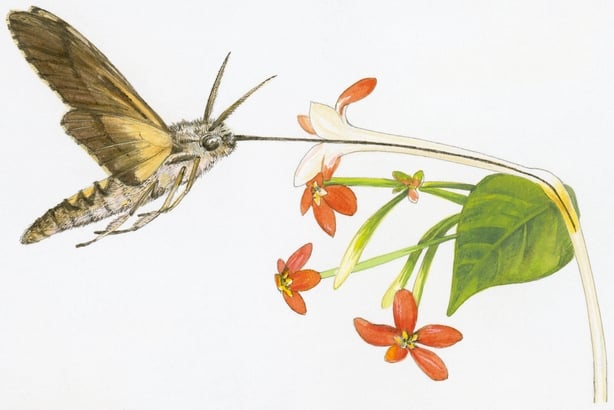
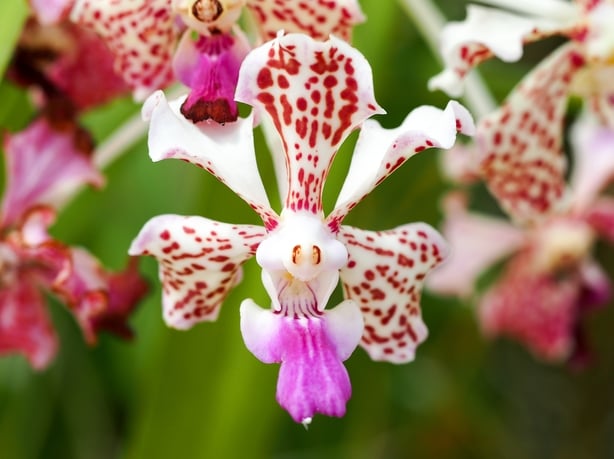
Of course, Darwin was right. 50 years later, after the great scientist had died, a moth exactly fitting that description was discovered on Madagascar. Xanthopan praedicta is an astonishing species of hawkmoth with a body length of 6-7 cm but a tongue that is 30 cm long!
For more information about Xanthopan praedicta and its relationship with the Madagascan Star Orchid, visit https://www.nhm.ac.uk/discover/news/2021/september/moth-predicted-to-exist-by-darwin-and-wallace-becomes-a-new-species.html.
Eradicating rats from Lambay
Matthew Jebb has a long-standing family connection to the island of Lambay, which lies off the coast of Co. Dublin. This island is home to extremely important seabird colonies, holding 74,000 nesting birds belonging to 13 different species, but they have a serious problem.
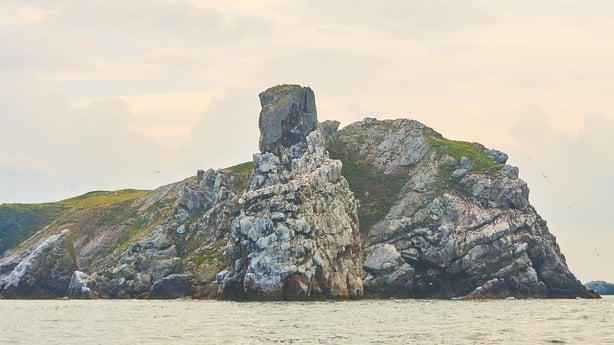
In 1918, a ship transporting livestock feed ran aground and was wrecked. Animal fodder was not the vessel’s only cargo, unfortunately; it also carried a consignment of stowaways, in the form of Black Rats, also known as Ship Rats, which quickly took to their new island home.
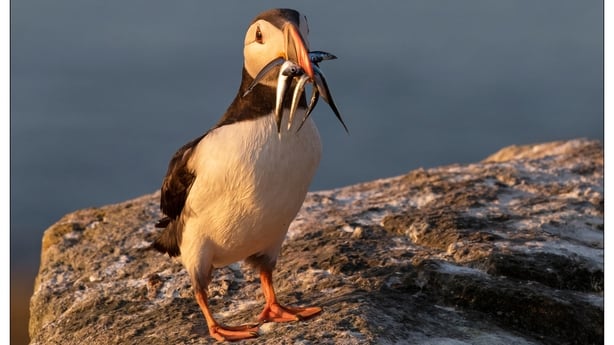
Ever since that fateful day, these invasive alien rodents have decimated breeding seabird populations on Lambay. Burrow-nesting species, such as Puffin, Manx Shearwater and European Storm-petrel, have been particularly hard-hit, with vast quantities of their helpless eggs and chicks falling prey to the rats.
But help is at hand. As Matthew tells us on tonight’s programme, plans are underway completely to eradicate the island’s rats over the course of the next five years. It will be difficult, costly and time-consuming, but if it is successful, it will give Lambay’s highly vulnerable seabird colonies and massive boost.
For more information about the plans to eradicate rats from Lambay, visit https://www.irishexaminer.com/lifestyle/outdoors/arid-41791742.html.