


Panel: Éanna Ní Lamhna, Richard Collins and Niall Hatch
Reporter: Terry Flanagan
All this week, from Monday to Friday, at 22:00 Derek Mooney and his Mooney Goes Wild team of experts are bringing you Nature Nights LIVE, a celebration of Ireland's rich flora and fauna with a special emphasis on nocturnal wildlife. This year, we are also teaming up with the Tree Council of Ireland to celebrate National Tree Week 2026.
Growing a Greener Future Together
The theme of National Tree Week 2026, Growing a Greener Future Together, reflects the power of partnership and community action in shaping a healthier, more sustainable Ireland.
At the heart of this collaboration is the longstanding partnership between the Tree Council of Ireland (www.treecouncil.ie) and Coillte (www.coillte.ie), working together to support tree planting, biodiversity and environmental awareness nationwide. We are proud to join with them, as Media Partner, for National Tree Week 2026.
Each night, we will share updates from events happening around the country and highlight the trees we often overlook. We will be placing a special focus on Ireland's native trees, all of which support insects, birds and mammals, store carbon and play an essential role in keeping our ecosystems healthy.
We will also hear from researchers who work after dark as nocturnal animals begin their nightly routines and we open the phone lines so listeners can ask questions directly, with an expert panel in studio ready to offer advice and insights.
If you have any nature-related queries for our panel of experts or would like to share your wildlife observations with fellow listeners you can do so in the following ways:
- By email to naturenights@rte.ie
- By WhatsApp to 087 680-6206 (or 00353 87 680-6206 if outside Ireland)
- By text message to 51551
Enjoying the Dusk Chorus
You can’t have failed to notice the fabled "grand stretch in the evenings", and neither have the birds. The ever-increasing amount of daylight prompts their bodies to produce hormones which put them into breeding mode, and in the case of the males, at least, that means that they start to sing. They can sing at any time of day, of course, but it is early in the morning and late in the evening when they really give it their all, hence the dawn chorus and the dusk chorus.
When coming into the RTÉ Radio Centre in advance of tonight’s programme, shortly before 19:00, our researcher Michele Browne was struck by the richness of the birdsong from the linear woodland that lies adjacent to the Fair City set. What better way to begin tonight’s programme – and this whole week of Nature Nights on RTÉ Radio One – than by listening to a bit of the gorgeous dusk chorus that she recorded specially for us. Click here to watch the video of Derek and Michele taking a listen...
For details of upcoming dusk and dawn chorus walks, as well as other birdwatching events, organised by BirdWatch Ireland’s local branches around the country, visit https://birdwatchireland.ie/events/
Getting up close and personal with an octopus
Next on tonight’s programme, we are joined by environmentalist and author Vincent Hyland, who is an expert on the coastal ecosystems of Derrynane on Co. Kerry’s Iveragh Peninsula. He takes a special interest in the nocturnal exploits of the local wildlife, and on tonight’s programme he tells us about some of his after dark encounters with moths, Long-eared Owls and Natterjack Toads.
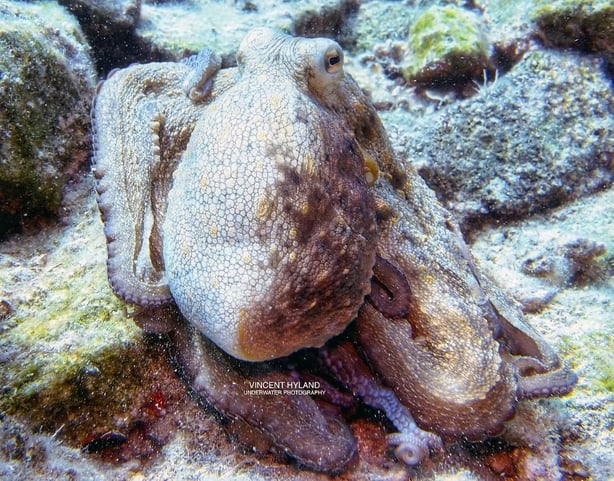
But, as Vincent tells us this evening and recounts in his wonderful book Wild Derrynane, it was under the water where he had one of his most memorable ever wildlife moments, while diving in the kelp forest off the shore of a small, rocky island called Carrigycrone. Reaching the bottom, he turned on his light, only to find himself face to face with a magnificent Atlantic Octopus. A very exciting experience, to be sure, but also a rather scary one... particularly when, without warning, the inquisitive mollusc perched itself on his head, sent one of its tentacles down the back of his neck and used another to try to pry the mask off his face! To view the octopus video, click here: https://www.vincenthylandartist.com/octopus.
To learn more about the Atlantic Octopus, also known as the Common Octopus, visit https://irelandswildlife.com/common-octopus-octopus-vulgaris/.
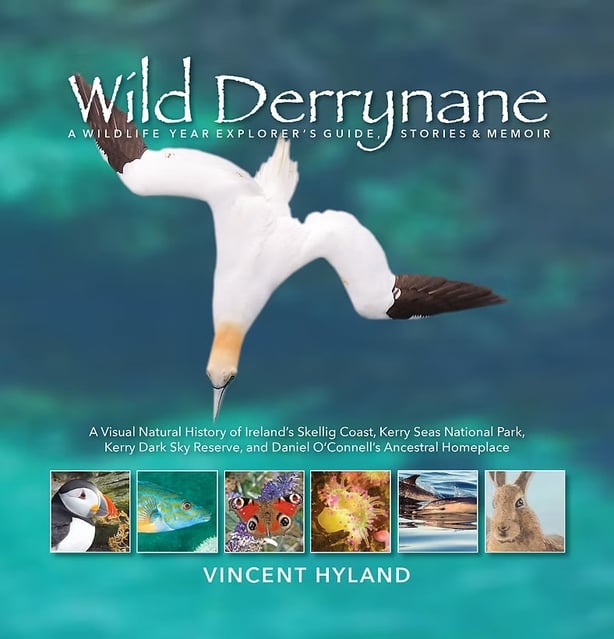
For more information about Vincent Hyland’s stunning book Wild Derrynane, a visual natural history of the Skellig Coast, visit https://www.vincenthylandartist.com/book.
Shamrock vs clover
A listener called Grania contacted the programme to say that she had been listening to Éanna Ní Lamhna discussing shamrock on RTÉ Radio One’s Liveline programme earlier today and that she had a bone to pick with her. She said that she was surprised to hear Éanna state that shamrock and clover are the same plant, as she strongly disagreed, on the basis that clover leaves have white markings while shamrock leaves are plain green.
In fact, the word "shamrock" is derived from the Irish "seamróg", which means "young clover". There are several different species of clover in Ireland, with Lesser Clover most frequently being the one to be dubbed "shamrock", though there are other contenders too. Indeed, there is still no consensus over the precise botanical species of clover that is the "true" shamrock . . . but we can, at least, say that is actually is a clover.
To learn more about shamrock, visit https://greensodireland.ie/2021/03/17/the-humble-shamrock/
Launch of National Tree Week 2026
Sunday 8th March saw the start of National Tree Week 2026, which will run until Sunday 15th March. Organised by the Tree Council of Ireland and Coillte to promote tree-planting, biodiversity and environmental awareness, this year’s theme is "Growing a Greener Future Together".
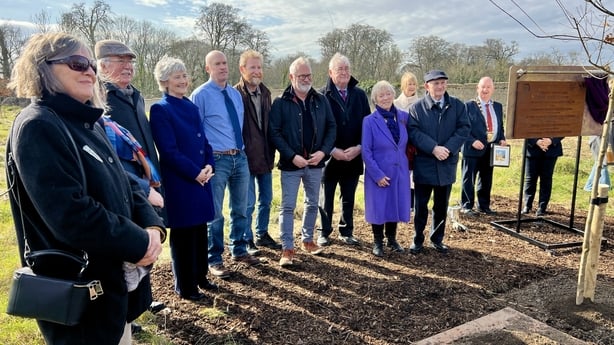
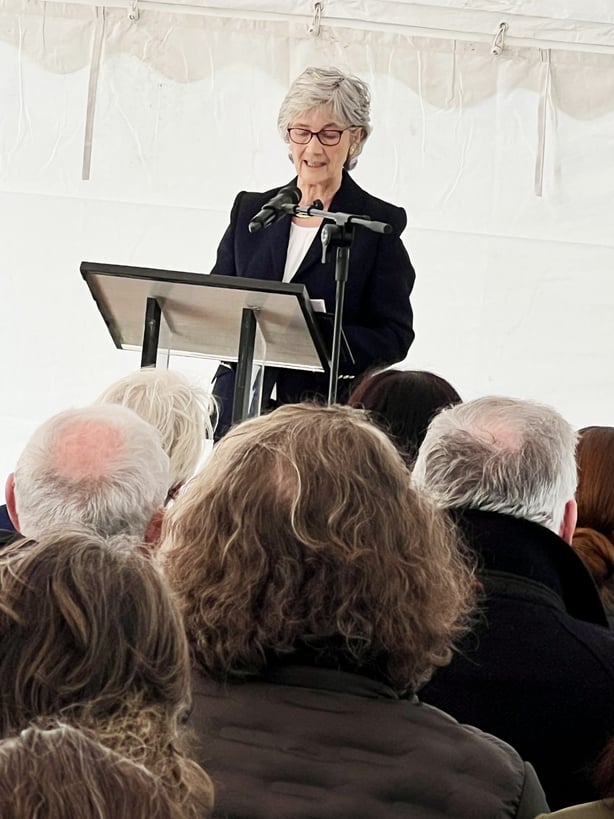
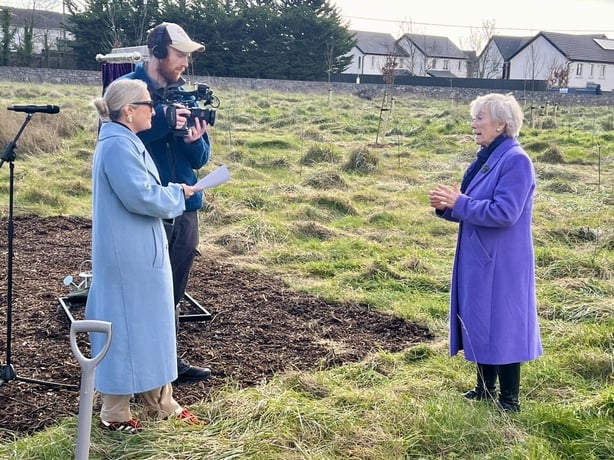
Last Sunday’s official launch took place at Newbridge Demesne in north Co. Dublin and marked the 40th anniversary of the Tree Council of Ireland. We dispatched our roving reporter, Terry Flanagan, to the event, where he spoke to current Tree Council of Ireland President Cormac Downey and recorded speeches by our very own Éanna Ní Lamhna (herself a former President of the organisation, not once, but twice) and Uachtarán na hÉireann Catherine Connolly.
To learn more about National Tree Week 2026, visit https://www.nationaltreeweek.ie/.
Nesting season will soon be upon us... knock on wood
Listener Ann Gethings, who lives in Co. Wexford, was in touch to tell us about a bird nesting box that she built with the Wexford Naturalists’ Field Club and gave as a gift to she sister Linda and her brother-in-law Brendan. Brendan put it up in his garden and, luckily for us, installed a camera beside it, which captured the following remarkable video.
That’s right: it’s a Great Spotted Woodpecker, tapping rapidly on the side of the wooden box... as well as on the lens of Brendan’s camera! But why, he would like to know. On tonight’s programme, we try to get into the mind of a woodpecker.
To learn more about Great Spotted Woodpeckers, visit https://birdwatchireland.ie/birds/great-spotted-woodpecker/.
For more information about the Wexford Naturalists’ Field Club, visit https://www.wexfordnaturalists.com/.
Rescuing a bat
It has been a busy week for Ann, as she recently made a fascinating and unexpected wildlife discovery of her own. While exiting the side door of her house the other day, she spotted a small, furry shape on the ground: a helpless Brown Long-eared Bat that wasn’t moving. When she picked it up – which, we stress, it is not recommended that you do – she noticed that its curled ears unfurled, so it was clearly alive. She wants to know what could be the matter with it and what she can do to help it.
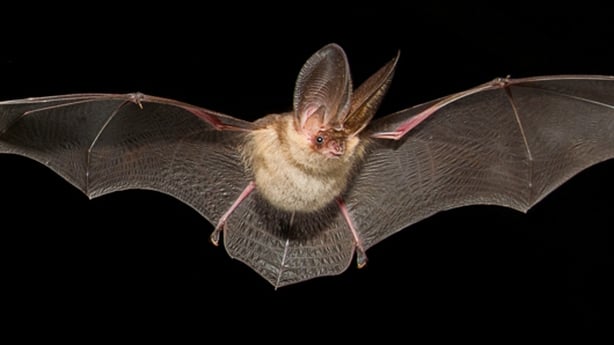
Enter a bat expert, Dr. Megan Power, a Research Scientist at University College Dublin’s School of Biology and Environmental Science, who shares some handy tips with Ann on tonight’s programme.
To learn more about Brown Long-eared Bats, visit https://www.batconservationireland.org/irish-bats/species/brown-long-eared-bat.
To find details of trained wildlife rehabilitators who can help stricken bats and other wild creatures, visit https://irishwildlifematters.ie/.
The reforestation of Atlantic oakwoods
Imagine vast stretches of verdant green, where mosses, lichens, and ferns dominate the view, growing high on the canopy and across the forest floor. There was a time when this was likely to be your outdoor experience in Ireland, but today, both here and across the globe, temperate rainforests are rare and endangered habitats.
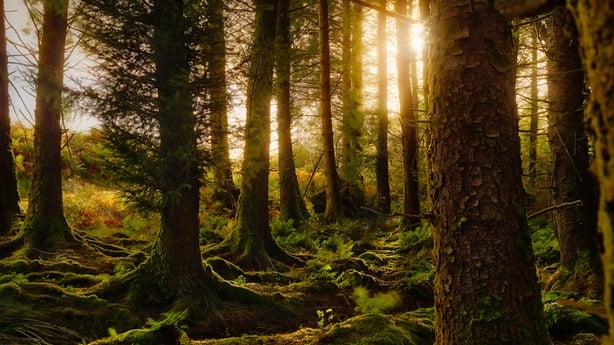
With 40% of the potential range of European rainforest occurring in Ireland and Britain, it is crucial that we protect and restore them. To talk to us about these magnificent woody biomes, on tonight’s programme we are joined in studio by Katerina Chernyuk, a PhD student at the School of Biological, Earth and Environmental Sciences in University College Cork, whose research focuses on Atlantic oak forest restoration in Ireland and Britain.
To learn more about Katerina Chernyuk’s research into bringing back Ireland’s rainforests, visit https://www.rte.ie/brainstorm/2026/0223/1556749-ireland-rainforests-restoration-trees-climate-nature-biodiversity/.
Identifying foxes by sound... and scent
This is the time of year when Red Foxes the length and breadth of Ireland fill the night’s with their piercing screams. These are their mating calls and this is their mating season. Once you learn the sound, it is very easy to recognise, but did you know that you can also identify foxes by smell?
An madra rua pic.twitter.com/tRowO59AWf
— Terry Flanagan (@mybroadcasts) March 10, 2026
As Éanna and Niall discuss on tonight’s programme, the pungent scent trails left by foxes are highly distinctive and are a sure sign either that one of these native wild dogs is, or recently was, nearby. It’s a difficult smell to describe: sort of like a musky-citrussy-floral-rubber odour, not unpleasant, that persists for some time.
To learn more about Red Foxes in Ireland, visit https://irelandswildlife.com/red-fox-vulpes-vulpes/
National Tree Week events
Each year, National Tree Week sees a plethora of events being run across the country, and 2026 is no exception. On tonight’s programme, we hear details of upcoming arboreal outings at the National Botanic Gardens in Glasnevin, Dublin, as well as the daily tree tours taking place at Altamont Gardens in Co. Carlow.
For more information about the National Botanic Gardens, visit https://www.botanicgardens.ie/.
To learn more about Altamont Gardens, visit https://heritageireland.ie/places-to-visit/altamont-gardens/.
Squirrels in a BBQ?!
Paula O Conner got in touch with us from Palm Harbor, Florida to tell us about an interesting discovery that she made recently at her home... so interesting, in fact, that we simply had to invite her to tell us more on tonight’s programme.
Recently, Paula went outside to cook some chicken on her BBQ grill, when she opened the lid and was greeted by this sight:
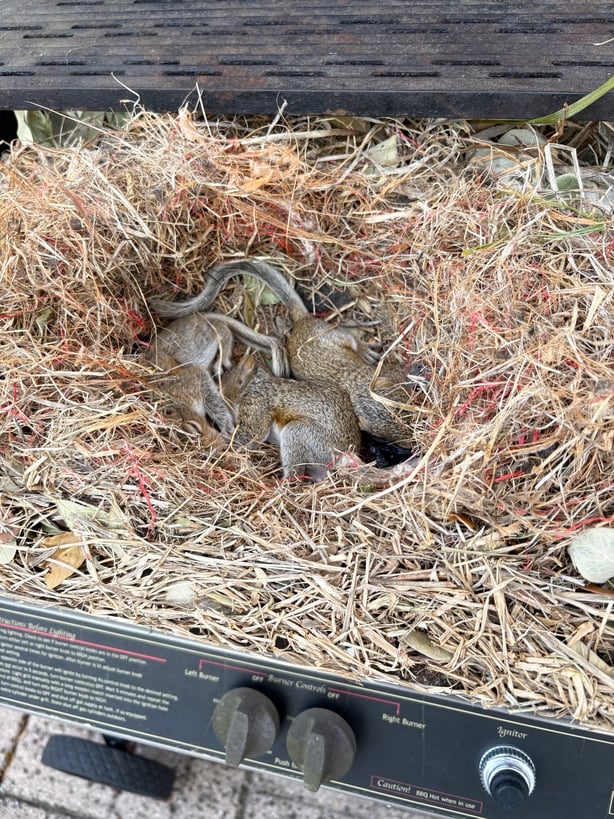
Those are three tiny squirrel kits – Eastern Grey Squirrels, to be precise – laying in a massive nest, or dray, which their mother constructed, without Paula’s knowledge, inside the BBQ. It’s very fortunate indeed that she opened the lid to check before lighting the gas burners! Mother and babies are doing fine and, all going well, should leave the safety of the grill very soon, allowing Paula to resume her outdoor cooking.
To learn more about Eastern Grey Squirrels in Florida, visit https://myfwc.com/wildlifehabitats/profiles/mammals/land/squirrels/.