


To listen to RTÉ.ie's radio and podcast services, you will need to disable any ad blocking extensions or whitelist this site.

0
00:00
00:00
Episode Notes
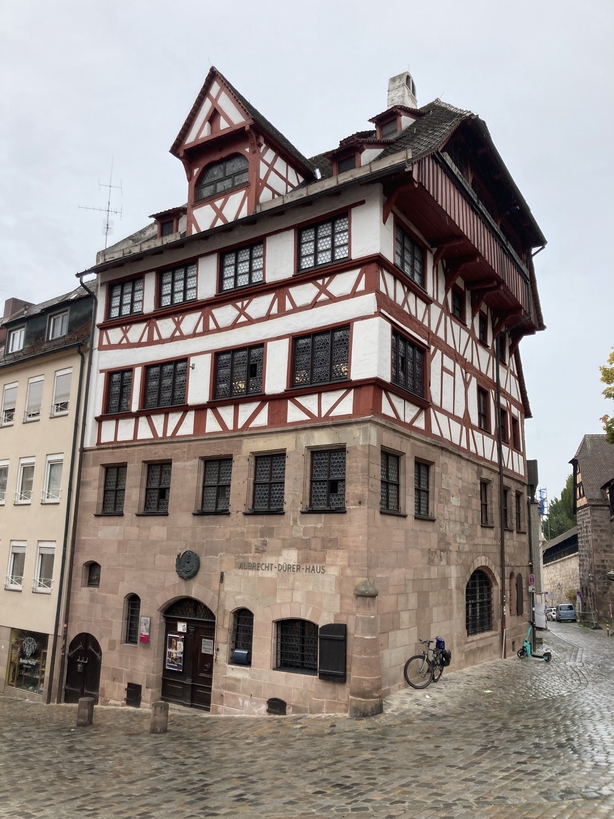
Nuremberg, the second-largest city in Bavaria, and the fourteenth-largest in Germany as a whole. Renowned for centuries as a hub for artisans and craftspersons, it was here, some 550 years ago, that one of the most famous figures of the German Renaissance, artist and theorist Albrecht Dürer, was born: on 21st May 1471, to be precise.

Dürer is perhaps most renowned for his intricate woodcut prints, an innovative style of art which allowed multiple faithful copies of artworks to be produced from painstakingly carved wooden blocks. Many of Dürer's woodcuts are held in extremely high esteem, but one in particular is probably his most famous of all: a depiction of what was, at the time of its creation in 1515, to the people of Europe an animal that was almost unimaginably exotic, mysterious and fantastical . . . one could almost say mythical.
The woodcut in question is the one known as "Dürer's Rhinoceros", an image based largely on a written description of an Indian Rhino: Dürer had never actually set eyes on the real thing. The resulting depiction of the animal is therefore strikingly inaccurate, though nonetheless a stunning and accomplished piece of art, and for many years formed the basis for the standard European idea of what a rhinoceros looked like.

Dürer immortalised the rhinoceros without ever actually seeing one and, all things considered, he didn’t do a bad job at all. Nowadays, it is considerably easier for the average person to see a rhino for him - or herself . . . but for how much longer? There are currently five different species of rhinoceros in the world, with three found in Asia and the remaining two found in Africa. These are the last survivors of an ancient lineage which stretches back over 20 million years to the Miocene era. Since then, a great many species have come and gone, including here in Europe, where until comparatively recently woolly rhinos walked with mammoths and Giant Elk, until climate change and human hunting pressure condemned them to extinction.
Climate change poses a grave risk to modern rhinos too, of course, as greenhouse gas emissions threaten their habitats and food sources. But that’s not the biggest problem facing these armoured giants. The name "rhinoceros" means "nose-horned", and it is these distinctive horns – or, more accurately, man’s selfish desire to harvest them, driven by greed – that have led to their downfall. Rampant poaching to meet the demand for rhino horn in certain parts of Asia, where it is erroneously believed to have benefits for human health, has meant that thousands of these large animals have been killed, their horns crudely sawn off, in some cases while the desperate creatures are still alive and subjected to the most appalling torture. These horns, which simply consist of keratin, the same substance that human hair and finger nails are made of, are then ground down to powder and fetch astronomical prices on the global black market.
South Africa is home to more than 80% of the world’s rhinos, with both the White Rhinoceros and the Black Rhinoceros found there. Fuelled by the growing demand for powdered rhino horn in Asia, between 2007 and 2014 rhino poaching in South Africa rose by a staggering 9,000%. Other African countries, such as Zimbabwe, Namibia and Kenya, also saw massive increases in the numbers of rhinos being killed for their horns. The problem grew so severe, and the slaughter so unchecked, that one of the two subspecies of White Rhinoceros – the form known as Northern White Rhinoceros – has already been doomed to total extinction. Just two captive females remain: with no males to help continue their line, when they finally perish, the Northern White Rhino will be no more.
There is still a widespread belief in some Asian countries, despite plenty of categoric scientific evidence to the contrary, that powdered rhino horn is a cure for a diverse range of ailments, from cancer to hangovers, and from fever to impotence. The substance has also become something of a status symbol. As black market prices rise, due to a scarcity of rhinos directly caused by poaching, so rhino horn is increasingly being seen as the preserve of the wealthy.
In south-eastern Asia, three rhino species teeter precariously on the edge of extinction. The Javan Rhinoceros is one of the most endangered large mammals in the world. The species once ranged widely across Asia, though sadly today only around 60 or so individuals are believed to remain. Their last stronghold on earth is Ujung Kulon National Park on the Indonesian island of Java. None exist in captivity.
Faring little better is the Sumatran Rhinoceros. The world’s smallest living rhino species, it was once distributed across large swathes of south-east Asia. Today, however, it is confined to a few remote pockets of habitat on the islands of Sumatra and Borneo, just like those other critically endangered ancient forest residents, the orangutans. The final two Sumatran Rhinos in Malaysia died in 2019, and the world population currently stands at less than 80 individuals, all in Indonesia.
The species which Dürer depicted, the Indian Rhinoceros, is the most populous of the surviving Asian rhino species. That’s not saying very much, however. Just 3,500 or so are believed still to exist in the wild, confined to pockets of southern Nepal, northern Bangladesh and northern India. Dozens still fall victim to poachers each year.
Permanent graphic art began, millennia ago, with cave paintings. Long after the artists who painted them, and indeed several of the species they depicted with their charcoal, ochre and blood, have perished, their images live on. Such artworks are the only contemporary visual record we have of the appearance of creatures such as mastodons, giant sloths and Cave Bears, of wild Aurochs cattle and European wild horses, of giant flightless Antipodean birds and marsupial lions. All are now extinct, gone forever, save for their bones and the images that ancient, long-forgotten artists made of them on cave walls.
Those prehistoric artists chose to paint these animal subjects because they realised their significance: not for posterity or for those who would come after them, but because they found them relevant to their own lives, and that their beauty and power were worth capturing.
One of the most striking animals to be portrayed in ancient cave art is the woolly rhinoceros, a creature that was widespread across prehistoric Europe and which obviously inspired awe, fear and reverence in the communities of the artists who chose to depict it in such detail.
In the same way, it's clear that Dürer was deeply affected and inspired by the sheer power and strength of the Indian Rhinoceros, and the elemental feelings that it could stir in an observer. He created his rhino print at a time, remember, when the animal was almost the stuff of myth in Europe, like a unicorn or a kraken. With one woodcut, he immortalised the great animal and brought it into the consciousness of the average person.