


Panel: Éanna Ní Lamhna, Richard Collins and Niall Hatch
Reporter: Terry Flanagan
In addition to listening to us on RTÉ Radio One at 22:00 every Monday night, don't forget that you can also listen back to each of our programmes any time you like at www.rte.ie/mooney. There, you will find an extensive archive of past broadcasts, conveniently split into different topics and segments.
Tonight’s programme features a fascinating discussion about Great Spotted Woodpeckers and the impacts they can have on wooden electricity poles. These amazing birds were formerly absent from Ireland, but following their natural colonisation from Britain roughly 20 years ago, they have been spreading and can now be found across most of Ireland, albeit still in fairly low numbers.
With this in mind, and to help you to learn more about these relatively new visitors to our island, our recommendation from the Mooney Goes Wild archives this week is a documentary all about this fascinating species. Presented by Terry Flanagan, it was first broadcast in May 2022 as part of our Nature on One series.
To listen to this special programme from the extensive Mooney Goes Wild archives, visit https://www.rte.ie/radio/radio1/clips/11403346/
Woodpeckers and electricity don’t mix
You may have seen in the news recently that residents in the Sixmilebridge area of Co. Clare, specifically the townland of Clogga, have been suffering a spate of power outages. The culprit: recently arrived Great Spotted Woodpeckers that have been excavating holes in wooden electricity poles, causing some of them to weaken and then snap in bad weather, bringing the power lines down with them.
As we hear on tonight’s programme, this is a relatively recent phenomenon in Ireland, which hosted no breeding woodpeckers until roughly 20 years ago, when pioneering individuals flew across the Irish Sea from Wales to Co. Wicklow and from Scotland to Co. Down. Since then, the species has been spreading, slowly but surely. Though still scarce and occurring at a low density, numbers have been increasing across the country, as evidenced by BirdWatch Ireland’s annual Irish Garden Bird Survey.
Novel though it may be in an Irish context, this is an issue that electricity supply networks have had to cope with for a very long time in most other countries across the globe, including virtually all of our European neighbours, as woodpeckers of many different species are found almost worldwide. ESB Networks can at least take comfort from the fact that there are many tried and tested solutions that can be copied from their international counterparts.
To learn more about the problems that the woodpeckers have been causing in Co. Clare, visit https://www.rte.ie/news/regional/2026/0211/1557876-woodpeckers/
For more information about Great Spotted Woodpeckers, visit https://birdwatchireland.ie/birds/great-spotted-woodpecker/
For more information about BirdWatch Ireland’s Irish Garden Bird Survey, which runs until the end of February, visit https://birdwatchireland.ie/our-work/surveys-research/research-surveys/irish-garden-bird-survey/
Naturescapes: getting a helping hand from the natural world
Naturescapes is a European project that focuses on nature-based solutions from a landscape perspective. The core idea is to work with multiple nature-based solutions to create outcomes that address long-standing socio-economic challenges, enhance biodiversity and respond to climate change.
One of several key locations where Naturescapes projects are underway is along the River Dodder in Dublin, where innovations such as pocket forests are being used to harness the benefits of nature. Our roving reporter, Terry Flanagan, went there to meet Mairéad O’Donnell, a post-doctoral researcher with the Naturescapes project who is based at Trinity College Dublin, to learn more.
For more information about Naturescapes, visit https://www.naturescapes-project.com/
For more information about Mairéad O’Donnell and her work, visit https://www.tcd.ie/botany/people/postgraduate/mairead-o-donnell/
Have you been feeling under the (extraordinarily wet) weather lately?
You may have noticed that the past few weeks have been exceptionally damp across much of Ireland, with massive and prolonged rainfall causing flooding, damage and suffering in many areas. You might think that it must have been the wettest January on record. In fact, as Éanna tells us on tonight’s programme, according to Met Éireann, it was only the wettest January since 2018.
That said, this year the rainfall and flooding have been particularly localised, with parts of Cos. Wicklow, Wexford and Dublin being particularly hard-hit. On tonight’s programme, our panel discusses the recent heavy rainfall, considers how climate change seems to be making extreme weather events more frequent and looks at ways that nature might be used to help to prevent increased flooding in the future.
For more information about the terrible flooding that was experienced recently in Enniscorthy, Co. Wexford, visit https://www.rte.ie/news/ireland/2026/0127/1555411-enniscorthy-flooding-drone/
The Brent Goose: a natural symbol of Dublin
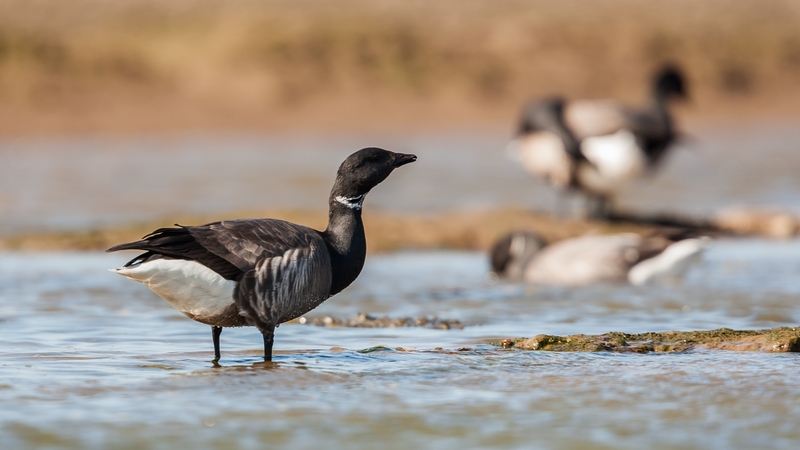
If Dublin city is ever on the lookout for a new mascot, officials could do a lot worse than to choose the Brent Goose. Breeding in High Arctic Canada during the summer months, each autumn sees a great influx of these migrant geese to the estuaries, parks and green spaces of our capital city, where they feast on their favourite food, grass.
Ireland is of vital importance for this species, which breeds further north than any other animal on the planet, and it is crucial that we keep track of them while there are here with us and of the journeys that they make when they are not.
And this is where you come in. We are joined on tonight’s programme by ornithologist Dr. Kendrew Calhoun, who tells us all about the amazing lives that these birds lead and how your sightings can help conservationists to keep track of their populations and their breeding successes.
If you happen to encounter Brent Geese, please go to the National Biodiversity Data Centre web portal and log the date, time, location and number of geese seen. You can also upload a photo of the birds.
To submit your own sightings of Brent Geese, visit https://records.biodiversityireland.ie/
For more information about Brent Geese, visit https://birdwatchireland.ie/birds/brent-goose-light-bellied/