


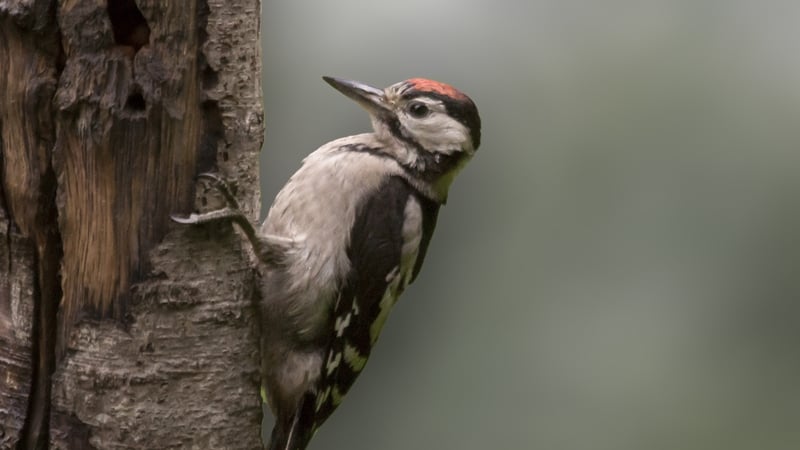
Panel: Éanna Ní Lamhna, Richard Collins and Niall Hatch
Reporter: Terry Flanagan
In addition to listening to us on RTÉ Radio One at 22:00 every Monday night, don't forget that you can also listen back to each of our programmes any time you like at www.rte.ie/mooney. There, you will find an extensive archive of past broadcasts, conveniently split into different topics and segments.
Tonight’s programme features a special insight into the remarkable breeding strategies of the Greater Horseshoe Bat. Bats are a much maligned and underappreciated group of animals which are essential for the health of our environment and which are well worth getting to know better.
To help you to do just that, our suggestion from the Mooney Goes Wild archives this week is a special programme dedicated to these remarkable flying mammals, first broadcast in July 2023. In it, Terry Flanagan dispels the myths about bats and highlights the important roles which they play in the ecosystem. He also meets the dedicated teams of volunteers that work tirelessly on behalf of these oft-misunderstood creatures.
To listen to this programme from the Mooney Goes Wild archives, visit https://www.rte.ie/radio/radio1/clips/22273771/.
Happy New Year!
As this is our first Monday-night edition of Mooney Goes Wild of 2026, we begin tonight’s programme by wishing all of our listeners a very happy New Year. We really appreciate you listening to our musings on nature every week and hope that you will enjoy all of the wonderful natural history content we have in store for you over the next twelve months.
If you want to tell us about any interesting flora or fauna that you come across, or if you would like to put any questions to our panel of wildlife experts, don’t forget that you can email us any time you like at mooney@rte.ie.
Woodpecker vs. Cherry Tree
Listener Fionnuala O’Connor from Naas, Co. Kildare was in touch with us recently to tell us about some damage to a cherry tree in her garden that has apparently been caused by a wild animal of some kind. Could it be the work of a woodpecker, she wonders, or might a squirrel be to blame?
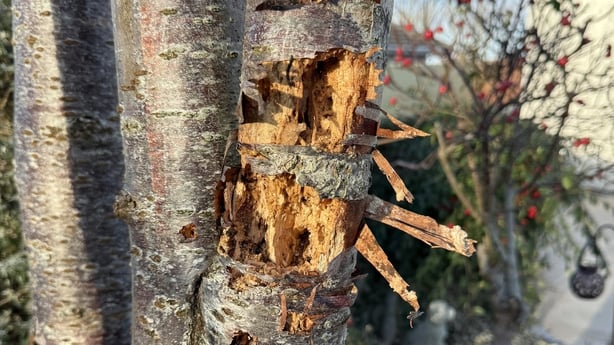
Based on the photos that Fionnuala sent to us, our panellists were quick to recognise the handiwork (or should that be beakiwork?) of a Great Spotted Woodpecker. While Grey Squirrels will strip bark from trees, the damage to the tree in this case is so deep and extensive that it could only have been down to a hungry woodpecker looking for food. Formerly absent from Ireland, over the past 20 years or so, following natural colonisation from Britain, these birds have slowly but surely been expanding across the country, and BirdWatch Ireland has received numerous reports of the species from the Naas area in recent years.
Woodpeckers’ ability to peck wood is quite remarkable. When drumming on a tree, a woodpecker will hit its face off the trunk multiple times per second at supersonic speed, experiencing forces of approx. 20,000 G. Their brains are specially protected by shock-absorbing fluid, while strong ligaments in their necks further serve to prevent injury.
For more information about Great Spotted Woodpeckers, visit https://birdwatchireland.ie/birds/great-spotted-woodpecker/.
When is best for bats to breed?
Is better to have offspring early or later in life? Well, it depends on several different factors, but when it comes to female Greater Horseshoe Bats, at least, it seems that motherhood can come with a cost... but not for all.
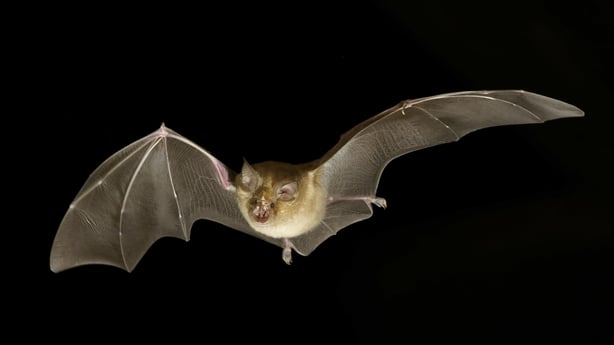
Dr. Megan Power from the UCD School of Biology and Environmental Science was the lead researcher in a recent study that assessed the cost of reproduction by measuring telomere length, a biomarker of ageing and stress, in 200 female bats over a five-year period in Gloucestershire, England. She joins us on tonight’s programme to tell us more.
For more information about the reproductive strategies of Greater Horseshoe Bats, visit https://phys.org/news/2025-12-motherhood.html.
Giving the precious inhabitants of the Dead Zoo some well-deserved TLC
Sadly, Dublin’s "Dead Zoo" (or to give it, its correct name, the Natural History Museum) has been closed for renovation for some time now and will remain so for the foreseeable future. All the exhibits had to be removed to allow for the extensive refurbishment required, like fixing major leaks in the roof of the building. But what has happened to the specimens that were on display there?
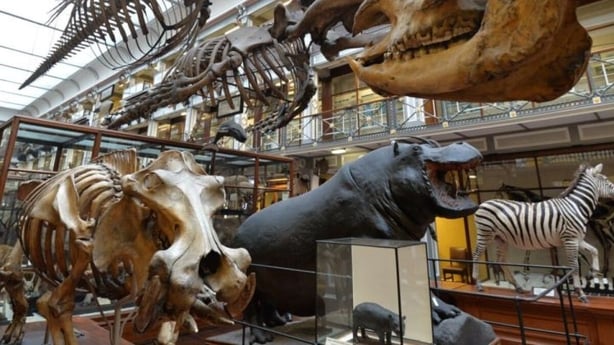
Don’t worry, they are all perfectly safe. They have all been moved to a large unit in north Co. Dublin, but not merely for storage purposes. While they are there, they will be cleaned, upgraded and catalogued, and eventually they will return to Merrion Square when the refurbishment work has been completed.
Our roving reporter, Terry Flanagan, recently paid a visit to the museum’s storage facility, where he met up with Emma Murphy, Curator of Terrestrial Zoology at the Natural History Museum, to find out more.
For more information about the Natural History Museum, visit https://www.museum.ie/en-ie/museums/natural-history.
Looking back at our special wetland bird programme from Harper’s Island
On January 2nd, a special programme from the Mooney Goes Wild team all about wetland birds was broadcast on RTÉ Radio One. It was recorded at Harper’s Island Wetlands Nature Reserve near Glounthaune, Co. Cork, which is owned and managed by Cork County Council in partnership with BirdWatch Ireland, Glounthaune Community (Glounthaune Community Association/Tidy Towns/Men’s Shed), and the National Parks and Wildlife Service. It featured Derek Mooney in conversation with bird experts Jim Wilson, Declan Murphy and Niall Hatch, discussing in real time the different bird species that happened to be on show in front of the reserve’s wonderful observation hides.
On tonight’s programme, we bring you a short extract from the programme all about the Dunlin, a member of the wader family and one of our smallest regularly-occurring wetland bird species. We also discuss another, larger wader species, the Redshank, most readily identified by the distinctive red legs which give the species its name, along with one of the largest Irish duck species, namely the Shelduck.
If you missed the programme when it was first broadcast, or if you would like to listen to it again, you can do so on our website. What’s more, you can even listen while you watch it being accompanied by wonderful video of the birds that we are discussing, filmed simultaneously for us by wildlife cameraman Donal Glackin.
For more information about Harper's Island Wetlands Nature Reserve, visit https://birdwatchcork.com/about-harpers/.
For more information about Dunlins, visit https://birdwatchireland.ie/birds/dunlin/.
For more information about Redshanks, visit https://birdwatchireland.ie/birds/redshank/.
For more information about Shelducks, visit https://birdwatchireland.ie/birds/shelduck/.
To listen back to our special programme about wetland birds, visit https://www.rte.ie/radio/radio1/mooney/2026/0102/1551149-mooney-goes-wild-wetland-birds-02-01-26/.
To follow all the wading activity as it happens from Harper's Island Wetlands Nature Reserve, click on this video below for the livestream: