



Junior Certificate student William Brosnan from Scoil Mhuire Kanturk, Co. Cork, tells Oliver Callan about his 'Dementia Shield' App, designed for AR (Augmented Reality) glasses. Listen back above.
A 15-year-old student from Kanturk has developed an AI-powered application for augmented reality smart glasses designed to help people living with dementia navigate daily life more independently.
William Brosnan, who is currently studying for his Junior Certificate, will present his "Dementia Shield" project at the International Dementia Conference in Athlone on May 13th and 14th.
Over 70,000 people in Ireland are living with dementia, with that figure expected to rise over the coming decades. William said his project was inspired by personal family experience, as well as by research he undertook through summer programmes in University College Cork and Dublin City University:
"I have a couple of grand-aunts and grand-uncles that have experienced dementia, and I've seen the effects it can have on people first-hand."
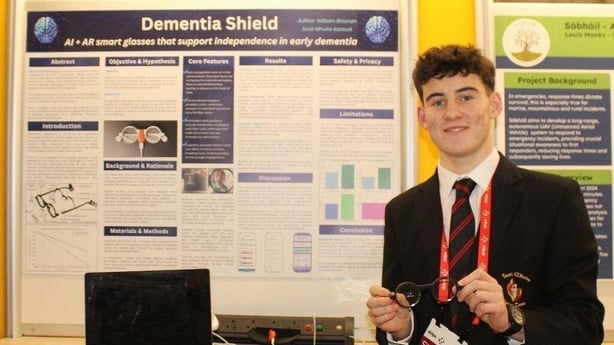
The teenager explained that the application works by connecting to commercially available AR smart glasses, using artificial intelligence to provide prompts, reminders and even facial recognition tools for the wearer:
"It’s a mobile application that connects to AR smart glasses that helps recognising faces, tells the dementia patient who they’re talking to, sets reminders and keeps reminders for daily tasks like going to the bathroom, eating, taking their medication and tasks like going to the doctors."
The smart glasses display information directly on a small screen visible to the wearer, and there are plans for future versions using bone-conduction audio technology.
The app includes GPS functionality to help users find their way home or locate family members if they become disoriented. It can also be programmed to contact emergency services or relatives if assistance is needed.
William said one of the biggest challenges faced by people living with dementia is forgetting basic but essential routines, and this can quickly undermine their ability to live independently, he says:
"They forget to take their medication, forget to drink water, forget to go to the bathroom, forget to eat. And this is one of the main reasons why carers are brought into the home, and that can often take away the feeling of independence in the dementia patient."

He believes the technology could reduce some of the stress and confusion experienced by dementia patients while helping them remain in their own homes for longer, William says:
"These glasses replace that need for a carer and will give reminders about taking their medication, drinking water, eating their food and going to the bathroom."
William named the project "Shield" because of its focus on reducing stress levels and offering protection against some of the impacts associated with dementia.
"The app is built around the fact that stress directly correlates to the onset of dementia. The more stressed a dementia patient is, the worse it gets. This app is built to reduce that stress and by reducing that stress, slowing down dementia, so therefore protecting people from dementia."
Despite his age, William already has an extensive background in coding and software development. He began programming when he was just five years old, he tells Oliver:
"I started learning coding at five years old, nearly as early as I could read."

He first learned using the Scratch programming language before moving on to more advanced coding projects and app development.
The Kanturk student has already received significant recognition for his work. He won the software category at the BD STEM Stars competition, secured the Boston Scientific Medical Device Award at regional SciFest finals, and later claimed the Junior Technologies of the Future award at the national SciFest finals.
Outside of coding, William said he also enjoys rugby, running, and fitness training, balancing those interests alongside school and software development.
Ahead of the conference in Athlone, he said he is eager to learn more from experts working in dementia care and research.
"I’m extremely excited to go there. I’ll meet loads of new people, people who are interested, people who know a lot about the topic, and I’ll be able to hopefully gather more research about how dementia works and how I could improve my glasses to help people with dementia."
More information on the Engaging Dementia conference in Athlone (13th - 14th of May 2026) can be found here.
If you’re personally affected by any issues raised in Oliver’s interview with William and you’d like to chat to someone, you can find contact details for helplines here.