


Two generations of second-hand shopowners - Frank McQuade (Flip), son Michael (Badlands), and daughter Sophie (Sacred Heart of Vintage) - join Oliver Callan in the studio. Listen back above.
In 2025, Vogue heralded Dublin as a thrifting hot spot, celebrating two Temple Bar treasures in their fashionable round-up.
The second-hand shops, run by a brother and sister, are featured in the fashion bible's recent list of the best vintage stores in the city: Sophie McQuade's Sacred Heart of Vintage and Mikey McQuade's Badlands.
Oliver Callan spoke to the pair, along with their Dad, Frank, the man who began the family empire along with his brother almost four decades ago. The conversation traced not just the rise of vintage, but a family life lived among clothes, culture and the ever-changing landscape of Dublin's Temple Bar.
Frank McQuade opened Flip on Fownes Street in the late 1980s, long before Temple Bar became the tourist hub it is today. The roots of the business, however, stretch even further back.
"Well, I suppose it’s my brother, Paul, started it really way back in the 1970s. He was in Galway, doing an army surplus store, and through that he’d drive trucks to Holland and Germany. That’s where he met people selling used clothing – it was very big on the continent then. That’s really how it all started."
As Temple Bar slowly evolved, so too did Flip, becoming a constant amid short leases, stalled developments and shifting plans for the area, Frank explains:
"Temple Bar wasn’t really developed then. They were going to build a bus station there. It was meant to go from the Central Bank right up past Eustace Street. Without the Temple Bar Development Council, it could have been very different. I bought the buildings up from the ’60s, but they were leasing them short-term."
For Sophie and Mikey, growing up above the shop meant Temple Bar wasn’t just a destination – it was home. Sophie says it was an exciting place to grow up:
"The Central Bank Plaza had all different people hanging around who’d come into the shop. It was the epicentre of culture in Dublin – skinheads, Goths, punks, skateboarders. Growing up watching Temple Bar unfold like that was really interesting. It’s gone through so many different eras."
Both siblings worked in the shop from a young age, gradually learning the less glamorous realities of vintage retail – including the back-breaking work of buying stock by weight, as Mikey McQuade says:
"They present you with these massive trolleys – thousands and thousands of kilos. You spend the whole day sorting the good from the bad, piling it all up, putting it on a pallet and sending it back. You don’t know what you’ll find. There’s always jewels, but there’s always rubbish too."
Despite online competition, the family remain committed to bricks-and-mortar retail. Sophie, who now runs Sacred Heart Vintage upstairs from Flip, believes the physical experience is essential, particularly when buying second-hand and vintage clothing:
"We don’t sell online because people want to look through everything, try things on and have a root. Vintage clothes were made for someone originally – fur coats, suit jackets – you really need to try them on. It’s really hard to sell online because people want to touch it and feel it."
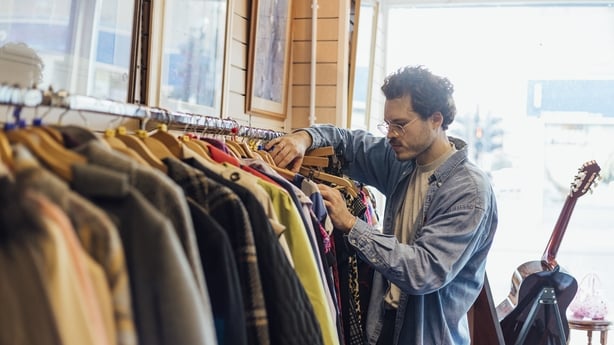
The enduring appeal of vintage, Frank believes, comes down to quality and longevity – something increasingly absent from fast fashion, he believes:
"If you’re producing a jean at a low price, the quality just isn’t there. A lot of denim now has stretch and tinsel in it – you get six or seven washes, and it falls apart. A 16-ounce denim lasts decades. That’s why Levi’s and workwear always come back. Quality never goes out of fashion."
Today, the McQuades run three distinct shops – Flip, Sacred Heart of Vintage and Badlands – each with its own aesthetic, but all rooted in the same principles. Across generations, customers now return with children and grandchildren in tow, browsing the same rails their parents once did.
As Oliver Callan noted, you can’t beat the browse – and for the McQuades, that simple pleasure remains at the heart of a family business that has quietly dressed Dublin for nearly 40 years.
Listen back to the full interview above or find it in the podcast feed for Oliver Callan on the RTÉ Radio app and other podcast platforms.