


Tech journalist Emmet Ryan and Child Neurological Developmental Therapist Ollwyn Moran discuss the link between in-game lootboxes and online gambling with David McCullagh. Listen back to the full conversation above.
Every parent has heard the words "I don't want it - I need it" from a pleading child at some point.
It could be for a packet of trading cards, a "real" Labubu or football boots that are destined to raise their game as if by magic. Advertisers have long been weaponising kids' pester-power to get stressed-out grown-ups to tap their card in exchange for some peace and quiet.
With calls-to-action embedded in "free-to-play" games, parents may be unaware of the new mechanics that are inspiring a new generation to pester them for their credit cards. Game designers are targeting kids to buy virtual items in games like Roblox, Fortnite and Brawl Stars.
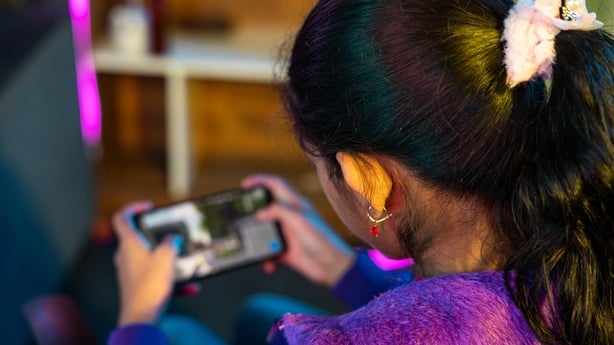
These include skins and accessories for avatars, as well as game passes to unlock special abilities and in-game currency, which doesn’t "feel" like real money, but still comes at a price.
Experts now believe this urgency to spend, which is linked to game play, could be training children how to gamble before they have any conscious notion of what gambling actually means.
Child Neurological Developmental Therapist Ollwyn Moran and technology journalist Emmet Ryan sat down with David McCullough to discuss whether games like Roblox could be shaping young minds in ways parents don’t fully realise.
Moran said the warning signs can be easy to miss because the games appear harmless. But beneath the bright colours and cartoon avatars, children are being primed to chase rewards in ways that look worryingly similar to gambling behaviour, she argues:
"Their brains are learning to seek that little dopamine hit over and over again."
In addition, unpredictability in a game is part of what keeps kids hooked, Ollwyn says. For younger players, especially, that unpredictability can become a habit. Moran describes the feedback loop:
"When a child is conditioned to keep trying, to keep opening, to keep spinning, that is the same neural pathway we see in early gambling addiction."
Tech journalist Emmet Ryan agrees, saying the industry has embraced "dark patterns" that push young players towards microtransactions and lootbox-style features.
According to WebWise, Loot Boxes are mystery bundles of virtual items that can be won by a gamer as a reward or can be purchased with real money.
Emmet describes how games funnel kids towards spending without ever calling it gambling - the intention is to make it clear to kids what's happening, whilst being confusing for the adults. The blurred language of in-game currencies doesn’t help. As Ryan put it;
"When money becomes pretend money with pretend names, it becomes much easier for kids to lose track of what they’re actually spending."
He noted that this shift is particularly acute in platforms like Roblox, where custom games made by other users vary wildly in quality and safety standards.
Developmental therapist Ollwyn Moran said the neurological impact can be far more significant for children than adults:
"A developing brain doesn’t have the braking system adults do - they are wired for reward, not restraint."
That natural reward-seeking instinct makes them perfect targets for mechanics that mirror slot machines – even when disguised as treasure chests or mystery boxes.
Both guests stressed that this doesn’t mean parents need to panic or ban gaming entirely. But they do need to understand the environment their children are playing in; as Ollwyn explains:
"If you know how the platform works, you know how to protect your child."
What can parents do?
- Play the game yourself. A few minutes exploring your child’s favourite game can reveal features you may not realise are there.
- Turn off in-game purchasing or tightly limit spending with passwords.
- Stick to age ratings – and remember that user-generated games inside platforms like Roblox often bypass those ratings.
- Talk to kids about gambling-style mechanics - name them, explain them, and make them visible.
- Keep screens in shared spaces, even for older primary-school kids.
- Agree on time limits that kids understand and help enforce.
Ryan emphasised that transparency is more effective than fear-based warnings:
"If you show them what the game is trying to get them to do, they get it. Kids are smart. They don’t like being manipulated."
The conversation also covered why regulation is struggling to keep up with the speed of the gaming industry, and how peer pressure inside online worlds is an added burden on kids. There’s also a deeper dive into how so-called "harmless fun" can shape attention, emotional regulation, and risk-taking patterns later in life.
You can listen back to the full discussion with Ollwyn Moran and Emmet Ryan by clicking the link above.