


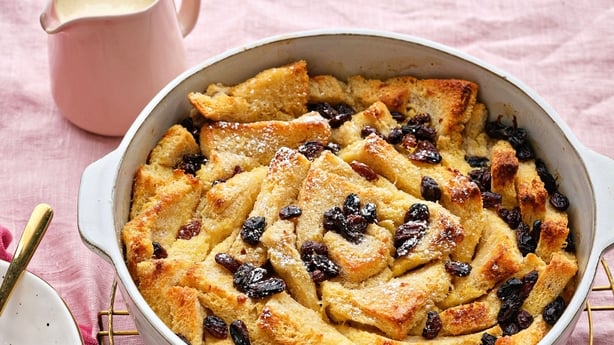
Bread and Butter Pudding
This is still one of my favourite desserts when I'm back at home in my parents’ house. Serve warm. Enjoy with lots of butter and mugs of tea.
Ingredients
- 60g caster sugar
- 4 medium eggs
- 300ml cream
- 250ml milk
- 1 tsp vanilla zest of ½ lemon
- 10 slices of bread (stale day-old bread is perfect)
- 60g butter, softened, plus extra for greasing 60g dried fruit, such as raisins, sultanas or currants
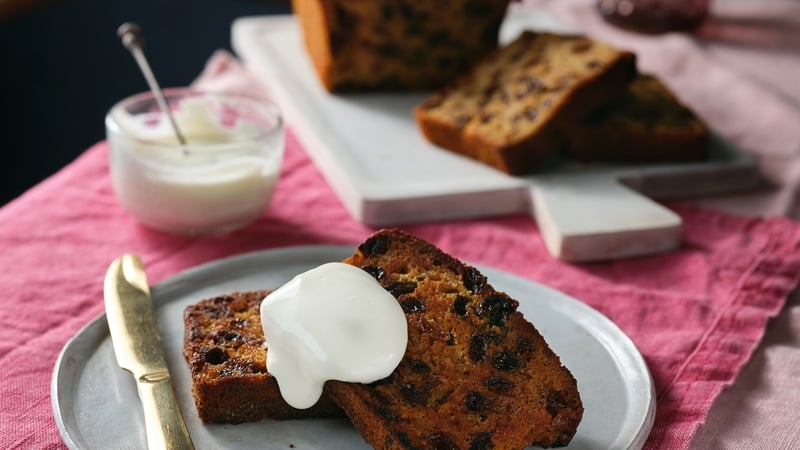
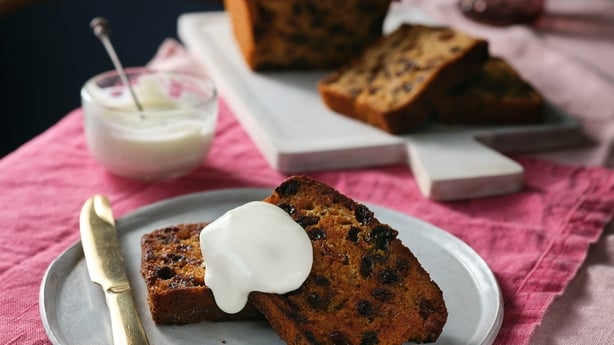
Traditional tea brack
Method
Lightly grease a 23cm square or circular baking dish with butter.
Make the custard by mixing the sugar, eggs, cream, milk, vanilla and lemon zest in a large jug. Spread all the slices of bread with the butter, then cut each slice in half diagonally to make triangles.
Layer the slices of bread in the prepared dish and scatter the dried fruit across the top. Give the custard mixture a final stir, then pour it over the bread.
Allow to soak for 30 minutes.
Preheat the oven to 180°C fan.
Bake in the preheated oven for 35–40 minutes, until the custard is set and the top is golden brown.
Ingredients
Makes 1 x 900g (2lb) loaf
- 300g sultanas
- 75g mixed peel
- 300g almost cold tea
- 125g caster sugar
- 1 medium egg lightly beaten
- zest of 1 lemon
- 1 tsp sweet spice or mixed spice
- 1 tsp vanilla 225g self-raising flour
Method
Put the sultanas, mixed peel and tea in a large bowl and leave to soak overnight at room temperature.
When you're ready to bake, preheat the oven to 180°C fan.
Line a 900g (2lb) loaf tin with non-stick baking paper.
Add the sugar, egg, lemon zest, spice and vanilla to the fruit and tea and mix well.
Gently mix in the flour, being careful not to crush the fruit.
Transfer to the lined loaf tin. Bake in the preheated oven for 60–65 minutes.
It’s done when a skewer inserted into the centre of the loaf comes out clean.
Allow to cool fully in the tin before cutting into slices. You can’t beat a cup of tea and a slice of brack spread with good butter.
Sally McKenna's Butter
Method
It's 2 litres of double cream at room temperature. If you over-whip cream in a mixer, what you get is butter and buttermilk. For butter is simply whipped cream that collapses and separates into globules of butterfat and the milk that separates from it.
Place 2 litres of room temperature double cream in the bowl of a
stand mixer and beat – using the whisk attachment – at medium
speed.
The cream will be softly, then stiffly whipped, and then it will
go a step further and separate into buttermilk and butter.
The next step is to remove as much of the buttermilk as possible, as
leaving it in will sour your butter. Turn the mixture out into a large
square of muslin resting in a sieve over a bowl and press to remove
the buttermilk into the bowl below.
Place the butter back in the mixer bowl. Whisk again for a few
seconds to expel more buttermilk. Once again, strain and squeeze.
Fill a bowl with very cold water and put in the butter. Using your
hands, knead the butter once more to remove more buttermilk.
Replace the water and knead out more buttermilk. Eventually you
will have a good butterfat mixture with no liquid.
Salt the butter if you wish, adding 3 teaspoons to the mixture and rubbing in with
your hands to distribute.