


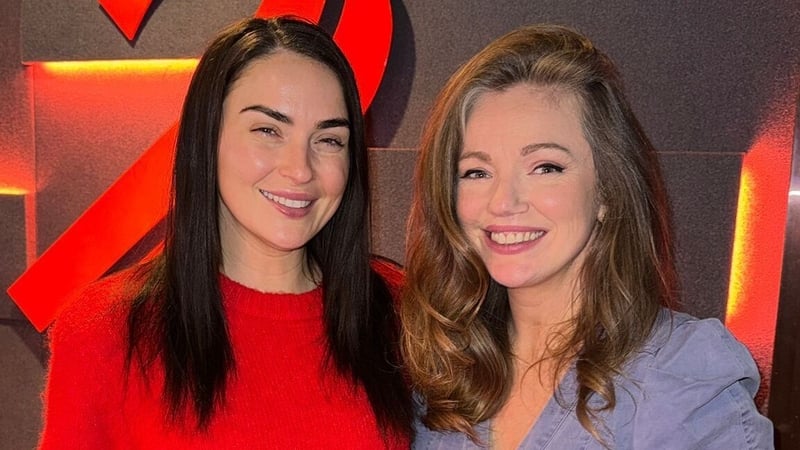
Sarah-Jane O'Regan - Performance Interpreter
Transcript of interview with 2FM Laura Fox Show Wednesday 25th February
LF: Laura Fox
S-JOR: Sarah-Jane O’Regan
LF: (0:00) Now, have you ever thought about what attending a live music gig is like for a deaf person? (0:05) Well, Sarah-Jane O'Regan is a deaf person and she works as a performance interpreter for the (0:10) deaf and hard of hearing community at live events. Now, she has done loads of gigs including Oasis, (0:16) Coldplay and Taylor Swift, but what does a performance interpreter do? I'm joined now (0:21) by Sarah-Jane O'Regan and we're also joined in studio by Caoimhe Coburn-Gray, (0:25) an Irish sign language interpreter. A big welcome to you both.
S-JOR: (0:31) Thank you. Thanks so much for having us. I'm absolutely delighted, you know, to be here and (0:37) it's, you know, it's, do you think how funny it is to have a deaf person on the radio? But at the (0:40) same time, we'll make it work.
LF: Sarah-Jane, you, you are a bundle of fun, which is no shock that (0:47) you are in the entertainment industry. But can you please tell me what a performance interpreter does (0:54) at a live gig or a live event?
S-JOR: So a performance interpreter really are there to provide access (1:01) to music for deaf and hard of hearing people. So of course, if someone is attending a live event, (1:08) maybe they would have different levels of hearing, but they can still access music. So my job is to (1:15) provide that access for them. But it's not just through the spoken words or the sung words in the (1:21) music, but it's also what does that music feel like? What does it look like? What is the story (1:26) in, in a song and its lyrics? It's to give that full experience, immersive experience of music. (1:33) So of course, you've got the artist, their view, their perspective being carried in their art.(1:38) You're trying to convey all of that in one succinct interpretation to deaf audiences.
LF: (1:43) I would just love to know what you would say to people who would be surprised that a deaf person (1:47) would want to go to a music gig if they can't hear music.
S-JOR: Yeah, this is, you know, I very often (1:53) see this kind of comment on social media and in the news.
I think it is important to remember that (1:59) deaf people are part of broader society. Music is part of the cultural heartbeat of Ireland. It's (2:06) part of society.
It's a form of storytelling. It carries our folklore and our cultural heritage. (2:13) So it's important that deaf people also have access to experience of that.
And also I know (2:18) that there were comments after the Oasis videos went online. I did see that one person was asking, (2:25) you know, Oh, a deaf person has taken my ticket. You know, they saw that they had lost out on a (2:31) ticket from someone who couldn't even hear the music.
And I was thinking, my God, you know, (2:35) that is not necessarily coming from a bad place, but I do think that it's just a misconception (2:40) that people have. They don't understand and think that, you know, that a deaf person is black and (2:46) white, that it's you can hear or you can't hear. And it's not that straightforward because there's (2:51) such a broad spectrum of experiences carried in the deaf community and very much so there's a (2:56) focus on the auditory and the ear and what they're picking up.
But of course you can experience music (3:01) through sensation, through feeling, through having captioning, through colored lights, (3:06) having an interpreter there. That's how you kind of give the texture of music to a deaf audience.
LF: (3:13) Would it be fair to say that everybody has kind of experienced what you're talking about? (3:18) You know, I walk into a gig and something that I speak about all the time from my very first (3:23) music festival to, you know, the most recent concert I've been to is that feeling in your (3:28) chest that you get when you walk into a room where music is being played and it vibrates through you.
(3:35) Yeah, exactly. But sometimes I think the atmosphere as well, that is sound as well. (3:42) So, you know, there might be a deaf person who wouldn't necessarily have full access, you know, (3:46) are other people singing from far away? Are the audience joining in? What's the emotion being (3:52) conveyed? So, like, for example, at Oasis compared to, you know, another gig, the atmosphere (3:58) was very different.
Like at Oasis it was phenomenal and it was all about the atmosphere that was there (4:04) and I really wanted to convey that through my performance as well through my interpretation.
LF: (4:08) And that is what you do. You do a performance and an interpretation because there's so much (4:12) emotion and rhythm in live music and what Liam and Noel Gallagher are doing on stage. (4:18) But as you're pointing out, it's what the audience brings to the atmosphere that you're also trying (4:22) to portray to a person.
S-JOR: Of course, I'm trying to convey their perspective, but I'm not trying (4:27) to take away from their performance or take away their limelight. I want to work with the artist (4:33) in tandem with the artist. They've, of course, written the lyrics. It's their art, it's their (4:38) songs. So I'm not trying to take away from that performance, but really I'm trying to add to it.
LF: (4:45) So tell me about being a deaf person and other deaf people, okay? How do they appreciate music (4:51) through the senses like touch?
S-JOR: Okay, so a lot of people assume that deaf people (4:57) only enjoy music through touch as a sensation, but that's really one facet. And of course, (5:05) you can see there's many different elements that can combine to give an experience of music. So (5:10) visual cues, touch, sensation, of course, that is a big one.
And there's been huge (5:16) technological advances with the introduction of haptic vests. And they really add a huge layer (5:24) to the experience of music for deaf people. And I know that from myself, the first time I was just (5:31) there as an attendee at a Coldplay concert and had a haptic vest.
And honestly, my life was changed (5:35) that night. Just to be able to watch the concert and then feel the vibrations at the same time (5:40) conveyed through the haptic vest, really at one point in there when I went to the bathroom, I had (5:44) to take the vest off. When I came back from the bathroom, I felt like something was missing from (5:49) my experience. And then I realized I hadn't put the vest back on. So realizing actually all that (5:54) was carried with the addition of the haptic vest, how much it allowed me to connect.
LF: (5:59) It's amazing how much of an immersive experience that it's given you.
What exactly does it do?
S-JOR: (6:05) It changes music into physical sensation and feeling. So if there is a strong rhythmic beat, (6:12) then that's conveyed in vibrations. And it's not really, it doesn't carry necessarily the meaning (6:19) of the song or lyrics, but it can carry other information around the melody and around (6:27) the make of the song.
So it wouldn't give a full experience of a song, but it does enable you to (6:34) connect in a more tangible way with music.
And not everyone enjoys that experience of wearing (6:42) a haptic vest.
LF: We've mentioned Oasis an awful lot. I would just love to know what kind of (6:47) preparation you did before the gig?
S-JOR: I love Oasis and I've loved them since I was a child. My brother (6:53) was completely crazy for them.
You know, I thought that they were so cool. And my brother was mad (7:00) into their music. And like with Coldplay, I just got influenced from many different directions.
(7:06) But my brother, he loved Oasis. So I was always kind of robbing his songs. I'd sneak into his (7:13) room when he was out and listen to his tracks and would listen to Oasis.
That's how I came across (7:19) them. So I listened to them growing up. So when the opportunity came up from Performance Interpreting, (7:24) they are an agency who provide interpreters for music concerts and gigs here in Ireland. (7:30) When the opportunity came up to interpret that concert, I grasped the opportunity, you know, (7:37) with both hands. And, you know, if I'm thinking about thinking back to me sneaking into my (7:44) brother's room as a child to listen to Oasis, and then I'd be interpreting their concert. (7:48) But I mean, the preparation, of course, I'm a highly visual person.
So I can, you know, hear (7:55) some sounds through my cochlear implant. But really, I see the sound. That's how I engage. (8:02) I need to be able to see it, to understand the songs properly. So I was watching an awful lot (8:08) of videos. I was watching the lad’s mouth patterns, watching how they performed, and trying to just, (8:16) I suppose, fully just absorb everything as much as I could.
Their style of singing. I was sleeping, (8:23) eating, breathing Oasis in the lead up to it. You know, I'd be singing Oasis along to myself. (8:30) You know, my children would say, would you ever stop? You know, everything was Oasis during (8:35) the preparation period for that. And I think, you know, it probably was over 100 hours, more than (8:40) that even. And then when I arrived, I think, of course, I was nervous.
I mean, I'm sure you can (8:46) imagine being nervous for the job and then standing on the stadium. And I think, honestly, (8:52) my brain just reached a place of calm. I kind of had to remove Sarah-Jane from who I was and just (8:59) convey the concert that was happening on stage and just fully connect.
Now, I couldn't actually (9:03) see the stage, but I could feel the presence. I could feel through the audience. I could feel (9:08) the performance that was happening.
And it was magical. It was my favourite job in the world.
LF: (9:12) I can imagine that it was your favourite job. I also can see that you were the perfect person for (9:18) it. You were so full of energy. So they would have been foolish to go any other direction. (9:23) But I would just love to know as well, like what are the biggest challenges for you (9:27) for interpreting such a fast paced, high energy music gig? And how do you overcome them?
S-JOR: (9:33) Well, of course, all interpreters have their own styles. Now for myself, as a deaf interpreter, (9:39) you might be wondering how that works. So I would often work with a hearing interpreter who would (9:45) work as a feeder and they would convey information to me.
So then I can then translate (9:52) that into a deaf perspective through the eyes of a deaf person. And of course, sometimes, as you said, (9:57) it's fast paced or some things might get lost in translation if you try to match the pace of (10:04) spoken word to the signing. So, of course, I can sign quickly, but you want to still have the (10:11) integrity of the message there.
And of course, you know, sometimes you make errors, but you're just (10:17) trying to convey the full energy of the song.
LF: How would you convey like the singing and the (10:21) screaming of a crowd?
S-JOR: Well, I mean, obviously, of course, a huge amount of it is about facial (10:25) expressions. An awful lot of the time people can think that ISL or sign language is based just on (10:31) the words that you see on someone's hands.
But actually, that's only approximately 30 percent (10:35) and 70 percent is body language and facial expressions. So, you know, if there's a (10:40) Mexican wave happening or if there's something happening in the audience, I'm trying to convey (10:44) that to deaf audience so that they're not missing out. They are still participants in the crowd.
(10:48) I'm giving them the information and then they can decide to do with that what they will. (10:52) So it's all about giving the audience control, giving them autonomy, empowering (10:57) them with what they need to know.
LF: Sarah- Jane, do you think that the musicians and the artists are (11:03) more aware of the needs of the deaf community now and like how have they started to include (11:08) deaf people in their gigs?
S-JOR: You know, there have been times when maybe the deaf community have (11:16) been left kind of to the side.
But then with the ISL Act of 2017, which recognized Irish Sign (11:22) Language as a language, that was a hugely important and impactful kind of milestone (11:28) for the deaf community, where it means that deaf people can demand access, can demand that (11:35) interpreters be provided. And then that raises visibility of interpreters. I mean, if you remember (11:41) the COVID health briefings, there were always interpreters there.
That actually really helped (11:46) in terms of raising visibility of interpreters on a national level. So then people began to see (11:54) interpreters more and more. I mean, also social media helps with that.
And of course, access is (12:00) important because it's our culture, it's our society. So it's important to view it that (12:05) interpreters are adding to the landscape and adding to the performance. And I think that (12:10) more and more, I mean, really my wish would be that if every show, every performance, (12:15) every live event could have interpreter access there, rather than it just being in response to (12:21) demand.
Because I think at the moment in Ireland, it can be very complex around who's responsible (12:26) for procuring interpreters, who's responsible for booking interpreters. And I mean, that can be sort (12:32) of an added burden and added maybe stress? for deaf individuals to make sure that interpreters are (12:38) there. Because at the moment, Ticketmaster do have accessible tickets, so you can register (12:43) for booking accessible tickets if you're registered on their system.
And then also concerts are (12:49) starting to promote if they have an interpreter there. But sometimes Ticketmaster don't, they (12:54) don't necessarily manage the ticketing for all live events. So it's important to encourage other (12:58) venues to take the initiative there.
And also for it to be clear as to how to get in touch with (13:03) venues. I mean, if we look at London, if we look at Wembley, so you can, you know, if you buy a (13:10) ticket, you email directly, you email the venue, and they will sort out an interpreter. And it's (13:14) this beautiful, streamlined system where you just email, whereas here in Ireland, it's like you buy (13:20) you buy a ticket, and then you email, you know, you'd love to be able to say, okay, hey, I'm coming, (13:25) give me what I need, you know, whether that be an interpreter, whether that be just that you then (13:29) have the option to just turn up and enjoy the event.
And you know, you get to focus on what (13:34) you're going to wear or what your plans are for the evening around it, rather than worrying about (13:38) whether access is going to be provided, you know, because that has to be exhausting as well to be (13:43) thinking about that the whole time.
LF: And especially you just mentioned there about, you know, (13:47) focusing on what your outfit is and what your hair and your makeup is and how you're going to (13:50) get to the gig and what friends are going to go with you the important stuff that you should be (13:54) focusing on.
S-JOR: Yeah, absolutely.
Like that's, that was the best part of the Coldplay concert was, (13:59) you know, texting in the girls WhatsApp group and seeing like, what's everyone wearing? What are (14:02) we? What's the plan for the evening?
LF: You know, talk to me because I know, obviously, I'm going (14:09) to assume that Oasis was your favourite bucket list gig that you got to interpret at. But is there (14:15) another one on your list?
S-JOR: Honestly, actually, the number one, the number one gig for me was probably (14:19) Coldplay because the access from the very beginning from the outset from their team, (14:25) they have an access team literally dedicated to that tour. So we bought tickets.
And then we emailed (14:30) Coldplay team directly and they just provided everything. So that concert, it was the concert (14:36) of a lifetime as a deaf audience member, because you could feel the music, you hear the music, (14:41) you have the haptic vests, we all had them. And I remembered that, you know, at the stage, (14:46) I was waiting to interpret and then I felt, oh, the vest isn't working, but because it was, (14:53) it couldn't feel anything.
And they were saying, no, just wait, just wait. Some of the audience, (14:57) the deaf audience were saying that, oh, no, I don't think my vest is working. But I was like, (15:00) if you just wait, just hold on.
And then when the boys came out onto the stage and the audience (15:05) started screaming and the deaf audience were going, oh, no, it's not working. And I was (15:10) asking them to bear with. And then the first chord was struck on the guitar and the vests kind of (15:15) came to life.
And I could see the ripple in the deaf audience as they realized that there. And (15:20) then, of course, you know, I started interpreting and it was just magic to see on their faces. (15:25) You know, I never wanted to leave.
I think I'll remember that for the rest of my life.
LF: (15:28) Sarah-Jane, I could keep you here all day, but before we let you go, can you please tell us (15:33) all about the Disrupt Disability Arts Festival that is going to be taking place from the 5th (15:37) to the 7th of March?
S-JOR: Yes. So I am involved with Disrupt Disability Arts Festival and (15:43) the aim of this festival is to give disabled and deaf artists a platform to show their work.
So (15:51) I'm so excited for my own show. So it'll be an ISL performance show where I will be displaying (15:57) how to enjoy and interpret and perform music through sign. And that's…I'm going to put my (16:04) own stamp on things and it will it'll be really… it'll be really interesting. I also have a little (16:09) Spice Girls number for yourself in the set list.
LF: Oh, I love this. It's going to be so fun, Sarah-Jane!
S-JOR: Yeah, (16:17) absolutely. It's going to be amazing!
LF: Fantastic! Sarah-Jane O'Regan, thank you so much for coming (16:23) in today. And thanks also to Caoimhe Coburn-Gray for signing. And as we were just chatting about, (16:29) Sarah-Jane O'Regan will be at the Disrupt Disability Arts Festival from the 5th to the (16:33) 7th of March.
All of the details are on disruptfestival.ie. Sarah-Jane and Caoimhe, (16:39) thank you so much for joining us this morning.
S-JOR: Thanks so much for having us.