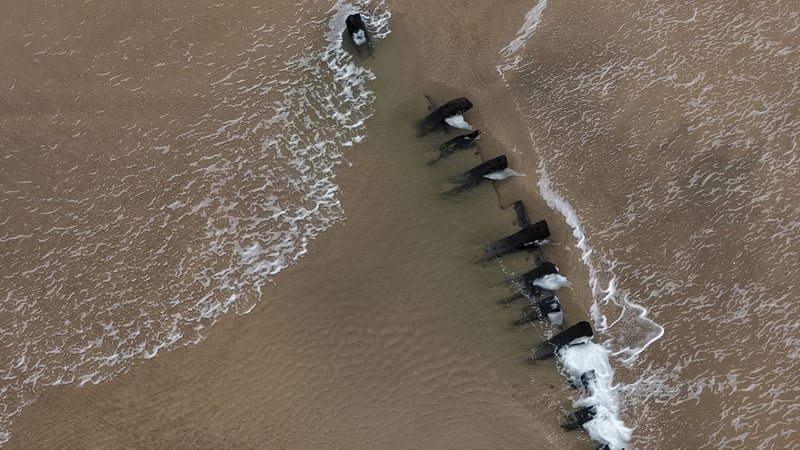

A mystery surrounding the final resting place of a ship that sank off north Donegal more than 200 years ago, claiming the lives of its 253 crew members, may be near resolution.
The HMS Saldanha, a 36-gun Royal Navy frigate which patrolled the coast during the Napoleonic Wars, sank in hurricane-like conditions in Lough Swilly on 4 December 1811.
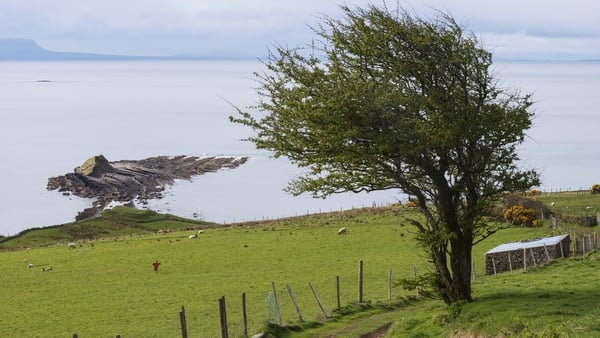
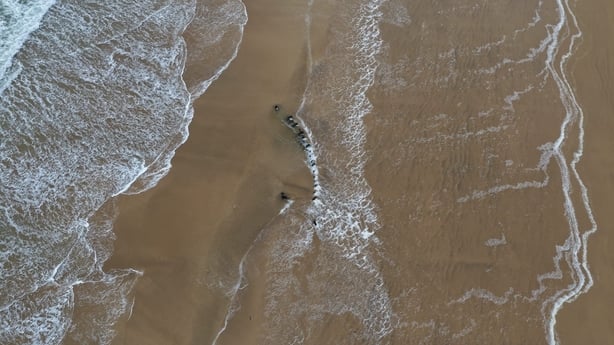
Sand displacement during the spring caused by high winds revealed what may be the starboard bow of the ill-fated ship on Ballymastocker Beach, Co Donegal.
Within several days, winds shifted the sands again and re-covered the timber structure. However, ensuing research has found the discovery is "consistent with the Saldanha".
The Underwater Archaeology Unit of the National Monuments Service's intends to carry out more extensive recording when tides and weather permit.
A spokesperson said research is continuing to identify the wreck and added they are liaising with the local community, who have a very keen interest in the Saldanha.
Local archaeologist and historian Dr John O'Raw says that the wooden structure is consistent with the Saldanha, having examined the wreckage and the ship's drawings.
"We can say it's consistent with being the first 14 meters of the starboard bow of the Saldana to about eight feet above the keel.
"But we can't say for certain it's the bow of the Saldana … proving it is another thing altogether. It's going to take a little bit more time," Dr Raw said.
He said they will need to see if the outer side of the planks are copper sheeted and if the material in the hold matches that of an Admiralty vessel of that time.
"We can determine some of those characteristics without disturbing the wreck and the best place for that wreck is exactly where it is - conserved in situ.
"The wreck will start deteriorating immediately once we expose it. The reason why it's in such good condition is that it hasn't been exposed in my lifetime in Buncrana.
"What we need to confirm what it is, though, ideally, is one piece of evidence that marks it as being the British Admiralty.
"If we find one piece like that; honestly, it's too big a section of wreck to be anything else that's unidentified," Dr Raw said.
What research work has been carried out since February?
The Tír Conaill Tribune first reported the emergence of the shipwreck in a detailed article about the ship, whose wreckage led to the building of Fanad Lighthouse.
A local research team used surveying techniques to take detailed measurements along with aerial photographs while the wreck was still exposed.
This information was georeferenced; images were aligned with geographic co-ordinates which gave centimetre accuracy positioning on some of the beams.
The National Monuments Service (NMS) told the BBC it carried out an inspection on 7 February and undertook a rapid recording, acquiring positive locational details for the wreck.
The NMS told RTÉ News research is continuing to identify the wreck and a team intends to return to the Fanad Peninsula later this month.
All wrecks over 100-years old are protected under the National Monuments Acts, and a licence is required to survey and investigate any such site.
What was the Saldanha doing before it sank?
The HMS Saldanha was sailing with the HMS Talbot in November 1811, patrolling the northern coast when British forces were engaged in the Napoleonic Wars.
The ship was a fifth rate Apollo class of the Royal Navy, commissioned in April 1810.
Dr Raw believes the ships would have been seeking American vessels, vessels coming from the states or European vessels going out the other way.
He says a crew of six to eight men operated each gun that was heavy, lethally dangerous with a huge recoil; crews had to fire, swab, reload, reassert position and fire again.
"The English had that down to a fine art of sometimes two, three minutes. For that reason, though, you had a very, very big crew," Dr Raw said.
He says some of the crew may have been forced to join by press gangs, acting for the Royal Navy during the 18th and early 19th centuries.
Following the storm that claimed the Saldanha; two substantial pieces of wrecked washed ashore. Many early reports said it was the Saldanha and the Talbot - information later deemed to be inaccurate.
"There was a letter from a midshipman in the Talbot which detailed events of the night, and that was conflated with the wreckage on the beach," Dr Raw said.
"The Talbot was blown south by the hurricane; she was too far west to make it to Lough Swilly. When the Saldana was being wrecked, the Talbot was close to Arranmore and by the following morning, she was in Clew Bay.
"One of your strategies for escaping a hurricane is to run in front of it with as little sail as possible; enough sail to control the vessel and keep going forward. You're running in front of the storm, and that's what the Talbot did."
He says the HMS records in London are "excellent" as they detail minute records including information about the ship, food, wind, swell and weather conditions.
He said the letters issued from Fort Dunree are available as are Admiral Edward Thornbrough letters from Cobh Harbour, two weeks before the Saldanha left.
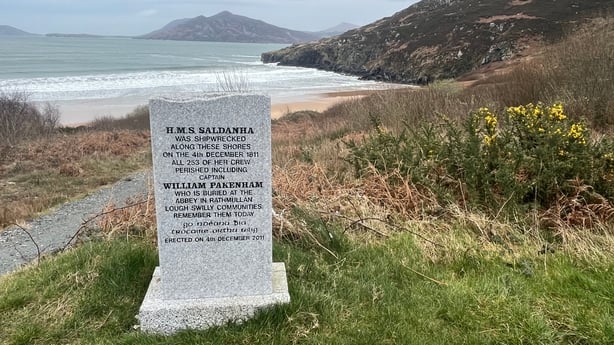
The Fanad community raised funds to erect a monument near Ballymastocker Beach in December 2011, marking the 200th anniversary of the tragedy.
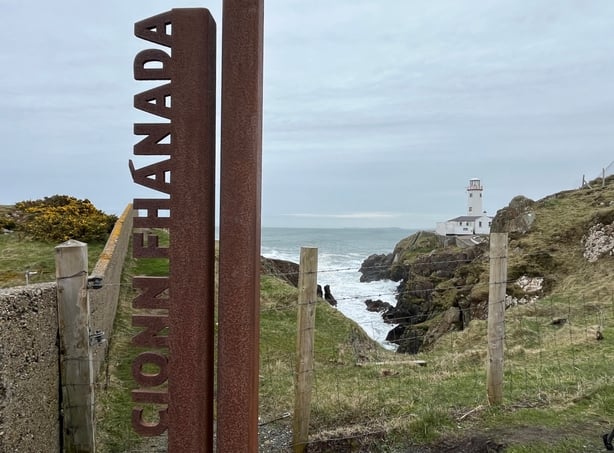
Fanad Lighthouse built following the tragedy
The tragedy of HMS Saldanha prompted the building of Fanad Lighthouse, which was first lit on St Patrick's Day 1817 and has illuminated north Donegal waters since.
Lighthouse manager Eimear Ní Mhathúna says that the now automated lighthouse, which doubles as a tourist destination, attracts 65-70,000 visitors per year.
"We're here because the Saldanha went down. They started work in 1815 and the Lighthouse was lit for the first time on St Patrick's Day 1817 and it's lit ever since," she said.
Ms Ní Mhathúna said they tell the story of the Saldanha using a virtual reality experience to introduce the story to visitors to the lighthouse.
Replica models are displayed at Fanad Lighthouse and across Lough Swilly at Fort Dunree Military Museum.
Museum Manager Gráinne McNally says the once British military base, which now hosts an onsite café and an exhibition centre, was the last of the three treaty ports handed back in 1938.
"My understanding is that the Saldanha it had come into Lough Swilly because there were rough seas, and as it came in, it hit the rocks over in Ballymastocker Bay," she said.
"We now have the Saldana building in commemoration to it. We were lucky enough to get this [replica] boat commissioned in memory to all the lives that were lost."
Ms McNally said an anchor from the ship, displayed in the museum was recovered by fishermen in the 1980s.
The Saldanha is etched in the story of Lough Swilly.
"The bodies came in on the beach locally. There's a memorial on the Knockalla coast road. It's around us all the time," Ms Ní Mhathúna said.