
Wetter winters, more flooding. Storm Chandra earlier this month saw scientists' predictions of climate change effects on Ireland ringing true.
Heavy rain falling on saturated ground, particularly in the Wicklow Mountains, brought misery for households and businesses as the Slaney and Dodder rivers burst their banks
There have been renewed calls for better flood defences, particularly in Enniscorthy, Co Wexford, but some believe the most effective flood prevention measures may be up in the hills.
Data from a bog restoration project in Co Wicklow could support their argument.
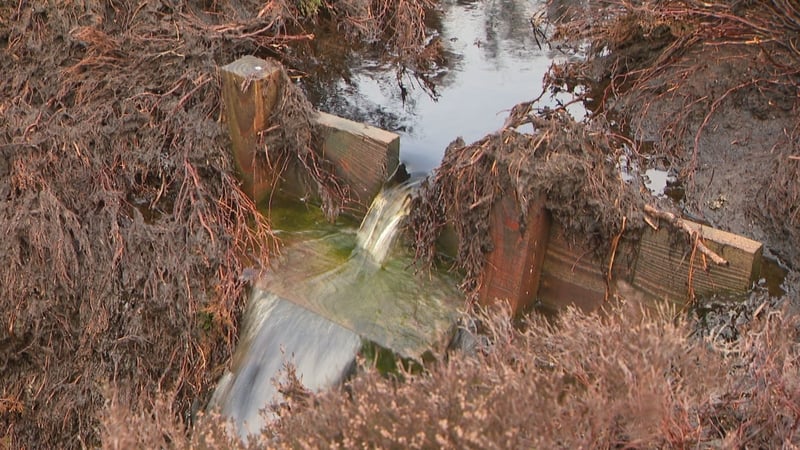
The project, run by the National Parks and Wildlife Service, involves rewetting a bog below the Sally Gap, on the lower slopes of Kippure mountain. Drains had been cut into the bog many years ago to dry out the peat for commercial extraction. Over several years, NPWS teams, working with contractors, have blocked the drains for an area covering about 120 hectares with wooden dams.
Watch: Bog restoration project in Co Wicklow could change the effects of climate change
We need your consent to load this rte-player contentWe use rte-player to manage extra content that can set cookies on your device and collect data about your activity. Please review their details and accept them to load the content.Manage Preferences
NPWS Scientific Advisor and Research Director Dr Shane Regan says gauges to measure water flow in the drains found a dramatic decrease.
"What we find is that the flow rate has decreased by about 30% post restoration.
"And what that means is that water is now being stored in the catchment. It's being stored behind the dams that we have to block the drains, and also within the peat itself."
This slows down the rainfall as it makes it way into the River Liffey. Dr Regan says the patterns have changed, even during heavy rain.
"Before the restoration work started, we were measuring the runoff in this drain, and when it rained, it really rained, and the water escaped the site really quickly."
He says that since the restoration the bog is storing water and flattening the peaks.
"There's less intensity in terms of the peak runoff events, which means you're going to reduce flooding downstream."
Peatlands cover around 80% of the Wicklow Mountains National Park and most of them are described as having an unfavourable conservation status. The work on the bog below Kippure is just one of several restoration projects in the park.
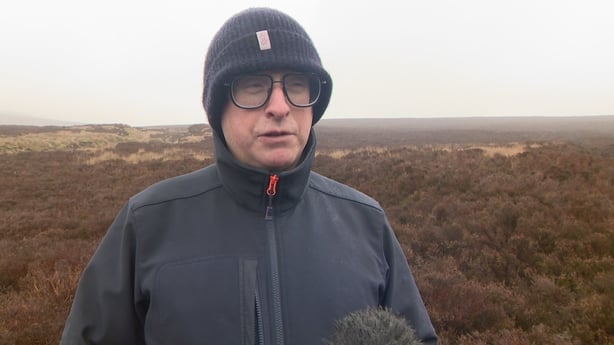
"There's a number of strands to that," says Damian Clarke, NPWS Manager of the Wicklow Mountains National Park.
"There's this kind of technical project here, where there's a lot of science behind a lot of engineering, large-scale. But then we have smaller, locally led, locally focused projects on bare-peat areas, where we use our own staff and volunteers and do similar restoration works."
He says water storage is just one of the benefits of bog restoration, "once these bogs are rewetted, once we stop the flow off them, the plant species come back. You know, bird life, all the things that should be there.
"This is kind of the iconic vistas of the National Park. These large open, could be described as bleak, areas. Seeing those kind of scars on, and those human scars on them ... but we can repair [them]. That takes time, but, you know, we can see that. We've proven it now."
The cost of the Kippure project is about €1 million. The benefits include the biodiversity gains, the water storage and switching the bog from being a carbon source back to being a carbon sink. Dr Regan explains that when a bog is restored to health, it absorbs about two tonnes of CO2 from the atmosphere per hectare every year.
Professor of Geomorphology at the Department of Geography at Trinity College Dublin Dr Mary Bourke says all these benefits make peatland restoration projects "incredibly important" but adds that they would be worth investing in for the flood protection alone.
"They really are the secret weapon that we have in the Irish landscape, in particular, for addressing our flood problem. So much of our landscape is covered by peatlands, and a lot of these peatlands have been adjusted or interfered with by human activities, whether it's industrial level, mining of the peat, or even local level or forestation.
"So what we're trying to do at the moment is to address some of that change that we brought to the peatlands to allow them to function naturally. And when they function naturally, they are a great help for mitigating the worst effects of floods."
No one is suggesting that peatland restoration will remove the need for other flood prevention or protection works and hard engineering solutions will still be needed in many Irish towns or cities.
But as accelerating climate change drives more extreme weather they can be a cost effective element of the response.