
The Dáil Public Accounts Committee (PAC) has heard that the introduction of localised flood warning systems could take another five to 10 years.
The first stage of the National Flood Forecasting and Warning Service has been delivered, with the Flood Forecasting Centre commencing operations in January 2024.
The head of planning and climate adaptation for the Office of Public Works (OPW) said the initial timeline for this stage was five years. However, Robert Mooney said this "ran over to seven years".
The second stage will be implemented on a phased basis with a focus on local flood forecasting.
Sinn Féin TD Joanna Byrne asked for a concrete timeline for the communities most at risk of flooding.
"I'm not hearing any hope, I'm not hearing hope for the people of Enniscorthy, I'm not hearing hope for the people who are repeatedly being affected in the same years because of the lack of a completion of this project," she said.
Mr Mooney responded: "I can tell you internationally 15-20 years is not unusual to stand up a flood forecast and warning from scratch."
When asked by Ms Byrne if it is "another five to ten years is what we are looking at", he said: "We are yes."
He said it was the understanding from the outset that establishing a flood forecast and warning service was going to take time.
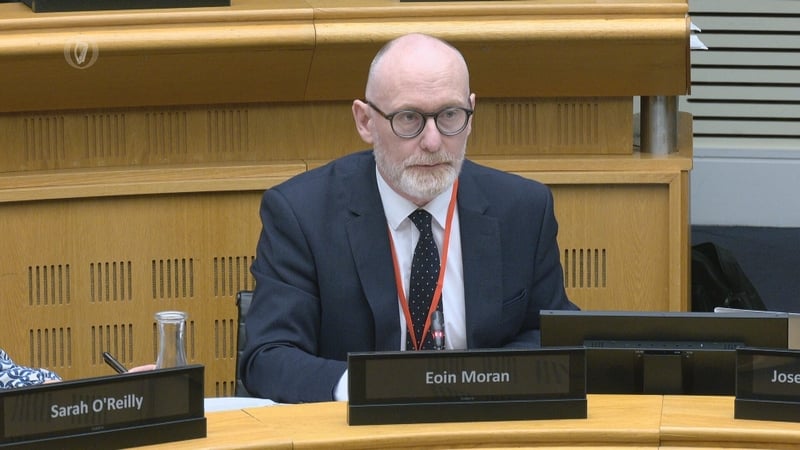
Met Éireann director Eoin Moran said it "fully" appreciates the urgency. He said the forecaster is working with its partners and is part of a multi-party system. He said a system-wide plan for this phase will be available this year.
Responding to a similar question from People before Profit TD Paul Murphy, Mr Moran said a plan is being put in place which will "include all those timelines".
When asked by Fine Gael TD Grace Boland, Mr Moran said "governance has moved" to the Office of Emergency Planning within the Department of Defence.
Fine Gael TD James Geoghegan asked if the development of technology and AI could shorten the timeline of 10-15 years.
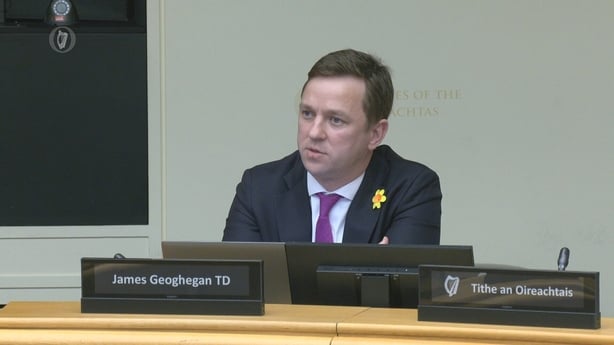
Mr Mooney said these are all considered when it comes to the "quickest way to deliver what we intend to".
Mr Geoghegan also asked if there was a "grain of truth" that "inter-agency wrangling" has led to a delay in recent weather warnings.
In response, the chairman of the OPW John Conlon said he "never fully understood this narrative", adding there has always been a "very constructive and robust relationship" between the OPW and Met Éireann.
OPW warns climate change will have 'significant impact' on flood risk
The OPW chairman also warned that climate change will have a "significant impact" on flooding and flood risk in Ireland.
Mr Conlon said that Ireland must be prepared to "deal with and manage the increased flood risk arising from climate change".
Ireland will be at more risk of flooding due to "rising sea levels, increased rainfall in winter, more heavy rain days and more intense storms", he said.
Mr Conlon said flooding poses a "significant risk to people, the economy, our environment, culture and heritage".
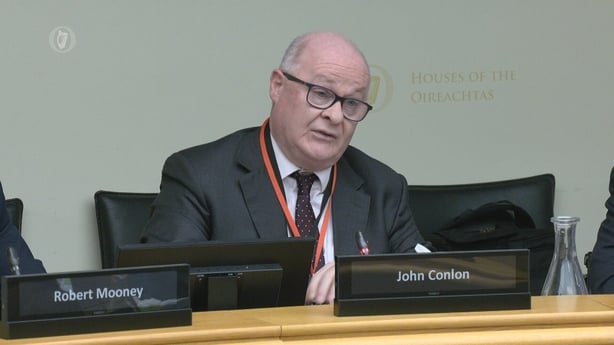
"Recent attribution studies have shown that climate change is already impacting flood events," he said.
Mr Conlon said an "accelerated" rise in sea level is "projected to continue to rise into the future, regardless of action taken to reduce greenhouse gas emissions".
"It may be that foundations for schemes being built now, are designed to accommodate increases in the height of flood events in the future," he added.
He said the Government has committed €1.3 billion to flood relief under the National Development Plan to 2030 and the OPW has invested €580 million in 56 completed flood relief schemes.
Mr Conlon said these schemes are currently protecting 13,580 properties nationwide and provide an "economic benefit in damages avoided estimated to be in the region of €2 billion".
He said 100 schemes are in the design, planning or construction phase.
Met Éirean's director also told the committee that climate change is a present-day reality.
"It is already reshaping weather patterns, intensifying extreme events, and heightening risks for communities globally and here in Ireland," said Mr Moran.
He said last year was Ireland's second warmest year on record, adding that "seven of Ireland's warmest years have occurred since 2025".
He said that 2025 "began with a significant snowfall event, followed by Storm Éowyn, which brought the strongest winds ever recorded in Ireland".
This was followed by the "warmest summer on record and fourth wettest autumn".