


Former ministers in the government and State bodies will be facilitated in giving sworn testimony to the Omagh Bombing Inquiry, according to a new Bill.
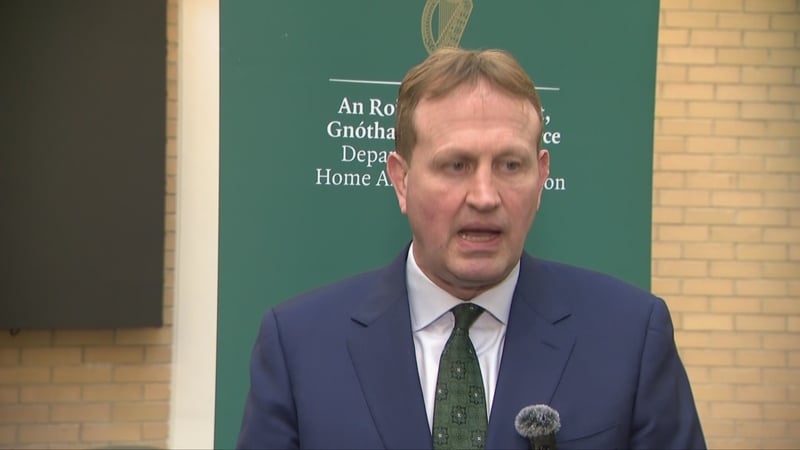
Minister for Justice Jim O'Callaghan secured Government approval for the Bill today.
It is designed to enable the taking of oral testimony in courts in the Republic for the purposes of the Omagh Boming Inquiry in Northern Ireland.
Mr O'Callaghan said: "Obtaining Government approval to present this Bill to Dáil Éireann in the coming days is another important milestone in delivering on the Government's commitment to facilitating and supporting the work of the Omagh Inquiry.
"This legislation relating to oral testimony will add to the suite of measures already implemented.
"This includes the Memorandum of Understanding which I signed with the chairman of the inquiry last April relating to the disclosure of Irish State materials, and the data protection regulations that I signed in November to enable the disclosure of sensitive personal data to the inquiry."
He said the Bill would "maximise the assistance" provided to the inquiry to fulfil its terms of reference while also safeguarding "the essential interests of the State" and the rights of witnesses involved.
He added: "The need for any further action to be taken by the Government in the course of, or following the conclusion of the inquiry, will be kept under review."
Former ministerial office holders will be provided the same protections as gardaí and other former office holders.
No garda response, says DUP
The DUP's leader has said that An Garda Síochána has "never" responded to requests from the Independent Commission for Reconciliation and Information Recovery (ICRIR).
Speaking to reporters in Stormont, Gavin Robinson said: "Families have gone to the ICRIR, and families have asked for information that would help them understand what happened to their loved ones.
"Do you know how many times An Garda Síochána responded to requests from the ICRIR?
"Never. They have never satisfied one request."
His comments came after a meeting with Minister for Foreign Affairs and Trade Helen McEntee.
Mr Robinson was asked if he had been given any information about a timeline for Irish legislation addressing the legacy of the Troubles.
He said there was "an indication" there was progress with the legislation, but he would need to study it with a "victim-centred" approach.
He said An Garda Síochána's responsiveness to the ICRIR is an example of the Government's approach to legacy issues.
He added: "We hear from Irish politicians continually that they're interested in satisfying the request of victims, they're interested in answering the queries that loved ones have.
"Actions speak louder than words.
"The ICRIR never once had a satisfied response to a request for information.
"So whether they honoured the framework agreement last September and set up a telephone line or not, it doesn't matter if they're not going to provide information through those channels."
Asked if he had "heard that" from the ICRIR, Mr Robinson said the Government has a "blanket refusal" for "any Irish State authority to engage with ICU".
He said: "That's their position, but they don't say it.
"You'll not hear it from them, all you'll hear are the honey words while engaging with victims and assuaging their concerns.
"They are not delivering or living up to the honour of the words they say."
Speaking to reporters in Belfast, Minister Helen McEntee said: "There's been a lot of back and forth in getting to even where we are today, and front and centre of everything that we do has to be the families of those who have been impacted and survivors."
The Minister for Foreign Affairs had been asked why the proposed legislation only allows for investigating how UK security forces failed to prevent the bombing, as some families and groups want the Irish Government to investigate how Irish forces could prevent the bombing.
She said the Government, Mr O'Callaghan and his department "have been working closely with the chair of the inquiry and making sure that any adjustments that needed to be made to this legislation, that they were made, and obviously, that we can be in a position once the first hearing started, to be able to provide whatever information is needed".
She added: "If there is more that needs to be done beyond this, the Irish Government will not be found wanting.
"But our focus and priority is making sure that the Irish Government is in a position to be able to support and to provide whatever information, or otherwise, is necessary throughout this inquiry."
