


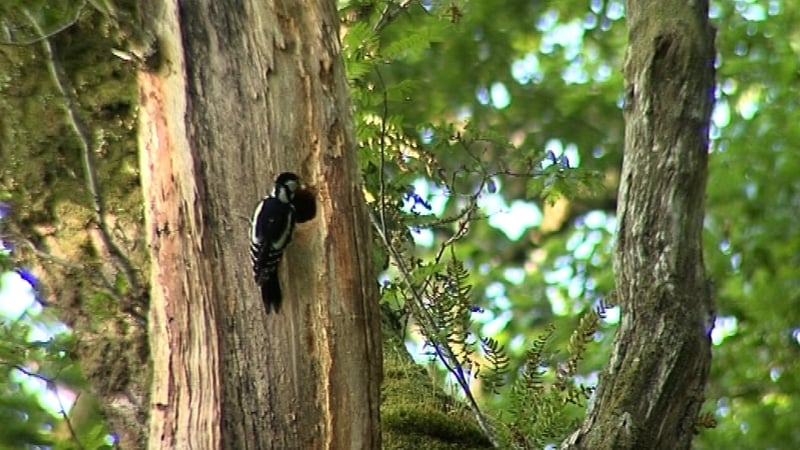
Power cuts in a Co Clare town have been caused by woodpeckers pecking electricity poles and not a faulty transformer or storms.
Fine Gael TD for Clare Joe Cooney asked ESB Networks to explain the repeated outages, which he said had caused significant inconvenience for householders in Clogga, a townland located to the east of Sixmilebridge.
Eight interruptions were recorded in 2025, including two multi‑day losses of supply in January and November. Three more outages followed in January 2026.
As the name suggests, Woodpeckers peck trees and wood searching for insects and also to communicate with each other.
In its response, ESB Networks said its staff were "very conscious of the continuity issues" experienced locally and confirmed that a major upgrade of the network is now under way.
The company said the unusual problem stemmed from woodpeckers boring into wooden poles, which had weakened them to the point that they had to be replaced.
We need your consent to load this rte-player contentWe use rte-player to manage extra content that can set cookies on your device and collect data about your activity. Please review their details and accept them to load the content.Manage Preferences
"At issue here is woodpeckers. They have been damaging our poles on the network," the company said in its response to Mr Cooney.
"Our colleagues are replacing these wooden poles with a composite pole in order to prevent woodpecker damage going forward."
ESB Networks said the work would require further planned outages, which would be staggered to "minimise the disruption to the customer".
It said that customers would receive advance notice of any interruptions.
"We apologise to customers for the inconvenience here, and thank them for their forbearance," the company said.
It added that the upgrade would lead to "improved resilience and continuity in the local network into the future".
Speaking on RTÉ's Today with Claire Brock, Mr Cooney, said apart from the the birds eating into ESB poles, they are flying into the cables and loosening transformers at the top of the poles.
"This is a serious concern", Mr Cooney said.
He said other countries have been forced to introduce metal poles because of similar problems.
The ESB has a filler it can place in poles to prevent woodpeckers eating them and they are examining doing this in the future, Mr Cooney said.
He added that the birds, which are a protected species, have been rare in rural Ireland, and it was believed that they had gone altogether.
"I couldn't believe it when I heard woodpeckers were causing the issue, he said, and when I told affected residents they asked; is this a joke?"
