



Criminal barristers in Northern Ireland who are striking indefinitely have called for urgency in addressing the "crisis" in the justice system.
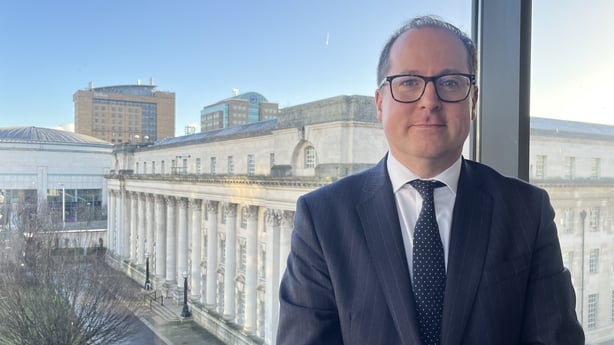
Chairman of the Bar Council of Northern Ireland Donal Lunny KC said barristers will not resume work on legally aided crown court cases "until the department shows the pragmatism and the urgency that's required to resolve the issue of crown court fees".
Counsel in the region had already withdrawn their services in some legal aid-funded cases last year due to the long-running dispute with Stormont's Department of Justice.
Barristers plan to increase their action from today by not participating in any current cases before the crown courts. Of the 193 members of the Criminal Bar Association (CBA) who voted on the proposal, 89% backed a full withdrawal of services.
The CBA said fees for legally aided criminal work have not been increased since 2005, making them worth just 50% of their original value.
Stormont Justice minister Naomi Long has committed to increasing their fee rates by 16%.
Mr Lunny said he recognised that Ms Long was in a "difficult position" as a result of funding cuts to the department, but that "in the overall scheme of the Department of Justice's budget and funds, a relatively small amount of money is all that's required to resolve this long standing problem".
He told the Press Association: "We know, for example that the data breach case (compensation claim from PSNI officers whose details were made public in a 2023 data breach), a conservative estimate as to how much that will cost the Department of Justice and the PSNI is something like £119 million - that's essentially the same: one issue, one incident, the same as the annual budget for legal aid.
"So as to how the minister in the department manage their money, that's a matter for them. But in overall terms what's required to fix this is a relatively small amount of money."
Sir Brain Leveson's review of criminal courts in England and Wales showed a backlog of up to 80,000 cases, with new trials listed as far in the future as 2030, a five-year wait from the point of charge.
Mr Lunny said the criminal justice system in Northern Ireland is headed the same way if the problems are not resolved.
"In a way, the strike is a red herring. The real crisis is that barristers and solicitors firms aren't doing criminal work because the legal aid rates are so poor," he said.
"In England and Wales, even though the legal aid rates are much better than they are here, they can't attract sufficient numbers of barristers either to do the defence work or the prosecution work, and that crisis that they're having is where we will end up if the rates aren't improved and improved significantly."
He added that young barristers in Northern Ireland "are not interested in doing crown court work because the pay is so poor, so you have an ever dwindling cohort of older barristers doing that work".
The family of Natalie McNally, who died after she was stabbed at her home in 2022, described the potential of further delays in her murder trial as a "kick in the teeth" when a judge last month cautioned the court may not be able to proceed in January as planned due to industrial action.
Mr Lunny said barristers "aren't blind" to the impact the strikes will have on victims.
"Barristers who are practicing in the crown court every day know exactly how traumatic those cases can be," he said.
"It won't just have an impact on victims, it will have an impact on accused persons. It will have an impact on witnesses. It will have an impact on jurors, people who are asked to serve on juries, so our members are very aware of the impact it will have.
"It's important to recognise that it was very much a last resort step. It was a step that was not lightly taken.
"As to how much of an impact it has, that's very much in the hands of the department," he said.
"The department, if they want to deal with this crisis - and there is a crisis in the criminal justice system aside from this strike - there is a crisis in the system that the department aren't showing any urgency in attempting to tackle."
When industrial action was announced, Ms Long accused barristers of seeking to "leverage further trauma and stress on victims" and said she wasn't confident "the CBA is committed to meaningful engagement".
Mr Lunny said Northern Ireland's Lady Chief Justice Dame Siobhan Keegan advised in November that the CBA and department engage with a specialist mediator, to which the barristers accepted and the department declined.
"We don't know their reasons, because we've never seen the letter that they wrote to the Lady Chief Justice, but we have always been and we remain willing, ready to mediate with the department if they change their mind," he said.
The Department of Justice has been approached for comment.
