


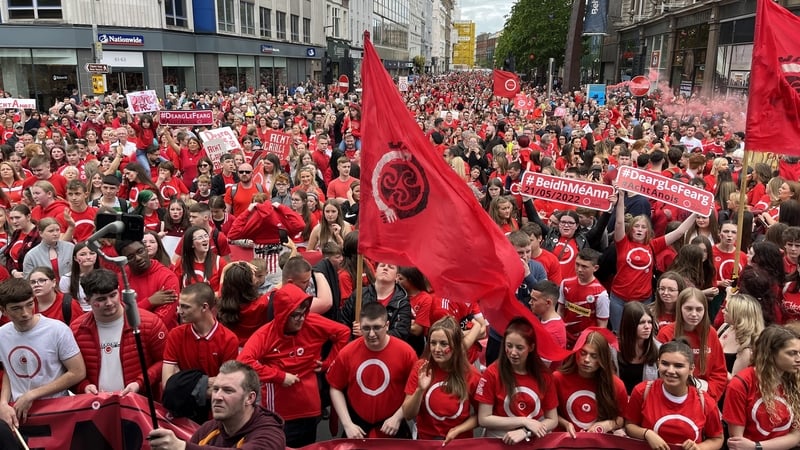
Disparities in plans to grant the Irish language official status in Northern Ireland need to be addressed or they will face continuing unionist opposition, ministers have been told.
DUP MPs questioned why a proposed Ulster Scots language commissioner would not have the same powers as one for the Irish language, as outlined in the Language and Identity (Northern Ireland) Bill.
Upper Bann MP Carla Lockhart claimed the legislation is "a reward for those who have weaponised the Irish language for decades".
But ministers said the Bill was crucial to future community cohesion in Northern Ireland.
Legislative protections for the Irish language in Northern Ireland were a key plank of the New Decade, New Approach agreement that restored power-sharing in January 2020 after a three-year stalemate.
However, an impasse over forming a new executive in Belfast continues after May's elections.
The draft law also proposes two commissioner roles - one for the Irish language and another for the Ulster Scots/Ulster British tradition.
Ms Lockhart told the Commons the DUP would vote against the Bill at second reading, and would table amendments, "and should those changes not be made, we will continue to oppose the Bill".
"This legislation, rather than addressing the facilitation and respect for language and identity, is in fact a reward for those who have weaponised the Irish language for decades," she said, adding that the Bill would result in language and identity being a "more potent weapon that causes greater damage".
Ms Lockhart said consensus and cross-community support are normally deemed the cornerstone of the political process in Northern Ireland, but warned the Bill "removes that cornerstone".
East Antrim MP Sammy Wilson claimed the Northern Ireland Secretary Chris Heaton-Harris had "quickly glossed over the role of the two commissioners", telling MPs: "This is one of the ways in which this does not faithfully reflect what was agreed in the New Decade, New Approach.
"The commissioner for Irish language will have the power to direct other public bodies, and that will have significant impact, especially on some unionist-controlled councils, depending on the decisions he makes.
"The Ulster Scots commissioner will have no such power to direct."
Alliance MP Stephen Farry (North Down) responded to the DUP, telling MPs it was time to "move past the comments about weaponising language and relegate those to a small minority of people who have said that".
"Let's focus on those who are genuinely asking for protections for the right reasons in Northern Ireland," he added.
SDLP MP Claire Hanna (Belfast South) told MPs she regretted that the language debate had "become zero sum", adding: "We have an opportunity through pieces of legislation like this and more to fly by those nets, particularly to a generation for whom 'us and them' just doesn't mean as much as all of us.
"We can make language about the richness of communication and about heritage and not about an identity marker."
Shadow Northern Ireland secretary Peter Kyle highlighted some areas for improvement but noted that Labour hopes the Bill receives "swift passage" through the Commons.
Mr Heaton-Harris said: "The provisions of this Bill are based on enshrining respect and tolerance for all Northern Ireland's diverse identities, cultures and traditions and indeed celebrating their contribution to Northern Ireland.
"We introduce these provisions in the firm belief that Northern Ireland's rich diversity contributes immeasurably to the Union, to which this Government holds a proud and fundamental commitment.
"It is our sincere and genuine hope that the parties in Northern Ireland will form an executive in the not too distant future to make the necessary appointments, oversee the implementation of this important package and maybe deal with some of the issues that have been raised by honourable members in this debate today."
