

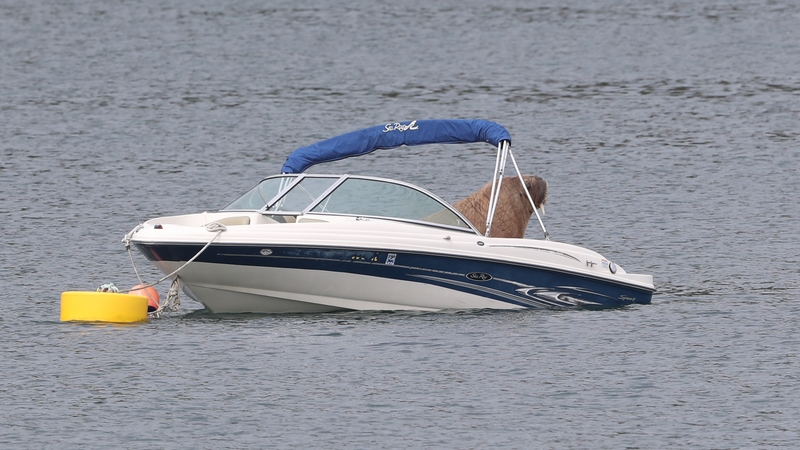
The Irish Whale and Dolphin Group (IWDG) and Seal Rescue Ireland have urged walrus-watchers to observe Wally the Walrus along Ireland's southern coast from a distance and not to interfere with the animal.
The Sightings Officer of the IWDG, Padraig Whooley, said the less interference from members of the public and organisations "who feel compelled to help it along" the better.
Speaking on RTÉ's Morning Ireland, Mr Whooley said: "It is doing absolutely fine on it's own and there is no evidence it will benefit from human protection."
Mr Whooley advised: "Don't mill around on boats as it has the potential to disturb this animal."
He said the walrus looks healthy and does not appear to be injured as it moves along the coast from Waterford to west Cork.
"We want it to move on so it can find the track north," he said.
The Arctic walrus was first spotted in Ireland off the coast of Valentia Island in March, and has since travelled 4,000km along the coast of western Europe, being spotted in France, Spain and the UK.
Efforts to build pontoons for the walrus is prolonging the difficulty, said Mr Whooley.
"The walrus is doing absolutely fine without us."
Mr Whooley said the walrus "is sinking one or two boats in every harbour" it enters.
He urged people to cover boats or remove engines, adding "it's not a walrus problem" and that insurance would cover any damage.
'People need to cooperate and respect him from a distance'
Melanie Croce, Executive Director of Seal Rescue Ireland, has described the walrus as a "juvenile wild animal" who is unpredictable and not here for people's entertainment.
She has echoed the calls for the public not to approach the walrus and to just observe him from a distance.
She told RTÉ's Today with Philip Boucher Hayes that he has been displaced from his Arctic habitat and it is hoped he can make his way back there.
Her advice for people wanting to catch a glimpse is to keep a distance of at least 100 metres and not to distract him by making noises.
Ms Croce also called on people not to share his location and to keep in mind he is tired as he is only four or five years old.
She said he is moving quickly across the coastline and by the time they had a pontoon organised for him he had moved on to the next location.
The walrus may have sustained some superficial injuries as he gets in and out of boats when people have tried to approach him in their boats and kayaks, she said.
She warned he could also cause damage if people get too close.
