
Interpol and An Garda Síochána have warned about increasing reports of 'sextortion' in Ireland and globally, saying young men are being most commonly targeted by individuals working within organised networks.
Sextortion - or sexual extortion - is a form of online extortion in which the target is threatened with the publication of intimate images or videos unless a financial demand is met.
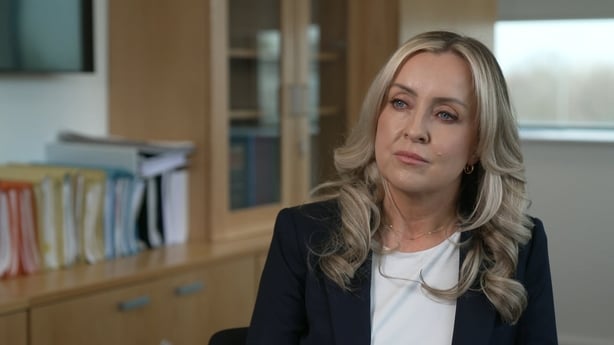
Detective Superintendent Sinéad Greene from the Garda National Protective Services Bureau (GNPSB) told RTÉ's Prime Time that over the last two years "it's something that we're seeing increased reporting of".
"The cohort of individuals that we're seeing that's being targeted most is young male victims, between the ages of 18 and 24, with males under the age of 18 being targeted as well," she said.
"They're engaging with individuals online on social media messaging apps, dating apps, and sharing intimate images and videos.
"What that ultimately leads to is the person on the other end, the individual themselves or a crime group, making demands for money or making demands for further images."
Senior officers at international policing agency Interpol told Prime Time that the crime remains vastly under-reported.
Director of Cybercrime Neal Jetton said the groups behind these crimes are "very organised," with criminals operating across borders and working in coordinated groups to target victims at scale.
These networks often run "mass campaigns", sending large volumes of messages across social media, gaming and dating platforms to draw victims in.
Once contact is made and an image or video is obtained, offenders "put immense pressure" on victims, threatening to share material with friends and family unless money is paid.
"You can look at any sort of statistics and what you'll see is an increase," Mr Jetton said.

Shane’s story
For one 21-year-old Irish man, that pattern unfolded within minutes.
Shane, not his real name, said he was contacted in May last year on TikTok by someone who he thought was a woman his age.
He was very active on TikTok at the time with thousands of followers, so it wasn’t unusual for someone he didn’t know to message him out of the blue.
"They said they're originally from Glasgow, but the way they spoke, it sounded like they just lived down the road from me. There was nothing really out of the ordinary than what I was seeing on Tinder or any other of the dating sites."
After messaging back and forth for a while, the woman suggested they move to a video call over Facebook Messenger.
"The call happened and I could see there was a girl staring at me through a camera, and it looked like the profile.
"It got intense really quick...she typed into the chat that microphone wasn't working.
"I'd say, two minutes [into] the call, her clothes were off on the screen, and she was messaging asking to see me... and asked me to take my pants off."
Shane said he "in a lapse of judgement, obliged" but that during the call he "could see a little red dot at the top of my screen, and then the call ended."
Shane realised the call had been recorded and within seconds, a three-second clip of the video, showing him with no clothes on, was sent to him.
"Straight away my heart sunk, I didn't know whether to shout or cry or scream or throw the phone or do what.
"I instantly knew straight away ... this is a scam, they're going to blackmail [me]."
Moments later, the woman he thought he was talking to started to demand money.
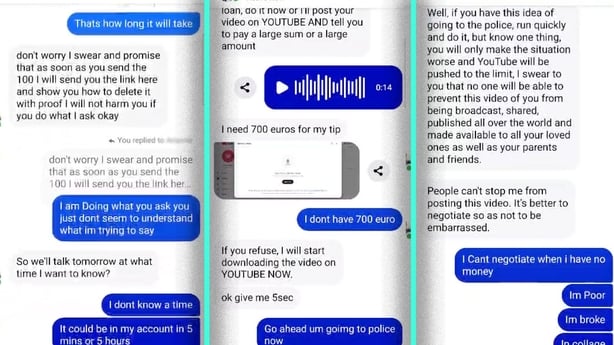
Shane screen-recorded the entire interaction and provided it to Prime Time. The messages show constant demands for money and threats to share the video with his friends and family on Facebook, as well as publicly on YouTube.
Initially, the scammers asked for €100 to be sent via payment apps like Western Union to an account based in Ivory Coast, in West Africa.
The scammer wrote: "As soon as you send the 100 I will send you the link [to the video] here and show you how to delete it."
Shane explained he didn’t have access to those apps but would send the money by Revolut.
"I sent over the money ... and then straight away he just kept demanding more and more. It was nonstop," Shane said.
But as soon as that was sent, they started demanding more.
"I need 700 euros for my tip," the scammers wrote to Shane, who said he had no more money to send. "Don’t mess with me ... I’ll give you 1 minute for my tip otherwise the video will end up on YouTube."
At that point, Shane said they started creating private groups on Facebook, with Shane’s friends, family and colleagues.
"They had about four different groups going with seven friends per group."
Although Shane tried to negotiate with them, the scammers followed through on their threats. They started sending the video into private Facebook groups, as well as on his friends' Facebook walls.
"They were colleagues, they were friends, they were mutual friends, family friends. It was quite literally anyone you can think of that could have seen it."
Once the video was shared, Shane didn’t know where to turn. "There was a lot of thoughts, dark thoughts, angry thoughts.
"I didn't know what to do, to be honest. I just broke down in my room. I messaged everyone privately saying, this is a scam, don't open the link.

"I was contemplating just leaving, packing up, going, blocking everyone and going. I didn't know how to confront my parents or anyone to tell them this has happened ... to be brutally honest with you, I just, I wasn't in a good spot."
Shane did contact his local garda station and made a statement.
"Straight away they were understanding. They straight away told me it was organised crime, they're criminals, they're gangs, I'm not the first person and they said I won't be the last, unfortunately."
An Garda Síochána do not comment on individual cases.
In a statement, it said that it "received report of an incident of fraud involving a male (20s) in the Eastern Region which occurred in May 2025. Gardaí engaged with the injured party and the relevant financial institution throughout the investigation."
Working with the Irish Internet Hotline, where people can report illegal online content, they managed to get the video taken down, although many of Shane’s friends, colleagues and family had already seen the video.
"There's jokes about calling me a paedo, calling me ... other not so nice names, and it has really affected me personally, as well as emotionally and physically.
"I felt dirty and I do still feel dirty when someone brings it up. I feel like I'm not a victim, but I'm suspect. I'm the person that's in the wrong over it, opposed to being the one that's had something happen to me."
Det Supt Sinéad Greene said that’s "really difficult to hear that somebody feels that they're not a victim because this is a really serious crime of a sexual nature, and the only way to target these individuals is to come forward to us and report it, not to feel shame, not to feel any embarrassment about that."
How the scammers operate
Interpol's Neal Jetton said what happened to Shane follows a classic pattern.
"They're going to put immense pressure on you, you know, put shortened timelines, things like that, say that they're going to talk to your friends, [that] they know who they are through like social media."
In terms of who is behind these scams, Interpol’s 2025 Cyber Threat Assessment report said digital sextortion has emerged as a prominent cybercrime across Africa.
"Sextortion is one of the top three crimes that they saw that was rising," Mr Jetton said, adding that regions like West Africa have emerged as hubs for this type of crime, although offenders operate globally.
The groups operating in this area are highly organised, he said.
"You do have those that are going to be recruiting. You do have those that are operating the profiles. You do have those that are going to have to go out and work with the money mules once the money is sent. And then you're going to have to have, you know, a tech support kind of team."
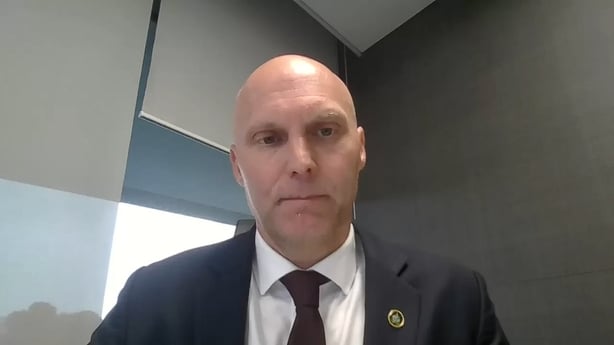
The groups are also using AI to expand their operations. "It allows a single operator to run a ton of different profiles, accounts, things like that, where it used to maybe you'd have to manage them with more people," Mr Jetton said.
"I think that AI is going to allow more automation, so it's going to make this crime type even more difficult to combat."
For Shane, he said he’s much more careful online now. "Socially, on dating apps, I'm very cautious in relation to anything like that. I don't really engage much in social media anymore."
He said he seeks "counselling for it" and "I do openly speak about it to my family, and you know, they are supportive of me ... They understand it was just a genuine mistake."
He wants to raise awareness about this kind of crime, and to urge people to seek support.
"Do come forward and don't let it build up and don't try to deal with it on your own."
The full report by Clarity Correspondent Kate McDonald and producer Lucinda Glynn will feature on the 2 April edition of Prime Time on RTÉ One and RTÉ Player at 9.35pm.
If you’ve been affected by any issues raised, please go to https://about.rte.ie/ie/helplines/ or contact the numbers below.
Irish Internet Helpline - Report Line: +353 86 8116273. Garda Confidential Line on 1800 666 111