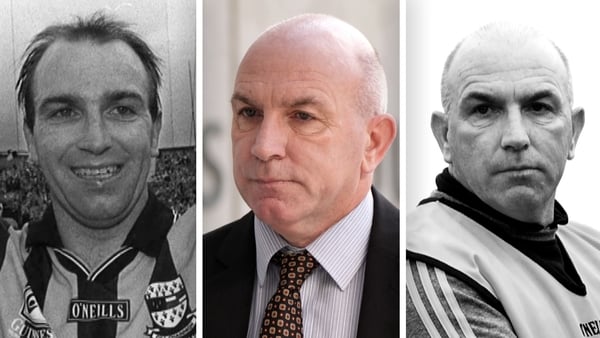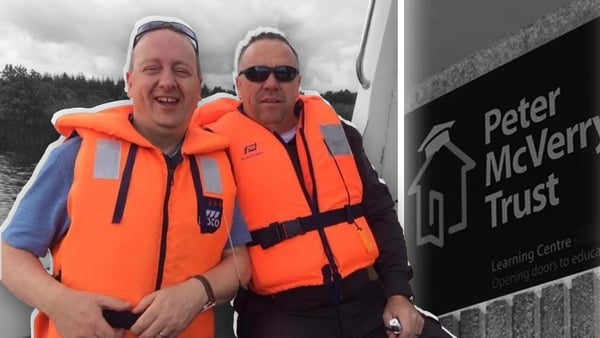
"I never thought it would be so hard to get the right people to do the right thing for the right reasons," 54-year-old former Air Corps technician, Gavin Tobin, told Prime Time.
Mr Tobin is one of around 20 men taking a case against the State – his case was lodged in 2014. He says he was exposed to hazardous chemicals in the period from 1991 to 1994 while working for the Air Corps and was not provided with personal protective equipment (PPE) or training in the handling or use of hazardous chemicals.
He joined as a 17-year-old in 1989 and two years later was assigned to a maintenance workshop, the so called 'engine shop' which held tubs of hazardous chemicals used to clean engine parts.
"I went into those chemical workshops… and we had no training whatsoever," he says. "You don't think of death or you don't think of illness or health at that age."
Mr Tobin says he "started getting sick" when still serving and "then [it] just continued on with gastrointestinal problems, immunological problems, neurological problems, mental health problems."
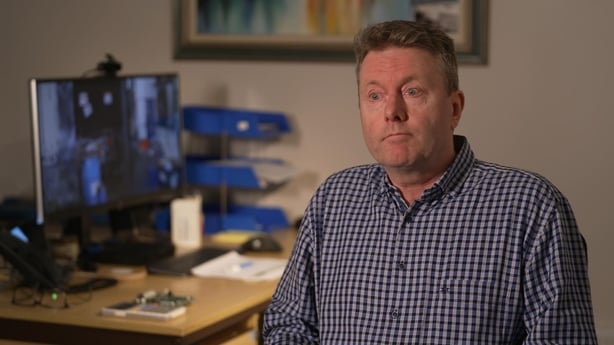
Air Corps technicians routinely used heavy-duty chemicals, for example, in stripping, cleaning or repainting engine parts.
"The chemicals that we're considering here are mainly organic solvents," says retired Toxicological Pathologist Professor Vyvyan Howard.
Prof Howard, who has examined around ten people who claim they were affected, is an expert witness for the plaintiffs.
"These compounds would cause what we call a diffuse neuropathy or a diffuse damage to the brain," says Prof Howard. They "can also affect other organs like the liver".
'Increased risk'
Mr Tobin wouldn’t have known at the time, but when he was serving, internal Air Corps reports were highlighting a lack of protection for Air Corps personnel.
In one 1992 report, a health and safety officer warned of "an increased risk of personnel contacting some form of industrial skin disease" because supplies of industrial hand cleaner and barrier cream had run out.
Gary Coll, 52, a technician who joined the Air Corps two years after Mr Tobin, told Prime Time they barely had the proper facilities to wash their hands.
"You had cold water. That's all they had in any of the bathrooms. There was cold water and maybe a carbolic bar of soap or something."
In another report from 1992, an Air Corps health and safety officer wrote to a superior that "it is unhygienic and unreasonable to expect a technician to work in an oil and grease environment without adequate protection."
The letter warned that it was "absolutely essential that these basic materials are purchased immediately to comply with conditions under the Health and Safety Act."
Mr Tobin lodged a case against the State seeking compensation in 2014. The State fought him, denying any responsibility. He describes a marathon process to secure the discovery of key safety information held by the Air Corps.
He first sought this discovery in August 2015, the High Court ruled in his favour in October 2016. Then the State appealed in 2018, Mr Tobin lost the case. He then appealed to the Supreme Court, which ruled in his favour in 2019.
"I beat them five nil," Mr Tobin said, noting that the five judges in the case unanimously sided with him.
"They had to give me the safety data sheet for every chemical used in Baldonnel," referring to the Air Corps headquarters in Dublin where he served,
But, he says, "the State ignored it".
"So, we started a High Court case against them for non-compliance with the Supreme Court order."
The High Court ruled in his favour in early 2023, and in October of that year he received hundreds of safety data sheets for various chemicals used at Baldonnel, more than eight years after he had first sought them.
Mr Tobin believes that there is a deliberate strategy to exhaust litigants.
"Delay, deny, die," he says.
‘Delay, deny, die' is a slogan used by the Air Corps Chemical Abuse Survivors group, which Mr Tobin spearheads.
It draws from the term 'delay, deny, defend' to characterise how insurance companies in the United States aggressively fought claims and denied valid claims in order to minimise pay outs.
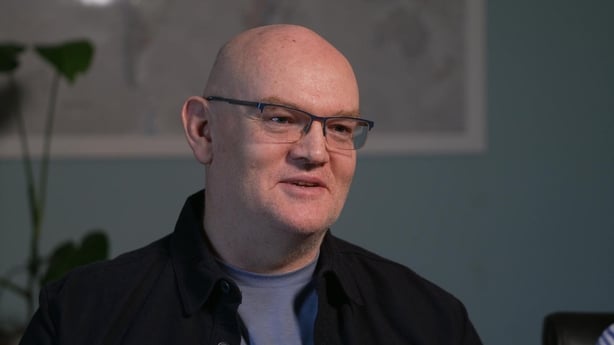
Mr Tobin's case is one of around 20 cases being taken by former Air Corps personnel.
The State "will fight the cases tooth and nail," according to Norman Spicer, senior solicitor at Coleman Legal.
For some, the consequences of the exposure are now life-altering.
Of the cases, some of which date from 2014/15, only one - taken by Gary Coll - has concluded.
He settled on the steps of the court last year, receiving €2m, with no admission of liability by the State.
When the Donegal man joined the Air Corps as a 17-year-old he was fit and athletic.
"More energy than I could use," Mr Coll recalls. "I was an exceptional runner... then I picked up rowing for a while, and I have two national titles in rowing."
But the 52-year-old is now classified as disabled. He suffers with short-term memory loss, mood swings, body shakes, mobility problems, and difficulties with his body temperature regulation - all problems that he says are connected to his exposure to harmful chemicals.
His wife Sheila has become his carer.
"He can't dress himself, usually, on his own… He needs help in the bathroom. He needs help with food, you know, getting himself fed," Ms Coll said.
Like other former Air Corps personnel that Prime Time spoke to, Gary Coll has developed an acute sensitivity to everyday chemicals.
"Anything shop-bought, like cleaners, soaps, shower gels, deodorants, Gary can't tolerate any of those," Ms Coll says.
She now mixes her own materials for washing and cleaning in the home. Vinegar and baking soda are ingredients of choice. She has "gone back to what my granny would've used," she says.
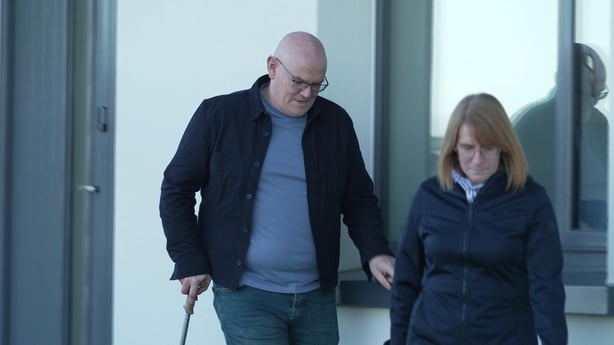
Mr Coll has been diagnosed with toxic damage to his central nervous system.
In the Air Corps for eight years, he worked in the avionics section on aircraft electronic systems.
Like other former personnel that Prime Time spoke to, he describes a careless culture towards the handling of a carcinogenic chemical called trichloroethylne or 'trike', which was regularly used in the Air Corps.
He says, despite manufacturer’s recommendations to wear PPE when using trike, it was used like a household cleaner in the Air Corps.
"You could have an instrument that you need to clean a sticker off," he says, and "you’d run next door to the engine shop to get a little bit trichloroethylene."
Trichlorethylene, notes Professor Howard, is "an acknowledged, human cancer-causing agent, particularly kidney cancer, but also liver cancer" and can also damage the central nervous system.
Such was the apparent lack of training that some men told Prime Time that they even used trike to clean their hands.
"If you got heavy oils or greases on your hands, sometimes washing them wouldn't take it off. So, we would literally dip our hands into the… trike."
It could "remove all oils and greases instantly," said 'Tadhg' who spoke on condition we did not use his real name.
Tadhg has a growth on his kidney. It is not currently cancerous, but he is worried.
"I am concerned because a couple of colleagues who did work with me have kidney cancer," he said, noting that a third former colleague had a cancerous kidney removed.
'Tubbing'
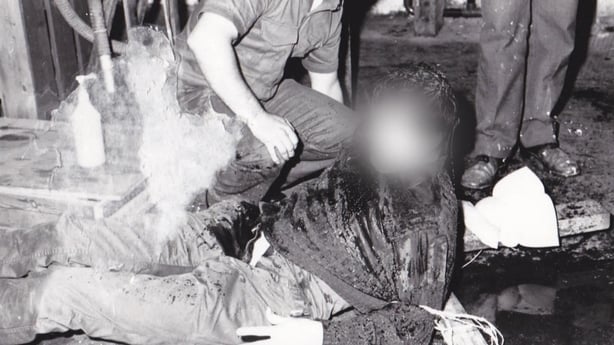
They say knowledge and enforcement of health and safety was so poor in the 1980s and 1990s that the young men even used dangerous chemicals in hazing rituals, including in a common practice known as 'tubbing'.
A report by an independent group established to scrutinise Defence Forces' policies and procedures for dealing with bullying, harassment and sexual misconduct, describes tubbing as: "the placing of an individual in a barrel, which may contain any combination of chemicals, oil, airplane fuel, deceased animal carcasses, or other substances, for the purposes of hazing or punishment."
"You could be tied to a stretcher and doused in hand soap or toxic chemicals," Mr Tobin said, "mainly because the people didn't understand what they were dousing [you] in."
"The biggest organ in the body, of course, is the skin," Professor Howard said. "So if you are wetted with something, that would certainly increase the likelihood of internalising anything that's in the liquid."
Mr Coll remembers one tubbing.
"I think it was my 21st birthday. I was set upon for tubbing and whatever was poured on me, it was very sticky," he said. "I developed a very bad rash. And a few weeks after that, I noticed that I started losing the pigmentation in my hair as my hair went white."
One side of his body was affected. Mr Coll, who was a redhead, ended up with the hairs on one leg turning white.
"It was surreal," he said, "I never got it back."
State's response
Despite reporting by some media - especially by the Irish Examiner - over the last decade, concerns about chemical exposure to those who served in the Air Corps have largely remained outside the public consciousness.
However, when he was leader of the opposition back in February 2017, current Taoiseach Micheál Martin raised it in the Dáil with then-taoiseach Enda Kenny.
"I want to raise a very serious issue with the Taoiseach which, on reflection, could represent a serious scandal," Deputy Martin said, after speaking to whistleblowers.
"It involves an unacceptable response by the State regarding exposure to dangerous chemicals at the aircraft maintenance shops in Baldonnel."
In the time since, Micheál Martin moved from the Opposition to the Government side of Dáil Eireann. He's now Taoiseach. While Tánaiste from 2022 to 2025, he was also the Minister for Defence.
The State continues to deny responsibility.
In court documents, seen by Prime Time, the State Claims Agency said that Air Corps members who worked with chemicals were provided with proper protection.
"Defendants at all times took reasonable care for the safety of the plaintiff and provided him with a safe system of work, proper equipment and proper training."
Yet many internal Air Corps documents call that certitude into question, including a 2014 report.
That report into a process involving the hazardous chemical trike says, "No records of training on the dangers of using Trikelone N or the process or how to properly carry out the process exist."
The report also said that "One (1) pair of gloves was available to be used between all personnel who could be required to carry out the process. No personal PPE issue was made to individuals."
The State Claims Agency did not accept an invitation to do an interview, but said it "seeks to act fairly, ethically and sensitively in dealing with people who have suffered injuries."
As far as Prime Time is aware, Gary Coll is the only ex-Air Corps member the State has compensated for chemicals exposure, with its €2m, no-admission-of-liability settlement last year, 11 years after he lodged the case.
"There's nothing easy when you sue the Government, they don't make it easy. I got exposed to chemicals and I sued the Government and they spent ten years punishing me for it," he said.
Other similar issues elsewhere have been resolved through different processes.
Australia
Before he became Taoiseach, Micheál Martin championed the example of Australia, which also had cases involving chemicals exposure within the Royal Australian Air Force.
The RAAF chemicals exposure issue related to the sealing and resealing of fuel tanks on F1-11 fighter bomber planes.
"It was prolonged repeated exposure to volatile organics, solvents, which were in the workplace … They were exposed without appropriate protective equipment," said Australian immunologist Professor Peter Smith.
In 2000, within weeks of Australian authorities being alerted, an investigation began and the following year a Health Care Scheme was introduced for those thought to be affected.
"They dealt with the problem and wanted to make sure there was no ongoing further issues with current service personnel. And they wanted to make sure that people that had exposure were looked after," Professor Smith said.
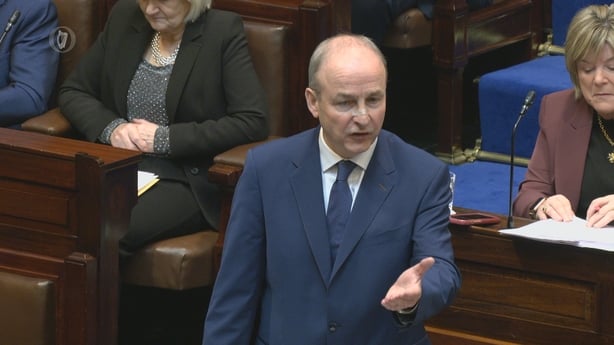
In 2017, Deputy Martin told the Dáil, "The Australian government's approach was markedly different to that of the Irish government, which is to deny repeatedly and resist and, more or less, say to the whistleblowers that it does not accept anything they are saying."
In Ireland, the only practical possibility of redress is via an invariably lengthy and expensive court case.
"Their [Australia’s] first instinct was to help people. Our first instinct was to cover up," says Mr Tobin, whose Air Corps Chemical Abuse Survivors group is campaigning for the State to provide focussed medical screening and other care for those affected.
Minister for Defence Helen McEntee declined an interview request citing the fact that the issue was before the courts.
Likewise, Taoiseach Micheál Martin, did not accept an invitation for interview.
When he was tánaiste, Mr Martin established the Defence Forces Tribunal, which has been up and running since last year.
It is mostly focused on sexual and other abuse in the military, but it also partly includes the chemicals exposure issue. Under its terms of reference, it will examine only the complaints process and how complaints were handled - not the actual issue of chemicals exposure.
"It's an investigation into complaints of chemical exposure ... Nobody complained, we didn't know to complain," Mr Tobin said.
While health and safety in the Air Corps is generally recognised to have improved since the 1990s, its poor record is not ancient history.
Prime Time has seen copies of monthly reports by a Baldonnel unit safety officer seeking to secure respirators for plane refuellers to protect them from fumes that can trigger conditions such as irritable bowel disease.
A May 2012 report stated, "Jet Fuel and Avgas exposure. Respirators required."
The request was highlighted again in October 2013 and other months. By August 2014, it was still in the outstanding column. Then in September 2016, the monthly report stated, "Respirators for refuellers, I've been told we are getting some."
Finally in November 2016, after four and a half years of asking, the monthly report noted, "Respirators have been given to refuellers."
The Air Corps did not comment specifically on these issues, except to say that "all Air Corps personnel are issued the Personal Protective Equipment they require to conduct their assigned role."
Air Corps safety culture improved on the back of several inspections by the Health and Safety Authority (HSA) in 2016.
Those inspections occurred after complaints to the HSA from then-serving member of the Air Corps, Paddy Gorman, along with two former Air Corps personnel, including Gavin Tobin.
But we may never know how many Air Corps personnel were harmed by chemicals poisoning.
Gavin Tobin has catalogued over 100 premature deaths that he claims may be linked to chemicals exposure, but unless and until the State does an audit, reliable figures will likely remain unavailable.
In 2017, when in opposition, Micheál Martin himself called for an audit to be undertaken.
"Will the government commission an independent health outcome study of aircraft maintenance personnel, similar to that carried out by the Australian government?" he asked.
Solicitor Norman Spicer, himself a former member of the Defence Forces, urges greater speed.
"They've been aware of this issue for over 10 years now, at this point, litigation's been ongoing for over 13 years. It really just beggars belief that they wouldn't put some measures in place to look after these public servants. Men and women who have served the State," Mr Spicer said.
Gary Coll’s wife, Sheila, said it appeared as though they did not matter because they were soldiers.
"They were out helping their country, serving the country, doing their job every day and yet they were exposed to these chemicals and nobody is saying ‘we will help you,’" she added.
Meanwhile, Gary Coll and others like him are living with the consequences of chemicals exposure.
"The future looks bleak, but we make the best of what we've got," Ms Coll said.
"With Gary's diagnosis, we don't know how long he's got. It could be next year; it could be five years."
A report on chemical exposure in the Air Corps from Paul Murphy and producer director Sallyanne Godson is broadcast on the 26 February edition of Prime Time at 9.35pm on RTÉ One and RTÉ Player.