

Comments last year by Taoiseach Micheál Martin suggesting that a significant proportion of households in emergency accommodation were refusing housing offers prompted RTÉ to examine how often people across the country refuse long-term homes.
Analysis of housing data from 16 local authorities shows refusals account for around one in ten offers nationally, suggesting that while refusals occur, they are not a major factor in people remaining in homelessness.
The research also exposes a fragmented and opaque data collection process within local government, which leads to difficulty assessing the true rate of refusals nationwide.
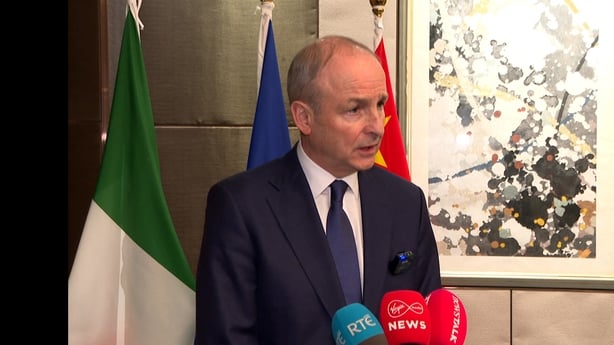
In September 2025, Taoiseach Micheál Martin told RTÉ's Morning Ireland that 26% of households in emergency accommodation in Cork City were refusing long-term housing offers.
The figure sparked discussions about whether people in emergency accommodation are turning down suitable homes, and whether refusals are a significant factor in how long people remain homeless.
"The homeless situation is more complex than presented," he said.
"The officials in the city council said to me that up to 26% of those in emergency accommodation in Cork City refuse an offer of a house. So, it's not as simple as presented. It tends to be more complex than housing not being available."
In the days after the comment, RTÉ began contacting local authorities to try to get a national picture of the number of households in emergency accommodation who refuse housing offers. We wanted to understand if the situation in Cork City was reflective of the national picture.
What emerged across the process was an insight into the fragmented way some data on local authority housing is collected across the country.
RTÉ sought data from the Department of Housing, which publishes quarterly performance reports referencing the number of housing offers made to, and refusals by, people in emergency accommodation.
When RTÉ sought to understand if the data in the quarterly reports could be combined to calculate a national figure, the Department said it could not, as its IT system "is not integrated with the various IT systems in use by Local Authority Housing Allocations teams."
It added that, as a result, "the number of social housing refusals recorded on [The Department's IT system] may under-represent the total number of social housing offers made."
RTÉ therefore sought figures covering the 12-month period preceding the Taoiseach’s comments from each individual local authority.
However, Cork City Council — the local authority referenced by the Taoiseach — did not hold figures for the most recent 12-month period and instead supplied data for the 2024 calendar year.
RTÉ subsequently returned to councils and requested comparable figures for the 2024 period.
Fragmented data
At that point, it became clear that local authorities also compiled the data in different ways.
Some councils which supplied data initially included people moving from emergency accommodation into private accommodation supported by Housing Assistance Payment (HAP) or the Rental Accommodation Scheme (RAS) within their total number of offers.
The majority did not, instead counting only allocations to Local Authority (LA) or Approved Housing Body (AHB) homes as offers.
In several cases, refusal rates could only be calculated after councils supplied additional breakdowns allowing private-rented exits to be excluded.
After attempting unsuccessfully to obtain comparable data from each local authority, RTÉ decided to exclude councils which could or would not provide data counting only allocations to LA or AHB homes as offers.
Of the 31 councils, 16 provided data in a way that allowed direct comparison.
This limited data was then used to understand the national picture.
Across the 16 councils, refusal rates ranged from 0% to 27%.
Of the 1,724 local authority or AHB housing offers made across those councils in 2024, 189 were refused, producing a national refusal rate of approximately 11%.
We need your consent to load this flourish contentWe use flourish to manage extra content that can set cookies on your device and collect data about your activity. Please review their details and accept them to load the content.Manage Preferences
When asked about refusal rates in 2024, Cork City Council, the local authority referenced by the Taoiseach, said "27% of families in Emergency Accommodation who were offered an exit to long-term housing refused the offer."
However, it would not provide a breakdown of what that 27% specifically relates to, despite repeated requests by RTÉ.
This lack of transparency prevents us from understanding whether Cork City has the highest rate of refusals nationally or is including refusals of other types of accommodation offers in the data it provided.
Partial data provided by councils was not unusual. The inconsistency underscores the limits of drawing broader conclusions from a single headline percentage.
While there are limitations to any interpretation given the available data, it would appear the 26% figure represents a local snapshot rather than reflects a national trend.
The Department’s quarterly reports, per the department itself, cannot be combined to annualised figures. However, they also point to a far lower level of refusal nationally than that listed by Cork City Council.
Data in the Q4 2024 report indicate a refusal rate of approximately 6%.
Local snapshots
Several other councils supplied data which were outliers to the national trend and could be misinterpreted if taken in isolation.
Wicklow also recorded a refusal rate of 27% but made just 11 offers in total — equating to three refusals. Though significant locally, the number has minimal impact on a national outlook.
Five councils — Galway County, Longford, Carlow, Louth and Tipperary — reported no refusals out of 159 total offers during the periods examined.
Most others recorded only small numbers, typically in single digits.
Dublin breakdown
Dublin councils manage approximately two-thirds of the country’s emergency accommodation system.
All four Dublin local authorities supplied comparable refusal-rate data for 2024: Dublin City and South Dublin each recorded refusal rates of between 10% and 13% while Dún Laoghaire–Rathdown recorded a lower rate, of just over 2%. Fingal’s refusal rate was 19%.
Taken together, Dublin’s figures broadly mirror the available national picture: most households accept the tenancy they were offered, with the four councils recording a combined refusal rate of 12%.
Why people refuse
Councils that provided additional detail cited a range of reasons for refusals, most of which related to location or suitability of the property.
Some households turned down homes because they were too far from schools, family supports, or existing childcare arrangements. Others raised concerns about safety, including reports of feuding or antisocial behaviour in certain areas.
Several councils said refusals were linked to the type of property offered — for example, families being offered apartments, homes without gardens, or properties that they perceived did not meet the needs of children or larger households.
A small number of refusals were attributed to mobility or medical issues, where the layout or access of a home was unsuitable.
What happens when an offer is refused?
Local authorities differ in how refusals are handled, but most said they apply some form of consequence or review process.
Several councils — including Louth, Kerry and Monaghan — stated that a refusal of a reasonable offer can result in households or individuals having their emergency accommodation withdrawn, as placements are intended to be temporary.
Where Choice Based Letting (CBL) is used, councils often apply specific rules. CBL is a process through which a council advertises the availability of a property to households on their accommodation waiting list. If they consider it suitable, households can then alert the council to their interest in it.
In Galway city, a household that refuses an offer after having expressed an interest in the property may be suspended from CBL for 12 months.
Several councils emphasised that staff engage with households after a refusal to try to understand the reasons, assess whether the refusal was reasonable, and discuss the implications for their housing application.
Limerick, for example, distinguishes between reasonable and unreasonable refusals, recording them separately. Of the 17 refusals recorded between October 2024 and October 2025, three were considered reasonable while 14 were deemed unreasonable.
Overall, while the approach varies, the majority of councils treat refusals as a formal part of the allocation process, with clear procedures in place to record them and, in some cases, penalties where the accommodation is deemed suitable.
There is no consistent national dataset from which refusal rates can be directly compared across all local authorities.
As a result, RTÉ’s analysis is based solely on the councils that supplied complete, like-for-like information.