Visitors to one of the country's top tourist attractions, Kilmainham Gaol museum, are being hit with a scam which sees them pay for fake tickets through duplications of the museum’s official website.
Staff at Kilmainham Gaol told Prime Time they have dealt with dozens of cases in recent weeks and warned that some visitors have lost thousands of euros.
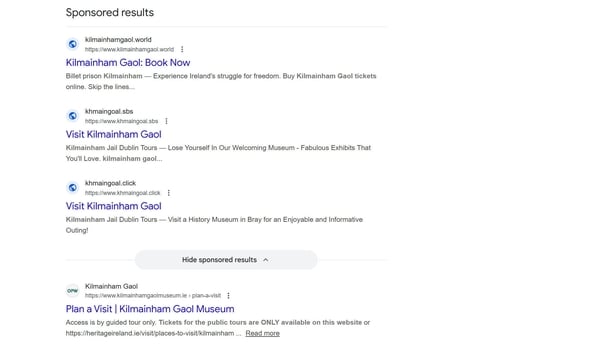
The scam operates through Google Search advertisements which appear as the top result for search terms related to the museum.
The link in the ads usually sends users to websites that are designed to closely replicate the official Kilmainham Gaol website, using similar layouts, colour schemes, and booking interfaces.
Prime Time examined the domain records for several of the websites promoted through these ads. All the advertisers identified by Prime Time were labelled as "advertiser identity verified" by Google.
Two of the sites were registered in January 2026, just days apart. One was created on 4 January, another on 9 January, and both began appearing in paid Google search results shortly afterwards.
'Identity verified’
According to Google’s own documentation, advertiser verification involves confirming that an advertiser is who they say they are, typically through identity documents such as passports, driving licences, or business registration papers.
Google’s verification process does not assess whether an advertiser is authorised to sell tickets for a venue or whether they are affiliated with the attraction they are advertising tickets for.
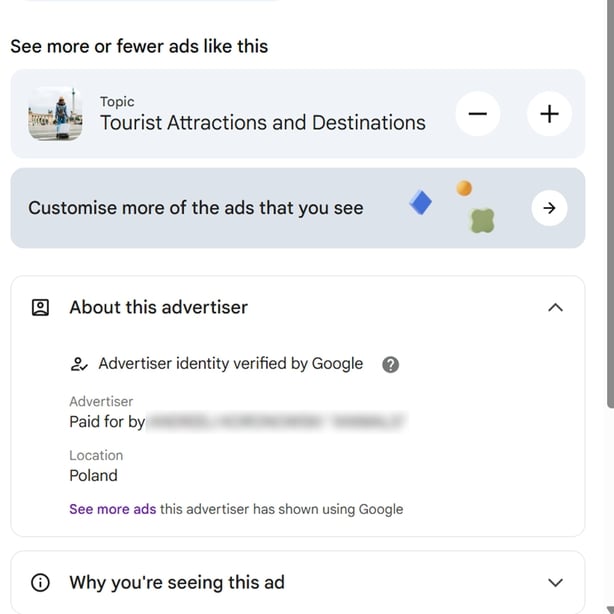
In other words, verification confirms identity, not legitimacy or authority.
Google search advertising operates on a pay-per-click model, meaning advertisers pay each time a user clicks on a sponsored result.
Several scammed in just one morning
Prime Time attended Kilmainham Gaol on Saturday morning and spoke to several visitors who only discovered their tickets were not valid on arrival.
Whitney, an American tourist, said she realised something was wrong only when she arrived at the museum.
"I went to what I thought was the website, and when I walked in the door they said I didn't have tickets," Whitney said.
"I just googled the website and the first thing that popped up was a Kilmainham Gaol address. The website looked super legitimate. I bought it online and they gave me confirmation and they said they would send an email, but I never gave them my email address, so I did wonder if something was wonky," she added.
On arrival, Whitney, who had just landed in Dublin from Florida that morning, said staff advised her to cancel the card she had used to make the purchase. She ultimately lost €16.

Another visitor, Josip from Croatia, said his bank intervened before he even realised he had been the target of a scam.
"My card was blocked straight away," he said. "There were multiple attempts to take money from my account."
Josip said there were three attempted withdrawals of between €250 and €300 from his account, which appeared in lari - the currency of Georgia - were blocked by his bank.
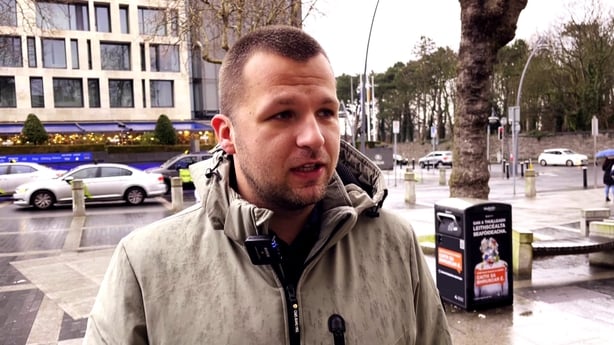
Seán, a visitor from Co Limerick, said he came close to buying a ticket through one of the scam websites, but did not complete the purchase.
"It seemed to be the top search on Google," Seán said. "It looked legitimate, and there seemed to be a lot of availability."
On a single day earlier this week, Prime Time identified at least four separate advertisers - all marked by Google as having their identities verified - running paid search ads in Ireland linked to Kilmainham Gaol tickets.
The advertisers are based in different countries according to Google’s Ads Transparency Centre, including the UK, Germany, Poland and the United States, and are not explicitly linked to one another. However, all shared key features.
All of the ads appeared at the top of Google search results, and above Kilmainham Gaol’s official website.
They also all use official-sounding language, such as "Kilmainham Jail Dublin Tours" or "Book Tickets," and they all direct users to websites unaffiliated with the Office of Public Works (OPW) which runs Kilmainham Gaol.
‘Acutely aware’
The OPW said it is "acutely aware" of an ongoing issue involving fraudulent websites and sponsored Google ads designed to mislead visitors to Kilmainham Gaol museum.
In a statement, the OPW said it has repeatedly reported misleading ads to Google, but that while some have been removed, new ones "frequently appear".
It said no third-party organisations are authorised to sell tickets for Kilmainham Gaol, and that tickets purchased through unofficial sites are invalid and cannot be honoured and that the only official website for ticket sales is kilmainhamgaolmuseum.ie.
The statement added that staff at Kilmainham Gaol have been dealing directly with visitors affected by the fraudulent activity, and warned that scam websites often claim to have unlimited availability for dates that are officially sold out.

In recent months, similar scams have been reported at other high-demand tourist attractions across Europe, including the Anne Frank House in Amsterdam, the Louvre in Paris, and Auschwitz-Birkenau near Kraków.
Platform responsibility
Google’s ad systems are designed to sell and place high-value search terms — like "tickets" — at speed and scale. Misleading advertising appears to be caught only after ads have already been published.
In many cases where individual ads are later removed, the underlying system and website remains unchanged, and can be duplicated to another web address, and another advertising account.
After being contacted by Prime Time about the issue, Google asked for screenshots of alleged scam sites related to Kilmainham Gaol.
Later, a spokesperson said the company has removed the ads identified by Prime Time and suspended the associated accounts for breaching its advertising policies.
The spokesperson added that Google prohibits ads that scam users and uses automated systems to detect and enforce against misleading advertising.
Under the EU’s Digital Services Act, large online platforms such as Google are required to assess and mitigate systemic risks arising from how their services operate, including risks to consumers.
The law does not require platforms to prevent every misleading advert before it appears, but it does place an obligation on them to identify patterns of harm and take reasonable steps to reduce repeat abuse.
The Kilmainham Gaol case highlights how quickly misleading ads can reach users before enforcement action, and how harm can occur in the gap between approval and removal.
A report on this subject from Jack McCarron and Aaron Heffernan is broadcast on the 22 January edition of Prime Time at 9.35pm on RTÉ One and RTÉ Player.