
AI chatbot Grok has brought something that was largely hidden into the mainstream.
Deepfake technology that can undress anyone in any image has existed for years but it was mostly confined to niche websites, apps, or private channels.
What changed around Christmas is that it was put directly into Grok, the AI chatbot. That made it available to every user of X - tens of millions of people.
Almost immediately, users began publicly prompting Grok to alter photos of real women, and sometimes children, to put them into bikinis or sexualised clothing.
Despite producing the images following prompting from users, and making them available publicly, Grok itself often labels the images it creates as adult content, which simply requires users to click to see them.
The subject of the original image has typically given no consent, and has no way to stop it.
Grok had been generating around 6,700 sexualised images an hour, before limiting the feature to paid subscribers, according to researchers.
It's a scale incomparable to anything else related to nudification online. The five most popular nudification sites combined produced just 79 images in the same period.
Elon Musk, who owns Grok and X, has said there will be consequences for anyone using Grok to make illegal content. Yet he also dismissed calls to restrict the tool as censorship and an attack on free speech.
For a platform designed to maximise reach and engagement, the controversy drives attention, and that is much sought after in the modern technology world and economy.
However, under Irish law, sharing non-consensual intimate images - deepfakes or not - is illegal. Unsurprisingly the generation of sexual material depicting a child is illegal.
Women and children are being subjected to this process - and it's something support groups say causes real and lasting harm.
AI Minister writes to Garda Commissioner about 'nudify' apps
Minister of State Niamh Smyth has written to the Garda Commissioner about the AI chatbot Grok, and similar apps, which are being used to generate sexualised images of both children and adults.
Grok functions as part of X - formerly Twitter - which has its European headquarters in Dublin.
"It is a criminal offence to create imagery like that, to disseminate imagery like that, to share imagery like that. They are the three basis for what Grok has done and what Twitter, now known as X, is [doing] in terms of breaking the law," Minister Smyth told RTÉ's Prime Time.
"We have the laws in place. We need enforcement," she added.
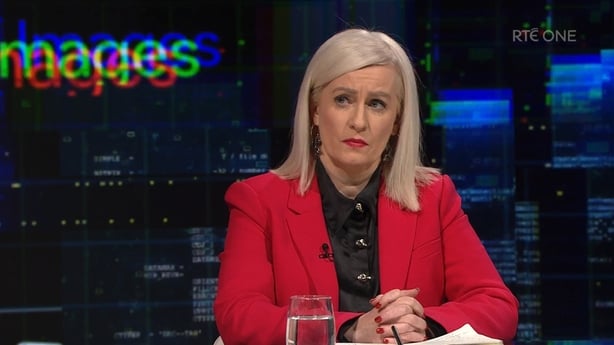
Asked, given her comments, whether the public can then expect there to be a criminal investigation into Grok, she said "my understanding is yes".
Minister Smyth, who has special responsibility for AI, added that she has written to the Garda Commissioner to clarify what steps are being taken to investigate the matter.
In the letter, seen by Prime Time, the minister seeks clarity on whether An Garda Síochána has the technical capability and resources to investigate "serious concerns about AI-generated content, particularly relating to non-consensual intimate images and child sexual abuse material".
"We've seen with emerging challenges around AI-generated content and online safety, strong robust enforcement mechanisms are needed to protect people, especially the most vulnerable," she writes.
Asked if Grok should be banned, the minister said she will be meeting the Taoiseach and Attorney General on Wednesday to discuss it.
"My own view is if X are not going to abide by the laws here in Ireland, yes, it should be banned," she said.
"I have disabled my account, and I know many of my colleagues in Government have also disabled their accounts," she said, adding, "I have no doubt that that Taoiseach, along with his Cabinet colleagues, will take a collective decision on this in the very near future."