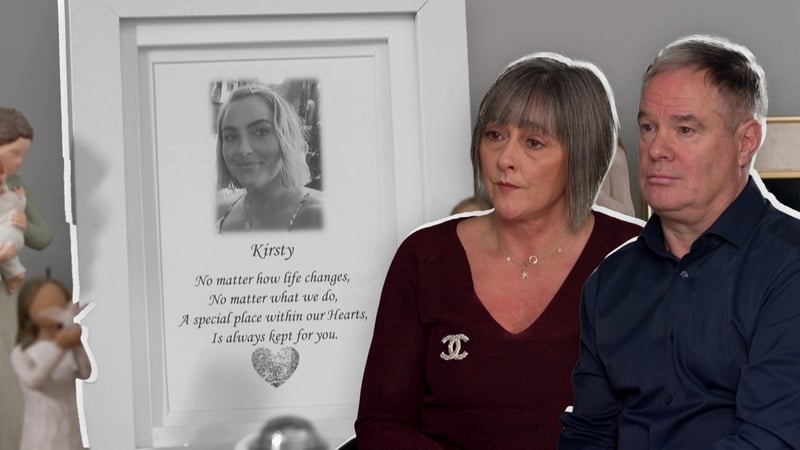

The family of a woman who was killed by her partner has spoken out to warn about the early red flags they recall from their daughter’s relationship and the impact of her death on her teenage son.
Kirsty Ward was 36 when she was murdered by Keith Byrne in a hotel room in Salou, Spain, in July 2023.
Byrne, from Co Meath, was convicted of murder by a Spanish jury and sentenced last year to 15 years in prison.
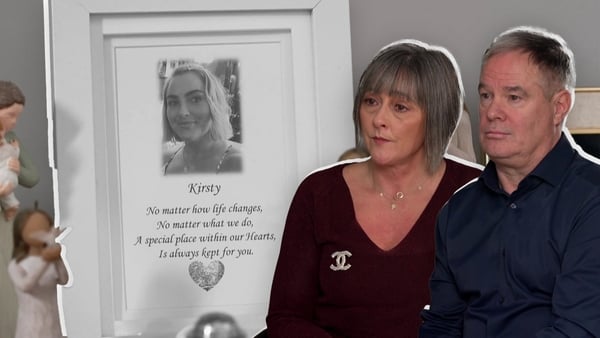
Speaking to Miriam O’Callaghan following the conclusion of a recent legal case, Ms Ward’s parents, Jackie and John, said they never believed their daughter’s life was in danger, despite unease about the relationship in the months before her death.
"I thought maybe he’d break her heart," Jackie says in an interview which aired on Prime Time on RTÉ One, "I never thought for one moment that she was in danger."
Ms Ward was a lone parent who had built a life in Dublin with her teenage son, Evan.
"She did everything for Evan," Jackie says. "She went back to college so she could give him the things she’d had herself growing up."
Eventually, Kirsty secured what her mother describes as her "forever home" for her and her son.
"She had achieved so much. She had her job, her home, and Evan. She was secure. And then she felt ready to start a relationship," Jackie says.
Kirsty began a new relationship in late 2022. At the outset, her mother says, she appeared happy and optimistic about its future, as she might have been at the beginning of any relationship.
Jackie met Byrne briefly before the couple went on a skiing trip. It was not a formal introduction, but she remembers being unsettled by how confident and familiar he was immediately.
"I just wasn't quite taken with him," she says. "It was a very brief meeting, but there was something about it."
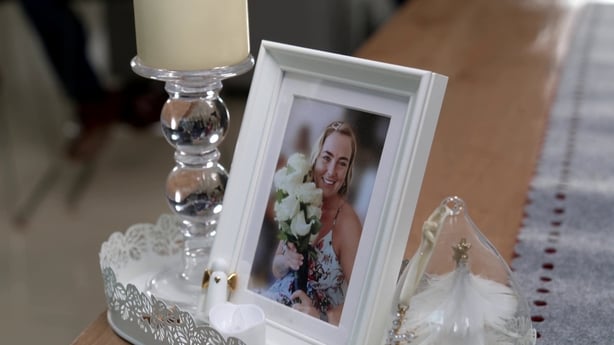
John began to notice changes too. Kirsty had always called into the family home after collecting Evan from school nearby. Slowly, that stopped happening.
"She didn't come in as often," he says.
"She would quite often pull up on the driveway, beep the horn, and Evan would leave - which was not something that had ever happened before."
Kirsty had previously spent long stretches of time in the family home after school, chatting with her sister Zoe and sitting down for meals.
"That started to happen less and less as the relationship went deeper. He was having a lot of influence over her," John says.
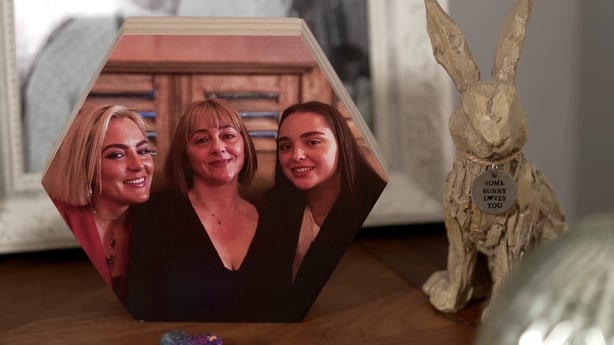
Jackie said she also noticed her daughter pulling back, though at the time she attributed it to the pressures of work, parenting alone, and a busy social life.
"I understood she was a single mum, working full time and going to the gym," she says. "Life was busy for her, and I was happy for her."
Still, Jackie said, a sense of unease lingered.
"It was like a mother's instinct," she said, "there was something not right, but I couldn't put my finger on it."
‘She didn't have that pep'
The last time Jackie saw her daughter was the day Kirsty left for a holiday in Spain.
She collected Kirsty and Evan from their apartment to drop her at the Aircoach. Evan was staying with his grandparents while his mother went on holiday.
"She didn't have that pep in her step," Jackie says. "She wasn't buzzing. She wasn't chatting the way she normally would."
Jackie hugged her daughter before she boarded the bus. As it pulled away, Kirsty waved from the aisle.
"I was particularly sad that day," Jackie says. "I said to my sisters that afternoon, 'I just wish she wasn't going'. I was quite concerned. It was a gut feeling."
Several days later, two gardaí knocked on the family's door.
John was home alone, recovering from open-heart surgery. Jackie was out with their youngest daughter, Zoe.
"They asked if this was Kirsty's address," he says. "Then they told me she had died, and that her partner had been arrested."
He had to call his wife and ask her to come home without explaining why.
"As soon as I arrived, it was obvious there was something wrong," Jackie says.
Jackie remembers seeing the two plain-clothes officers and knowing instinctively what had happened.
"I said, 'What has he done?'" she recalls. "I knew."
What happened in Salou?
Evidence heard during the Spanish trial established that Kirsty and Byrne had argued repeatedly on the day she was murdered. At one point, she left him on the beach and went into a shop, visibly distressed.
Two Spanish women - a mother and daughter - noticed her and comforted her. They exchanged phone numbers and planned to meet the following day.
Unknown to her parents at the time, Kirsty had already booked a flight home by that point.
"There was a series of texts. Her telling him the relationship was finished. That seems to have been a turning point for him," John says.
That evening, after Kirsty had fallen asleep, Byrne strangled her with the cable from a hair straightener.
"He murdered her," John says. "That’s what he did."
Byrne later dragged Kirsty's body into the hotel corridor and claimed he had found her dead. He initially made no mention of suicide; Byrne's claims about this emerged two days later according to John.
"He had time to think," John says. "And then he came up with his story."
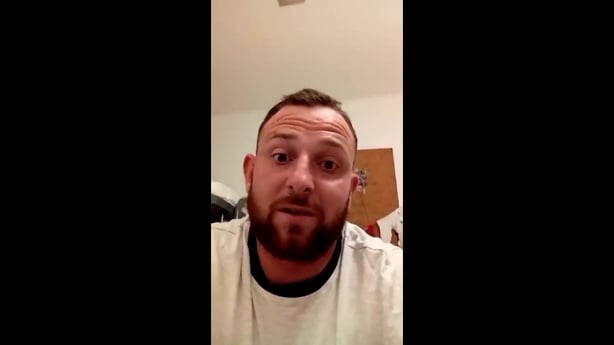
For Kirsty’s parents, attending the trial in Tarragona was harrowing. Proceedings were conducted in Spanish, and Byrne was allowed to give evidence without taking an oath or answering questions.
"His defence was he was the victim," John says.
Jackie remembers him describing Kirsty in cruel terms and as having "four personalities in one day."
Critical evidence came from a former partner of Byrne's who testified against him, saying she too was the subject of an attempted strangulation from Byrne.
"She was very beneficial to this case. She was able to describe in detail what happened [to her] and the aftermath for her," Jackie added.
Byrne was found guilty and was sentenced to 15 years for the murder of Kirsty with time off for the two years he has already spent in custody.
'Zero remorse'
Even after his arrest, Byrne continued to deny responsibility. From prison, he posted on social media claiming he did not know Kirsty.
"Our phones lit up," John says. "We were disgusted."
"I was so hurt as well for her. I thought if she knew that this man that she had entered into a relationship with was saying these things about her ... she'd be horrified," Jackie says.
For John, it clarified the kind of man they were dealing with.
"This is another Joe O'Reilly. This is another [Richard] Satchwell. Found guilty, zero remorse. Still trying to wriggle his way out of it," John says.
Losing Kirsty’s home
In the weeks after Kirsty’s funeral, another shock followed.
Kirsty lived in a home owned by the Approved Housing Body, Clúid Housing, which had been secured after more than a decade on the housing waiting list.
Evan was 14 when his mother died. Several weeks later, a letter was posted on the apartment door requesting that Clúid intended to relet the unit. In the wake of his mother's killing, Evan was staying with relatives at the time.
"It was marked 'urgent' in black marker," Jackie says. "I was disgusted."
Because Evan was under 18, he had no automatic legal right of succession to the tenancy.
Despite the family offering to pay rent and provide guardianship arrangements, Clúid proceeded.
The family took the case through the courts, ultimately reaching the Supreme Court, which concluded in November. The court ruled that Clúid had acted within the legislation, however in dissenting judgments two judges criticised the existing law.
Clúid told Prime Time it was obligated to operate within the State's social housing rules.
It said in a statement, Clúid said: "We are deeply aware of the tragic circumstances surrounding this case and extend our heartfelt sympathy to the family. As the Supreme Court judgment has confirmed, a minor under 18 years cannot legally take on tenancy rights and responsibilities.
"Decisions as to which applicants will be offered social homes are made by local authorities, rather than by Clúid, in accordance with that Council’s housing list."
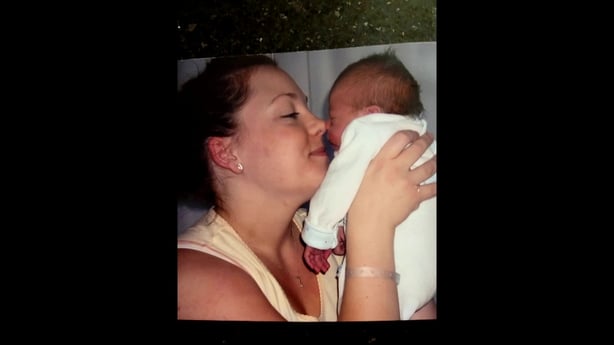
Living with the loss
Now living with members of his extended family, Evan, who is in fifth year in secondary school, has a part-time job and is learning to drive.
"He's incredibly caring, a very responsible young man," Jackie says. "But he misses his mom very much."
She believes losing access to his home has stalled his grief.
"I still believe he should have that apartment, or at least access to it. It has halted his grief," Jackie added.
Jackie visits Kirsty's grave regularly and says her religious faith is a great comfort.
"You need, you need to have that faith that, to know, she's with me and I believe she's with me," she says.
John says the family still moves between good days and bad days, and has had to come to terms with the permanence of the loss.
"It has taken me a little while to realise, but it's going to be that way forever," he says.
A warning
Part of the reason why Jackie and John decided to speak publicly was to raise awareness of the warning signs of coercive and controlling behaviour, and bring Keith Byrne’s name to public prominence.
"He's going to return home at some point to this country when his sentence is finished and complete. He's going to take up a job. He's going to take up a relationship," Jackie says.
"People need to know Keith Byrne's name and how dangerous he is."
Their advice to anyone who recognises the warning signs is simple - "get out," John says.
Miriam O’Callaghan’s interview with Kirsty Ward’s parents, produced and directed by Tara Peterman, is broadcast on 8 January edition of Prime Time at 9.35pm on RTÉ One and RTÉ Player.