


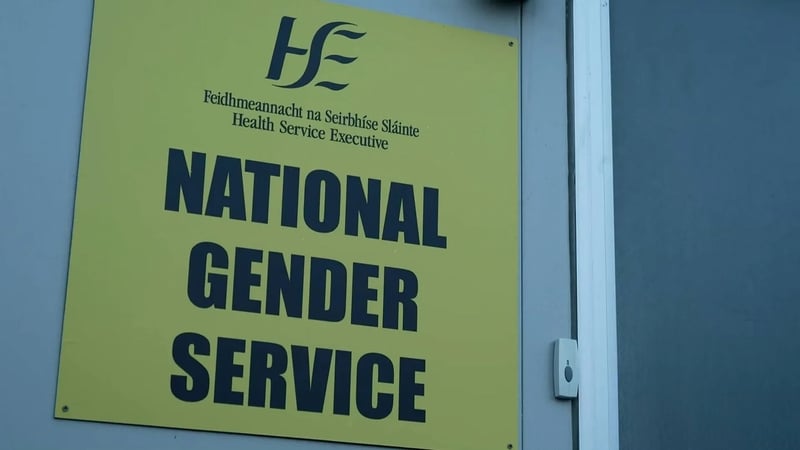
The National Gender Service (NGS), which provides healthcare for transgender adults, is closing its waiting lists due to a lack of resources, Prime Time has learned.
"This action is intensely regrettable," the chair of the NGS's Clinical Governance Committee, Brian Cotter, said in a letter to health officials explaining the decision.
That letter, seen by Prime Time, was sent to Health Minister Jennifer Carroll MacNeill and HSE CEO Bernard Gloster by the NGS this morning.
There are around 2,470 people currently on the waiting list, which the NGS plans to close to new clients on 1 March 2026. Those who are on the list will be assessed, though at current rates that process could take many years.
As of last month, the average waiting time for assessment was four and a half years. In December 2019 it was 14 months. While the NGS is an adult service, it accepts referrals for those aged 17.
In his letter explaining the NGS decision, Mr Cotter said that "the chronic lack of resourcing" of the NGS "has been evident for some years, and is now at a critical point."
He said that "it has been clear that the lack of resources would result in increasing waiting times and could compromise our ability to continue to provide a service.
"Despite repeatedly highlighting this risk over the last number of years, we remain in a situation where we have neither the staff nor clinical space to safely and effectively provide a service."
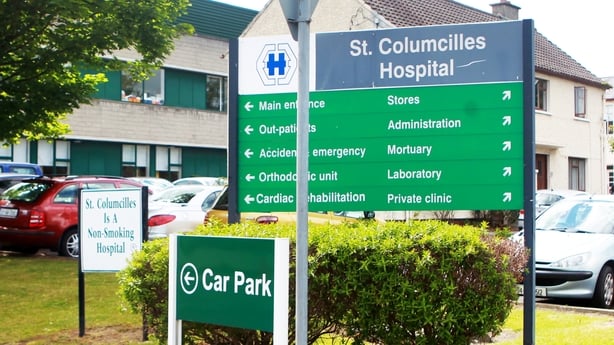
Currently based in a two-room prefab in the grounds of Dublin’s St Columcille’s Hospital in Loughlinstown, the National Gender Service is the State’s only multidisciplinary clinical service for transgender healthcare.
Its current team includes an endocrinologist, a psychiatrist, a psychologist, nurses, a social worker and an occupational therapist.
A transgender person is someone whose gender identity does not match their biological sex. This mismatch can cause extreme psychological distress, known as gender dysphoria.
Like in other countries, the demand for transgender healthcare in Ireland has increased dramatically in recent years.
In 2005, the service that later grew into the National Gender Service had just five referrals of transgender clients. In 2013, the figure jumped to 55, and by 2018 it was 288.
NGS figures provided to Prime Time show that, last year, 587 referrals were added to the waiting list.
NGS staff have said their service is particularly restricted by a lack of appropriate clinical space, including soundproofed rooms for client consultations.
Issues with working environment
A 2022 NGS document seen by Prime Time described the working environment as "uncomfortable and frustrating for staff."
The document stated that "Sensitive phone calls with service users need to be taken outside or in staff member’s cars (using work phones) as the noise and activity in the prefab can make it very difficult to hear service users and to communicate effectively."
Though its clinical work generally requires utmost confidentiality, the service has only two soundproofed rooms, one in its prefab and one in the main hospital.
These rooms are "not enough to see the number of patients we need to see. Therefore, we use other spaces and rooms that are not suitable," according to the NGS document.
"This is a serious issue in terms of compliance. The clinical space is unacceptable to the service users attending the service. The lack of clinical space has become so critical that at times, we have been unable to schedule clinical reviews, despite clinician availability, as there was no appropriate clinical space provided."
The working environment described in 2022 remains generally unchanged, staff said.
Prime Time saw an extract from the November 2025 NGS risk register – which lists potential risks for the organisation as well as potential impacts and solutions.
The continued problems with inadequate accommodation are noted.
"Dedicated clinical space needed: currently the NGS is operating out of a two room prefab with no dedicated space. Work on securing new premises ongoing," it said.
That work, handled by the HSE’s Capital and Estates section, has been ongoing since at least 2019, when plans were drawn up for a new NGS building on the grounds of St Columcille's Hospital. Those plans were later dropped.
Then in 2021, the HSE proposed moving the NGS to HSE buildings at Cherrywood, near the M50 motorway. Those plans were also dropped.
In 2023, the HSE proposed moving the National Gender Service to a building in Clonskeagh, near University College Dublin. Internal drawings were produced with significant preparatory work done, progressing to decisions about colour schemes, fabrics, and floor coverings.
In 2024, the HSE changed course again and proposed relocating the NGS to a building on Merrion Road in Dublin 4. In September, those Merrion Road plans were dropped.
Prime Time asked the HSE if it had current plans to relocate the NGS and, if so, to where.
"Currently, the HSE is completing an options appraisal regarding the most suitable location for the National Gender Service (NGS)," it told Prime Time. "Once a preferred option is identified, should an infrastructural intervention be required, the proposal will be developed in line with Infrastructure guidelines and HSE governance procedures."
Prime Time also asked how much the HSE paid in fees to third-party property-related professionals (such as architects, valuers, builders, interior designers etc) in connection with prior plans for new premises for the NGS at St Columcille's, Cherrywood, Clonskeagh, and Merrion Road.
The HSE said it had paid a total of €77,682.67, including VAT, in such spending "on Design Team fees, surveys etc to explore and develop options at Clonskeagh and Elm Park Green [Merrion Road]..."
It said that no such costs were incurred for the other two proposed locations.
Prime Time subsequently asked the HSE for its reaction to the National Gender Service closing its waiting list. A response has not yet been received.
Staffing issues
While a lack of adequate space has been one festering problem at the NGS, so too has inadequate staffing numbers to cope with the huge demand for its service.
Currently, the service has funding for an allocation of 12.5 clinical staff, but only 7.25 posts are occupied, according to figures supplied by Dr Paul Moran, consultant psychiatrist at the NGS.
The extract of last month’s NGS risk register seen by Prime Time includes "Unsafe service" due to lack of adequate staffing: "As well as resulting in loss of safety and risking poor clinical outcomes, there is a risk of burnout and loss of staff..."
That entry has been on the risk register unchanged since 2022.
Questions about model of care
Staff at the National Gender Service also told Prime Time of another risk affecting the organisation – from people opposed to the way their organisation handles referrals.
NGS staff told Prime Time that they have been intrusively filmed while at work, insulted and abused on social media, and have had protests outside their workplace.
Those incidents arise from an ongoing and vocal, campaign by transgender rights activists against the NGS’s Model of Care, which is based on an in-depth assessment of a client’s situation by a psychiatrist before treatment - if any - is recommended.
NGS clinicians believe it is more comprehensive and safer for the client because they are less likely to be recommended a treatment which may be inappropriate, and which they may ultimately regret.
However, others, including transgender rights advocacy organisations in Ireland, oppose the NGS approach , saying it is too intrusive and involves questions that are too invasive.
They favour what is often referred to as a gender-affirming model of care, which is supported by the World Professional Association for Transgender Health (WPATH), an organisation which includes non-clinicians as well as clinicians.
WPATH is an international "interdisciplinary organisation... working to further the understanding and treatment of gender dysphoria by professionals in medicine, psychology, law, social work, counselling, psychotherapy, family studies, sociology, anthropology, sexology, speech and voice therapy, and other related fields".
Transgender rights groups in Ireland, who support WPATH, say that adult patients should have a very strong – or even decisive - role in deciding their treatment pathway. That pathway may involve taking cross-sex hormones, or undergoing surgery to remove breasts or genitalia.
The WPATH model was supported by the Fine Gael/Fianna Fáil/Green Party coalition in its 2020 Programme for Government. That document stated the government would "Create and implement a general health policy for Trans people, based on a best-practice model for care, in line with the World Professional Association of Transgender Healthcare (WPATH)."
However, after questions were raised over the WPATH-supported model of care, including by clinicians at the NGS, the Fianna Fáil/Fine Gael 2025 Programme for Government included no reference to WPATH.
It instead promised to "ensure a transgender healthcare service that is based on clinical evidence, respect, inclusiveness and compassion."
In response to questions about the NGS current model of care, which has been criticised as intrusive and invasive, Dr Moran said "it is essential to ask detailed, specific" questions about very personal matters "when considering irreversible medical and surgical treatment that can affect people’s ability to have sexual relationships or have children."
"This is indeed intrusive, but absolutely necessary," he said, adding "people who feel unable to talk about these things in a clinical setting, are not ready for the life-changing treatments involved."
Earlier this month, a Labour Party motion proposed by Health Spokesperson Marie Sherlock TD was passed in Dáil Éireann without a vote being taken.
The motion noted that "stories from transgender people constantly highlight how Ireland's flawed healthcare system is not working, with invasive and insensitive scrutiny from the current National Gender Service."
It called on the government to "provide a model of gender-affirming care in primary care settings, with a focus on General Practitioner-led (GP) care, based on informed consent as per WPATH and World Health Organization [WHO] guidelines and international best practice."
The motion also called on the government to replace the National Gender Service "with a new national clinical programme for transgender healthcare in Ireland, with integrated care pathways recognising a key role for GPs, and the major need for recruitment of specialists providing gender-affirming care."
Dr Moran of the NGS criticised the Labour Party motion as "significantly misinformed" in many regards, including the reference to WHO guidelines. "There are no WHO guidelines regarding Gender Healthcare, and there have never been," he said.
He also criticised WPATH, saying what he called "the most extensive and authoritative review of evidence in Gender Healthcare," by UK paediatrician Hilary Cass, "found that the WPATH Standards of Care (SOC8) were not evidence based and unfounded."
"The most unfortunate thing about this Labour Motion," he said, "is that it was brought to [Dáil Éireann] at a time when there is an ongoing review of Gender Healthcare and a comprehensive program to develop a new Model of Care."
"The HSE has established a National Lead, a Working Group, and a Clinical Advisory Committee who are working to develop new models of care for children and adults in Ireland," he said.
"It would have been more appropriate for the Labour Party to contribute its opinions on Gender Healthcare constructively via the ongoing [model of care] redevelopment process, than present an uninformed, and inappropriate motion."
Speaking to Prime Time, Deputy Sherlock defended her motion, stating that it "is part of a constructive contribution to the redevelopment process" for a new model of transgender healthcare.
She criticised the lengthy waiting times at the NGS, stating that "if you are trans and waiting for four years to see somebody, it leads to other outcomes in terms of self-medicating."
She also sent on her statement in the Dáil when putting forward the motion on 3 December.
In it, she said, "No country is perfect but we can learn a lot from Iceland, Malta, Spain and Australia. Malta is a small country like our own. It has shown the way. Its model is a de-pathologised model, building on maximising the health and psychological well-being of the individual."
