


Alexandre Shulenia, a doctor from Chernivtsi, a city in southwestern Ukraine, flew out of Kyiv last Thursday with a group of friends. Their flight departed about 40 minutes before Russia bombed the airport.
News of the escalation of the Russian attack flashed up on their phones when they landed in Egypt for a short trip.
But, on Wednesday, less than a week later, they were determined to make it back to Ukraine.
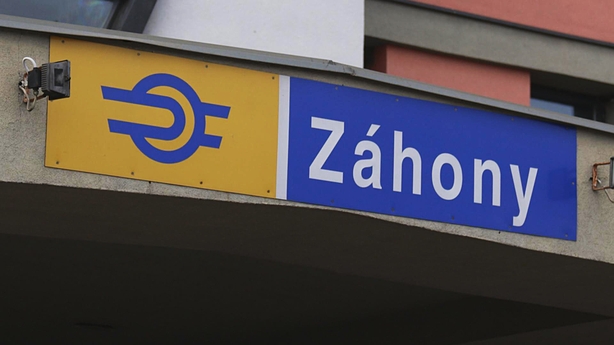
"It's our home, it’s our country – we should help and do everything that we can," Alexandre told RTÉ's Prime Time outside Záhony train station, on Hungary’s northeastern border with Ukraine.
"Today, we are going to Ukraine," she said, with tears in her eyes, her lips trembling.
Alexandre’s friend Natalia was also afraid, but resolved.
She said she believed victory for Ukraine was possible, and that she was returning to Ukraine to be with her children.
"My children are there. It is my life – my children are my life. I must help them," Natalia said.
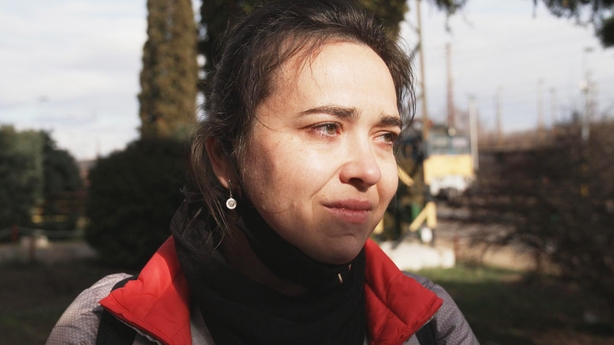
Natalia wrapped her hands around her throat to make a choking gesture. In broken English, she said "I hope my hands, Russian Army." What she was suggesting was crystal clear.
"I hate them," she said.
On the other side of the platform, a train arrived. "International! International!" a volunteer shouted, indicating that another refugee train from Ukraine had arrived.
A window opened, and a small child stood up and waved to the people on the platform.
A woman beside him stuck her head out the window and smiled. "Are you relieved to be here?", I asked. She broke down and said she was "so happy".
The woman and the child were just two of hundreds of refugees who arrived at Zahony train station. It took more than three hours for them to disembark the train carriages, for the police to ask for passports and documents.
Looking down the track, babies were handed out of the train down to waiting volunteers. It was a heartbreaking scene, so reminiscent of Europe’s ugliest history. When you see it up close, it impacts. This is the consequence of war.
Inside the train station, two refugees – two sisters fleeing Ukraine’s second-largest city, Kharkiv – huddled together on Wednesday.
Amani and Maaza Altareeh are students in university in the now devastated city.
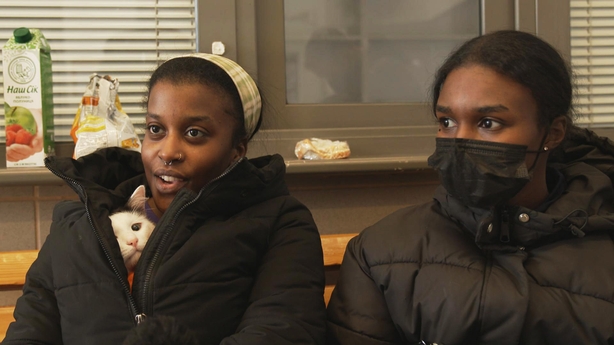
Originally from war-torn Sudan, they now think they will return home to Sudan.
"From a war to a war," Maaza said, laughing. "But it is okay," she said.
In the midst of the worst humanitarian crisis Europe has seen for decades, there is still some humour and human resilience on show.
As we speak, a cat pops its head out from inside Amani’s coat.
The sisters are just two of dozens of others who have brought their pets with them on their journey out of Ukraine.
On Wednesday, the train station was jammed. There were cats in baskets everywhere and dogs barking, mothers trying to sooth their children to sleep on the floor.
A child aged five or six, staring into the distance, saw our camera and stared into the lens. Her expression never changed.
Normally children want to be filmed, and they smile or wave. But this child’s stare was vacant, a child haunted by the experience of war.
You cannot fail to be struck by what is happening here, and more than once over several hours, it brings tears to your eyes.
Another journalist walked along the track, taking in the scene. There were tears in his eyes, and tears in mine. We shook our heads. It is impossible to hide the human impact of what the world is seeing unfold.
At a nearby petrol station, we are filling our car with fuel, I noticed a Ukraine car registration queuing behind us, so I walk back and say hello and ask them if everyone is okay. I wanted to hear about their border-crossing experience.
They are from western Ukraine, where things, they said, have not gotten too bad yet.
One woman, poking her head out of the car, asked if people in Ireland knew what was happening to them.
I couldn’t help but react with surprise. "Know about it?" I said.
I told them my neighbours have Ukranian flags in their windows, with one that reads, "With Ukraine In Heart". They all started crying and said "thank you, thank you".
We met the occupants of the car on the long journey from the Ukrainian border to Budapest, where the Hungarian Government is trying to deal with the growing number of refugees.
It is a country ruled by an administration that has not been welcoming or kind to refugees and migrants. Prime Minister Viktor Orbán notoriously referred to them as "poison" in the past.
But, this week, Mr Orbán visited one refugee reception centre on the border. Two days later, his wife, Anikó Lévai, also visited.
Hungary wants the world to know that, despite its right-leaning politics, and what has been said in the past, the borders are open to anyone who wants to cross.
Quite how they and the rest of Europe deals with the millions of people who need somewhere to go, will be the true test of the European Union as we face a war that could change the union as we know it, threatening the peace we once took for granted.
