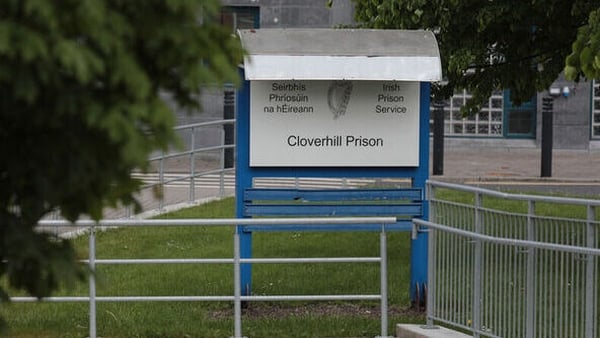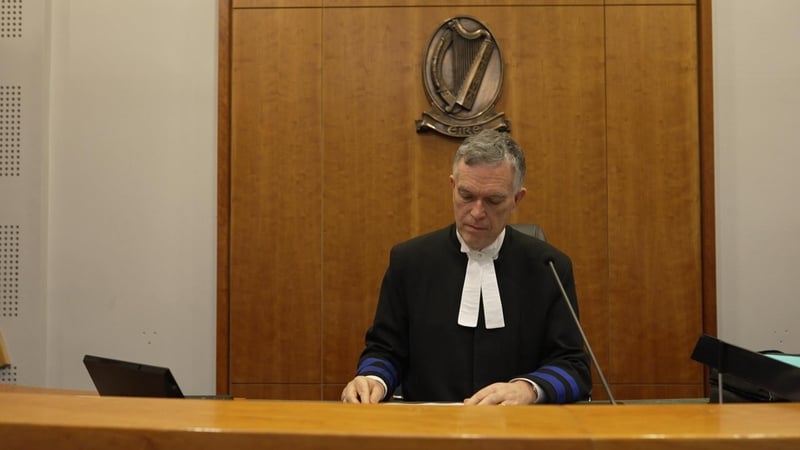

Following on from reporting on psychiatric care in Ireland, RTÉ Investigates' Conor Ryan spent the day in Cloverhill Court, where several psychiatric patients were in the dock while waiting for places in a hospital.
A judge has hit out at the limited options available to him to appropriately deal with psychiatric patients appearing before his criminal court.
On a single day, Judge Alan Mitchell dealt with seven hearings to decide if defendants had the mental capacity to be tried on criminal charges.
During these, he questioned the HSE on when it would open vacant units at the Central Mental Hospital (CMH) and said he would consider striking out criminal charges if no other inpatient options were available.
Sitting at Cloverhill District Court, Judge Mitchell said he was looking at "lateral thinking" to try to get people in need of mental health care out of prison.
Solicitor for the HSE, Alan Doyle, told him that it was hoped 10 beds at the CMH would be opened by the end of March but that this had not been confirmed.
Judge Mitchell said as soon as those beds were opened, demand would see them filled.
"When the beds become available within a month they will be filled because of the demand across the country," he said.
RTÉ Investigates was present for the hearings to document the backgrounds of those who were being held in prison while awaiting admission to a hospital.
WATCH: RTÉ Investigates: The Psychiatric Care Scandal on the RTÉ Player
The alleged crimes ranged from minor public order matters to serious assaults.
During the hearings, Cloverhill Prison's in-reach and court liaison psychiatrist Professor Conor O’Neill provided reports on the conditions of the men.
Judge Mitchell was told a previous system of therapeutic bail, available to people charged with minor crimes in need of hospital treatment, had seen hundreds of similar defendants moved to hospital.
But this practice had been suspended following a recent Judicial Review and there were no beds available in the CMH or any alternative means to facilitate transfer to other psychiatric units.
In one case, the judge struck out assault charges against one man who had been in custody for longer than he would have been had he been sentenced had he been fit to be tried.
But the judge said this was unsatisfactory because there was no criminal record if the man was to do something similar again.
He said this was not in the best interest of the victims, but it would be unfair to keep a man on remand indefinitely who needed medical care.
In another case, a psychiatric patient did not turn up in court and was said to be missing.
In a third case, a 50-year-old man who suffered from delusions had his cases moved to the Circuit Court for another fitness hearing to determine his mental capacity.
Other cases revealed the plight of men who the court heard should not be in prison.

Mr G
A married father suffered a medical illness a number of years ago and this led to brain damage. The knock-on symptoms and his behaviour caused problems for his family.
Prof O’Neill said as a consequence of that medical incident the man had damage to his brain and showed symptoms of temporal dementia.
At home, he displayed bizarre behaviour such as cleaning the house with coca-cola and erratic outbursts.
He has been considered unfit to be tried in a court and his condition was never likely to improve.
"He is not somebody who requires admission to a psychiatric hospital, he is somebody who requires a supported environment like a nursing home," Prof O’Neill said.
The court heard a place had been found in a private specialist nursing home type facility, but HSE funding to support the arrangement has yet to be agreed.
The man’s barrister, Alex McDonnell, said his client had been in custody since July 2025.
"He is in a custodial setting when he should not be," Mr McDonnell said.
Mr McDonnell asked Prof O’Neill if "Mr G" could get the treatment he needs in a prison setting.
"No," Prof O’Neill replied.
Mr McDonnell said the evidence before the court was clear that the man was not fit to be tried and it was the State’s problem to solve if there were no beds available in the Central Mental Hospital.
"The court has to follow the evidence," he said.
Judge Mitchell reserved judgment until 4 March to allow time for a decision to be made on funding for the specialist home.
Unknown, Unknown
A man believed to be from Lithuania appeared although there were doubts about his identity and he was listed on the court diary as "Unknown, Unknown".
He has no address and has given his name as "Thomas M.C. Mahon", which was not true. There are two potential dates of birth for him on file.
Prof O’Neill told the court that the man’s background was "very difficult" to establish. He claimed to be from Jupiter, was 300 years old and came into his body as a 26-year-old.
He was being detained on the D2 landing of Cloverhill since his arrest earlier this month. In the days leading up to his arrest, he had presented at the Mater Hospital, who discharged him and said he was not suffering from a mental illness.
He subsequently presented at Tallaght Hospital Emergency Department and was given a provisional diagnosis of psychosis and thought disorder.
He was not admitted. He was asked to leave the hospital but refused and was then arrested by gardaí and brought to Cloverhill Prison.
The court was told that in prison, he presented as a patient with symptoms of schizophrenia, psychosis and thought disorder.
"He has declined treatment and he needs mental health treatment in a hospital setting," Prof O’Neill said.
The prison psychiatric team has been unable to get clarity from the directors of the Mater Hospital and Tallaght Hospital as to who would accept care of him if he was released, because he his previous history is unknown.
Judge Mitchell granted him bail, if he was able to take it up, of €300 on his own bond. His case was put back to 4 March to allow time for the hospitals to respond.
His barrister, Aisling Ginger-Quinn, said the process of therapeutic bail would have helped a man like this until the practice was recently suspended.
She said in her experience, waiting for hospitals to accept people like this can take too long.
"There is nothing in place instead of therapeutic bail, it hasn’t been replaced," Ms Ginger-Quinn said.
"We have seen time and time again that these processes can take an exceptional amount of time and he could end up continuing to deteriorate [in prison]."
Living in a tent
A 35-year-old Wexford man who had been living in tent was told there was no place for him in a hospital.
He was psychotic and in custody for summary offences, mostly related to public order matters in Dublin 1 or in Wexford, and he has been assaulted in prison.
He had an IQ of 68 and suffered from schizophrenia, thought disorders and delusions. Prof O’Neill said it was difficult to assess him because he was erratic and could not stick to a coherent narrative in conversation.
When he was arrested, he had been homeless in Dublin, his personal hygiene was very poor with long hair and a long beard.He claimed he was from Colombia and Siberia, and during previous spells in Cloverhill he said he was from Slovenia and Nigeria.
He previously tried to set fire to his family home and could not live there as a result.
Prof O’Neill explained to the court that between spells in custody he had been "living in a tent or sleeping in a field".
"His chaotic lifestyle makes it very difficult for him to engage in services," he said.
Under questioning, Prof O’Neill said he did not think the man had the capacity to instruct solicitors.
Defence counsel, Alex McDonnell, said that while the prison psychiatric team "was doing all they could for him" it was an "inappropriate setting".
"He needs to be treated in an approved medical setting… the number of times he has been released only to be remanded again. This has to come to an end," he said.
Judge Mitchell said if there were no beds available in the CMH, he may consider striking out the charges as alternative to prison.
He said if he declared the man unfit to plea it risked provoking a stand-off with the CMH and he had to have regard to the lack of beds available. The case was put back until 4 March.
If you have been affected by the issues raised in this article, visit Helplines – RTÉ or Supporting People Affected By Mental Ill Health.