Solar panels used widely across Ireland, including in large solar farms, at airports, and on government buildings, were sourced from companies linked to forced labour and environmental devastation in the Xinjiang region of China, RTÉ Investigates has found.
Two Chinese solar panel manufacturers, JA Solar and Jinko Solar, were sourcing a raw material called polysilicon – one of the essential ingredients in the manufacture of panels – from Xinjiang, where China has built a regime of forced labour and repression targeting the region's ethnic minorities, particularly Uyghurs, a system some critics, including the US government, describe as a genocide.
In a landmark 2022 report, the United Nations concluded that human rights abuses in the region were widespread and could constitute crimes against humanity.
China denies all allegations of human rights abuses in Xinjiang, and described such allegations to RTÉ Investigates as "lies and disinformation cooked up by anti-China forces."
JA Solar and Jinko Solar panels can be found on sites across Ireland, including at a new solar farm at Shannon Airport, opened by Minister for Climate Energy Darragh O’Brien on 28 November, in Wicklow County Council’s car park, and in Ireland’s largest solar farm developments, including at sites owned by ESB.
The panels are also in widespread use in homes and businesses across the country.
The Shannon Airport Group said it "complies with all EU public procurement and policy directives" and that it was reviewing its procurement processes. "We are committed to strengthening checks across the extended supply chain," it said.
Wicklow County Council said the contractor that installed its panels made a "self-declaration" that it would not "employ labour in a manner that is discriminatory."
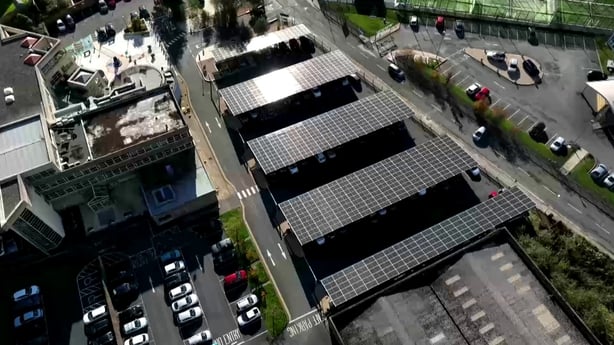
Both Shannon Airport and Wicklow County Council use JA Solar panels. The ESB said it had procurement procedures in place to "ensure that all procurements undertaken by, or on behalf of, ESB are compliant with all applicable Irish and EU legislation."
Developers of large solar farms that RTÉ Investigates identified as using JA or Jinko panels said that they followed rigorous procurement processes and had policies in place to ensure the modules they used did not contain polysilicon linked to forced labour.
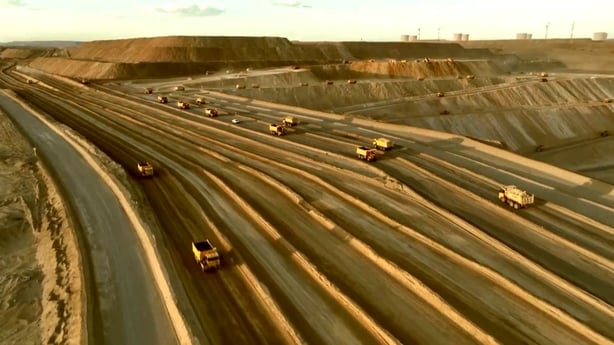
The investigation also found that enormous volumes of coal, the dirtiest fossil fuel, were being mined and burned in order to process and purify the polysilicon.
This lead to extremely high levels of air pollution in an industrial zone called Zhundong Development Park, one of the most important areas for polysilicon production in China, where polysilicon companies are co-located with vast open-pit coal mines. Three of the world’s top ten polysilicon manufacturers are based in the park.
China's subsidisation of its solar industry has driven down prices and made solar power the most affordable energy source in the world, but critics say this has been done at a human and environmental cost that is too great to ignore.
Research indicates that, if used, solar panels repay their carbon output within four years, and can provide about 25 years of pollution-free power generation.
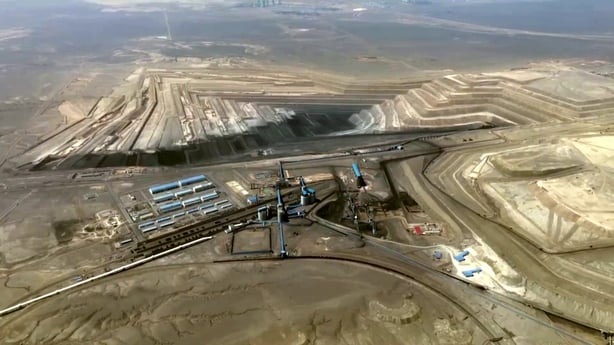
China's production of panels, however, has vastly overshot demand. It produces twice as many as is needed by the global economy, and the environmental cost has primarily been borne by Xinjiang.
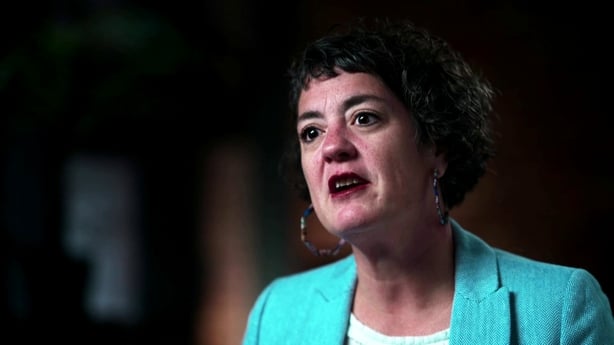
"There are crimes against humanity being perpetrated in the Uyghur region, so we don't see this as a trade issue or even a national security issue," said Patricia Carrier, a human rights lawyer with the Coalition to End Forced Labour in the Uyghur Region.
"The Chinese government has purposefully invested heavily in several sectors to ensure that they are concentrated in or reliant on Uyghur forced labour and also very lax environmental standards...so not only is there forced labour being used, but it is also very environmentally damaging."
Industry bodies say that China's dominance comes at the cost of social and human rights, and has "jeopardised" and "undermined" Europe's commitment to a "fair and resilient energy transition."
"The nexus between forced labour and the unsustainably low prices of Chinese-made solar PV modules and inverters poses a serious threat," said the European Solar Manufacturing Council in a letter addressed to the then taoiseach Leo Varadkar and energy minister Eamon Ryan in January 2024.
"Without EU regulations scrutinizing goods throughout the value chain for forced labour, European PV manufacturers, adhering to higher social and environmental standards, are jeopardised."
Despite this, China drew widespread praise at the recent Cop30 climate action conference in Brazil.
"China is coming up with solutions that are for everyone, not just China," said André Corrêa do Lago, a Brazilian diplomat that acted as president for the Cop30 conference.
"Solar panels are cheaper, they’re so competitive that they are everywhere now. If you’re thinking of climate change, this is good."
Though allegations of forced labour and environmental issues in China’s solar industry have been known since at least 2020, Ireland continued to import and deploy panels from JA Solar and Jinko Solar.
Both have long-term polysilicon supply contracts with polysilicon factories based in the Xinjiang region, including Xinte Energy, a subsidiary of the Chinese energy giant TBEA, which also owns open-pit coal mines in the Zhundong Development Park that supply Xinte Energy.
Research by Sheffield Hallam University and Human Rights Watch has documented the mines' participation in poverty alleviation and labour transfer schemes - schemes that have been identified as linked to forced labour by organisations including the United Nations.
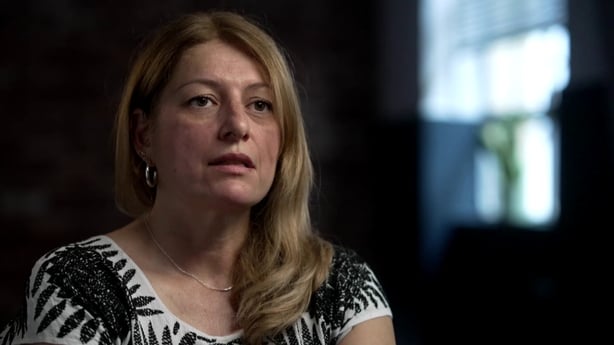
"Uyghur people are being forced to work in conditions where, first of all, they don't have a choice to say no...there's no informed consent available," said Professor Laura Murphy, the academic who led Sheffield Hallam's research team.
"Because if you say no to a programme like this, the Chinese government has explicit directives that indicate that the police can lawfully detain a person who chooses not to go on a poverty alleviation programme or a labour transfer programme."
Labour transfers continue to take place. Research by RTÉ Investigates found that, in the last year alone, thousands of workers, deemed "surplus rural labour" by China’s authorities, have been transferred to work in Zhundong Development Park, with, in at least some cases, their farmland transferred into state ownership, according to reports published by local authorities and state media organisations.
But Jinko Solar’s links to forced labour in Xinjiang are even more direct: it received ethnic minority workers at a Xinjiang factory it owned between 2018 and 2020.
The factory lies about one kilometre away from a high-security detention facility. Jinko Solar sold the factory in 2024, but its most recent annual report indicates that it is continuing to source from it, detailing almost €200m in procurement from the facility under its new name, Shibang Solar.
JA Solar said it has a "zero-tolerance policy toward any form of forced or involuntary labour or human rights violations."
It said its customers had "full transparency into our operations and supply chain for the information necessary to support their due-diligence processes."
Jinko Solar said it had "zero tolerance for forced labour in any form" and that it had divested from its former subsidiary in Xinjiang.
"All Jinko modules can satisfy the client’s requirement regarding traceable, independently audited supply chains to ensure compliance with internationally recognized labour and environmental requirements," it said.
It did not dispute assertions that it was continuing to source from the Xinjiang facility or from Xinte Energy.
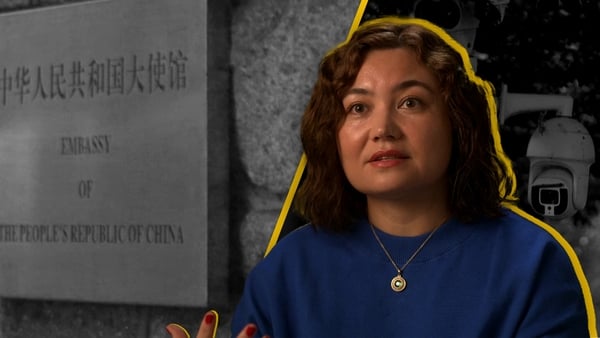
China has long denied allegations of forced labour and human rights abuses in the Xinjiang region. The Chinese Embassy in Ireland told RTÉ Investigates that all activities in "strictly adhere to environmental protection regulations and industrial policies, continuously driving green and low-carbon development."
The Irish Government has consistently said it has raised the issue of human rights abuses in Xinjiang in bilateral meetings with Chinese officials.
However, such is the scale of China’s dominance in renewable energies, sourcing alternatives to Chinese solar panels can be challenging.
"We all need to get a bit real...We cannot gear up in terms of the wind infrastructure or solar panels without the manufacturing capacity in China," the then tánaiste Micheál Martin told the Seanad in 2024. "We can cut ourselves off and that is what some want us to do - it is very easy to do, but it has consequences."
Some European countries, however, have decided to take action.
Both the United Kingdom and Italy placed restrictions on the state procurement of solar panels from China earlier this year.
But China remains the dominant supplier. Figures for 2023 show 95% of modules installed in the EU are imported from China.
This puts Ireland in a unique bind, because the state is lagging way behind on its climate targets.
On a per capita basis, Ireland has the highest emissions target gap of any EU member state. Bringing new renewable sources of energy onstream, and fast, is essential to make up that gap.
The consequences if that does not happen could be staggering. A report by the Irish Fiscal Advisory Council and Climate Change Advisory Council said Ireland could face fines of up to €26 billion if it misses its targets.
The pressure to meet those targets means that, for now, new solar farms, using Chinese panels, will likely continue to open across the country.
Reporter Joe Galvin's on solar panels will broadcast on Prime Time on 9 December at 9.35pm on RTÉ One and RTÉ Player.