


The euro zone economy will slow in 2026 after war in the Middle East triggered the second energy shock in less than five years with the severity of the hit determined by how long the conflict drags on, the European Commission said today.
The surge in oil prices to above $100 a barrel will push up inflation and depress sentiment among firms and households, it added.
"Before the end of February 2026, the EU economy was set to keep expanding at a moderate pace alongside a further decline in inflation, but the outlook has changed substantially since the outbreak of the conflict," the EU executive said in a statement.
The European Commission now forecasts euro zone gross domestic product growth will slow to 0.9% in 2026 from 1.3% in 2025, with a rise of 1.2% in 2027.
In its last set of forecasts in November, the expectations were respectively 1.2% and 1.4%.
The EU executive also raised its forecasts for inflation to 3% in 2026 from a previous 1.9% and to 2.3% in 2027 from 2%, reinforcing the case for a rise in European Central Bank interest rates.
The ECB is set to increase borrowing costs at its next meeting on June 11 after disruption to the Strait of Hormuz shipping lane caused a spike in oil prices and pushed inflation in the euro area well above the bank's 2% target. Financial markets expect one or two further moves in the following 12 months.
The Commission said the principal risk to its forecasts was the duration of the Middle East conflict.
The data underpinning its estimates had cutoffs of late April to early May and although a fragile ceasefire is in place between the US and Iran, Hormuz remains effectively closed.
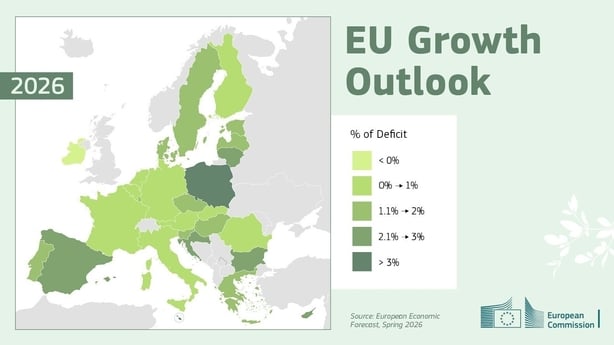
In view of the uncertainty, the EU executive said it had drawn up an alternative scenario based on longer disruption, in which energy prices would peak in late 2026 and only gradually return to baseline levels by the end of 2027. Inflation in this case would not ease and the economy would not rebound in 2027.
European Economy Commissioner Valdis Dombrovskis said that under the adverse scenario the forecasts for growth this year and next would roughly halve.
Read more
Irish GDP set to fall by 1.2% this year - Commission
In its main forecast, the Commission said domestic consumption was expected to remain the principal driver of growth, even though consumer sentiment dropped to a 40-month low when the US and Israel launched air strikes their on Iran.
Business investment is likely to be constrained by tighter financing conditions, lower profits and heightened uncertainty, while weaker overseas demand is curbing growth of exports.
Nevertheless, the EU executive said investments in supply diversification, decarbonisation and lower energy consumption meant the EU economy was better placed to manage the current shock than the one seen in 2022 following Russia's invasion of Ukraine.
