


A new report shows that consumer uncertainty due to global events has sparked a sense of caution among shoppers, who are showing signs of making more considered purchasing decisions as discretionary spend is squeezed by rising fuel prices at the pumps.
The latest update from Worldpanel by Numerator shows that shoppers visited stores more frequently in the four weeks to April 19, with trips up 3.2% year on year, as they seek out value and deals against a backdrop of price rises.
Footfall also increased over the latest four weeks, with shoppers on average making just over 23 trips in the month, or one more than during the previous, but volume per trip continued to decline, and were down 3.4% year on year.
Take-home grocery sales in Ireland increased by 4.4% over the four week period compared to the same time last year, Worldpanel by Numerator figures also reveal.
The timing of Easter this year meant shoppers started their purchasing earlier in March, boosting value growth compared to the previous four weeks, it noted.
Emer Healy, Business Development Director at Worldpanel by Numerator, said that unlocking value for money remains front of mind for shoppers when purchasing everyday goods.
"Loyalty cards are one of the main ways shoppers are attempting to manage spend, with 73% claiming to use such schemes, while 67% of shoppers claim to be buying on promotion more often," Ms Healy said.
"What's particularly interesting is how deliberate shoppers are being in balancing value with indulgence. While promotions clearly played a key role in helping households stretch budgets ahead of Easter, we still saw shoppers trade up for the occasions that mattered most," she added.
Today's figures show that shoppers took advantage of the increase in promotional offers available in the run-up to Easter, with almost 20 million more packs bought on offer compared to last month.
"Brands held 50% value share, contributing an additional €174m in value spend and growing ahead of own label ranges, which generated an additional €47m. Shoppers prioritised premium products for occasion-led choices, with an additional 3.9 million packs featuring in Easter baskets compared to last month," she added.
Today's figures show that sales increased by 37% in the four weeks to Easter Sunday, which fell on 5 April this year compared to the run‑up to the holiday last year.
Sales of Easter eggs grew even faster over the corresponding period last year, with sales up 49%. More than €15m was spent on Easter eggs alone in the seven days to Easter Sunday.
However, lamb did not feature as prominently at the Easter dinner table this year, with sales down 31% year on year.
April also brought a clear uplift in spring-cleaning activity, with sales of household products up 8% year on year, supported by particularly strong demand for household cleaners and laundry products.
"The brighter days and feeling of spring in the air has prompted a seasonal reset in household routines, with shoppers spending a combined €2m on these products versus last month," Emer Healy noted.
Meanwhile, online sales rose 9.7% year on year, with shoppers spending an additional €22m through the channel.
The arrival of new shoppers to the channel over the 12 weeks has brought the proportion of Irish households purchasing their groceries online to over 20%.
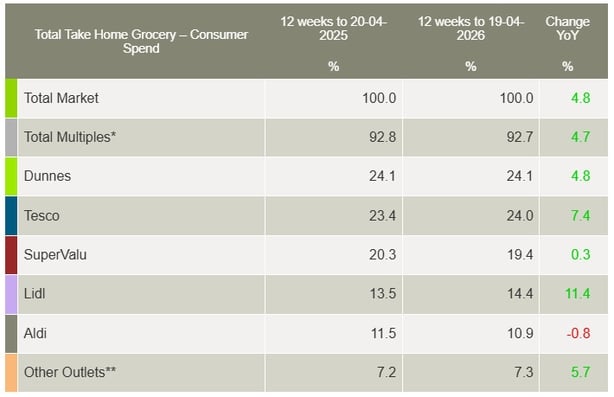
Over the latest 12 weeks, Dunnes holds 24.1% market share, with sales growth of 4.8% year on year. Dunnes shoppers returned to stores more often, with trips up 4.4% versus last year, contributing an additional €36.9m to overall performance.
Tesco holds 24% of the market, with year-on-year value growth of 7.4%. New shoppers to Tesco stores were up 3.9 percentage points on last year, contributing an additional €32.1m to overall performance.
SuperValu holds 19.4% of the market with growth of 0.3%. Consumers made the most shopping trips to the grocer, averaging 24.2 trips over the latest 12 weeks. New shopper arrivals contributed an additional €17.9m to performance.
Lidl holds a 14.4% market share, up 11.4%. An influx of new shoppers to stores, alongside existing shoppers making larger trips, drove an additional combined €38.9m in sales.
Meanwhile, Aldi holds a 10.9% market share down from 11.5%. Increased trips to store and new shopper arrivals drove an additional combined €10m in sales, today's figures show.
